
Nov
Knowledge of Weapons, Weapons What
What Materials Are Brass Knuckles Typically Made of?
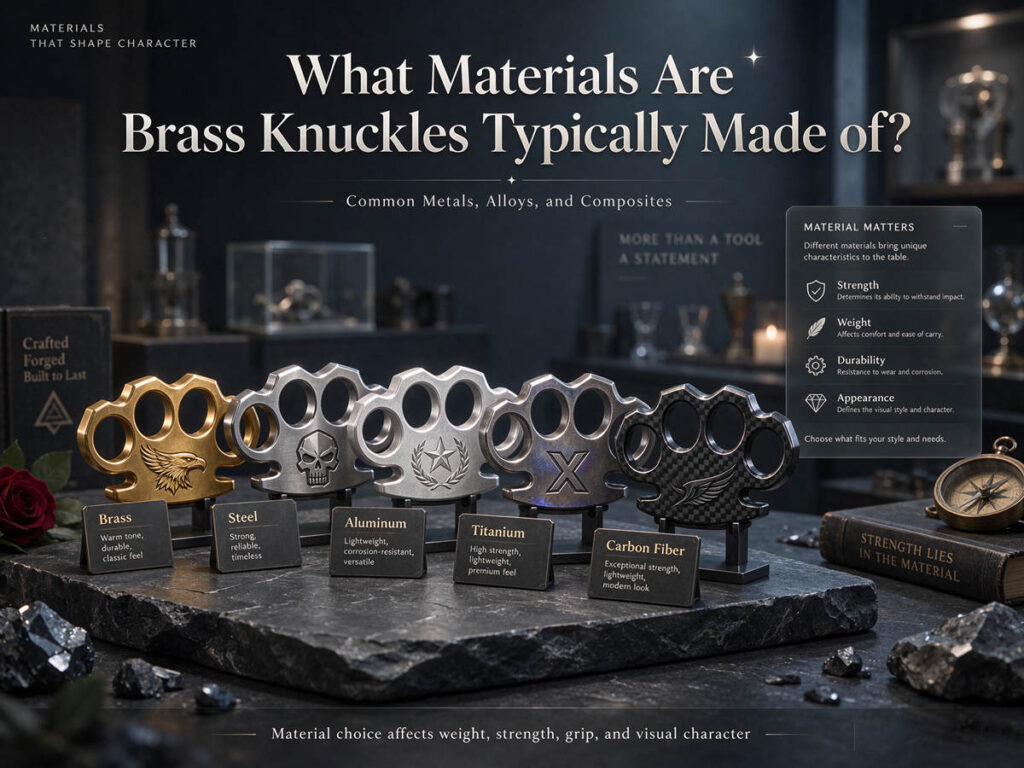
When people hear the term brass knuckles, they often imagine a traditional golden-colored metal object with four finger openings and a distinctive curved frame. However, despite the name, not all brass knuckles are actually made from brass. Over time, manufacturers have used a variety of metals, alloys, and other materials to create different appearances, finishes, and collectible styles, making material composition an important subject for anyone interested in the history and design of these objects.
From traditional brass and modern stainless steel to lightweight aluminum and cast zinc alloys, each material has its own characteristics, manufacturing requirements, and visual qualities. Some are associated with historical examples, while others are more common in contemporary decorative products and replicas. Understanding these differences can help collectors evaluate product descriptions, recognize misleading material claims, and appreciate how metalworking has influenced the development of brass knuckle designs.
This guide explores the materials commonly associated with brass knuckles, explains their general properties, and considers how material choices influence appearance, maintenance, and collectible value. It also looks at modern variations such as the 1 finger Brass Knuckle and the Brass Knuckle ring, where decorative styling has become an increasingly noticeable part of the design conversation.
1. Brass: The Traditional Material Behind the Name
Brass is the material most closely associated with the traditional image of brass knuckles, and its historical importance explains why the name remains widely used even though modern examples can be manufactured from many different substances. Brass is an alloy composed primarily of copper and zinc, with the exact proportions varying according to the particular grade and its intended application.
Its warm golden appearance makes it visually distinctive, especially when compared with the cooler silver tones commonly associated with steel and aluminum. Brass is also widely used in decorative hardware, musical instruments, fittings, and ornamental metalwork, so its connection with traditional metal accessories extends well beyond this particular category.
Appearance and natural aging
One characteristic of brass is its ability to develop a surface patina over time. Exposure to air, moisture, handling, and environmental conditions can gradually change its original appearance, sometimes producing darker brown or greenish surface discoloration. Some collectors appreciate this aged appearance because it can give an older metal object a distinctive character, although patina alone cannot establish an object’s age or historical authenticity.
A polished brass surface may look bright and reflective when new, while an untreated or naturally aged example can develop a softer, more subdued appearance. These differences are especially noticeable when comparing contemporary decorative pieces with older objects preserved in private collections or museums.
Why brass remains recognizable
The association between brass and traditional knuckle dusters has become so established that the material name is still used to describe the general category, including products made from other metals. This is an important distinction for buyers and collectors because a product described as brass knuckles may not necessarily contain brass.
For anyone researching traditional designs, the material should always be confirmed through a reliable product specification or historical record rather than inferred from a golden finish. A brass-colored coating, for example, is not the same thing as solid brass.
2. Steel and Stainless Steel: Common Modern Alternatives
Steel is another material frequently associated with metal knuckle dusters and related decorative objects. Unlike brass, which is a copper-based alloy, steel is primarily an iron-based material containing carbon and, depending on its grade, other alloying elements.
Its appearance is generally silver or gray, although polishing, brushing, coating, and other finishing processes can create substantially different visual effects. Steel has also played an important role in industrial manufacturing, making it a familiar material in many types of metal products.
Carbon steel
Carbon steel is an iron-carbon alloy whose properties vary according to its carbon content and manufacturing history. It is widely used in industrial applications, but it can be susceptible to rust when exposed to moisture and oxygen without suitable protection.
For collectors, an important consideration is the difference between ordinary surface discoloration, protective coatings, and actual corrosion. A dark finish does not necessarily mean that an object is made from carbon steel, and a silver appearance does not prove that it is stainless steel.
Stainless steel
Stainless steel contains chromium, which helps form a protective surface layer that improves corrosion resistance. Different grades have different compositions and characteristics, so the term stainless steel does not describe one single material with identical properties in every application.
In decorative metal products, stainless steel is often associated with a clean, modern appearance. It can be polished to create a reflective finish or treated to produce a more understated brushed surface.
However, stainless steel should not automatically be considered completely resistant to every form of staining or corrosion. Environmental conditions, surface contamination, and the particular alloy all influence how a metal behaves over time.
Understanding steel descriptions
When a product listing uses terms such as hardened steel, stainless steel, or carbon steel, collectors should look for specific material information instead of relying on broad promotional language. A precise grade or manufacturer specification is more informative than an unsupported statement that an item is made from premium metal.
3. Aluminum and Zinc Alloy: Materials Used in Contemporary Designs
Modern manufacturing has made it possible to produce metal objects in a wider range of materials and finishes than those traditionally associated with brass. Aluminum and zinc alloys are two examples that frequently appear in discussions of contemporary metal accessories, particularly products that emphasize different surface treatments or decorative shapes.
Although both are metals, they have distinct compositions and manufacturing characteristics, so they should not be treated as interchangeable terms.
Aluminum
Aluminum is a lightweight metal known for its natural resistance to corrosion. It develops a thin oxide layer when exposed to air, helping protect the underlying material under many ordinary environmental conditions.
Its relatively low density makes it common in transportation, construction, electronics, and consumer products. In decorative manufacturing, aluminum can be finished in different ways, including polishing, brushing, and anodizing.
Anodizing is an electrochemical surface treatment that creates a controlled oxide layer and can also support different color finishes. As a result, aluminum accessories may have appearances ranging from natural silver to black, gray, or other colored surfaces.
When examining an aluminum product, the stated material and finish should be considered separately. A colored coating does not necessarily indicate a special alloy, and the appearance of a product alone cannot establish its exact composition.
Zinc alloy
Zinc alloys are used in many manufactured decorative objects because they can be formed into detailed shapes through casting processes. Their composition may include additional metals, and their properties vary depending on the specific formulation.
Zinc alloy products can feature intricate surface details, decorative patterns, and a variety of coatings. They may also be finished to resemble other metals, which makes accurate material labeling particularly important.
A golden-colored zinc alloy object, for example, should not be described as solid brass unless its composition has been verified. Similarly, a silver-colored finish does not establish that a product is made from stainless steel.
Why accurate descriptions matter
The distinction between aluminum, zinc alloy, brass, and steel is important because these materials have different physical and chemical characteristics. For collectors, knowing the actual composition makes it easier to understand an object’s manufacturing background, appearance, and long-term care requirements.
4. Other Materials: Plastics, Polymers, and Composite Designs
Although metal remains central to the traditional appearance of brass knuckles, contemporary replicas and decorative interpretations may use non-metallic materials as well. Plastics, polymers, and composite materials appear in a wide range of consumer products, and they can be shaped into forms that resemble traditional metal designs.
These materials should be considered separately from conventional brass or steel examples because their physical properties and manufacturing methods are different.
Plastic and polymer materials
Plastics are synthetic or semi-synthetic materials made from polymers, and their characteristics vary widely according to their chemical composition and manufacturing process. Some are rigid, while others are flexible or designed to withstand particular environmental conditions.
In decorative products and replicas, plastic can be molded into different shapes and finished with colors or coatings that imitate the appearance of metal. However, a metallic-looking surface does not mean that an object has a metal core.
Collectors should therefore distinguish between the visible finish and the underlying material. If a listing describes a product as metal but provides no composition details, asking the seller for clarification is a sensible step before making assumptions about its construction.
Composite materials
Composite materials combine two or more different substances to create a material with a particular set of characteristics. Examples in other industries include fiber-reinforced polymers and carbon-fiber composites, which are used in sporting equipment, vehicles, and industrial applications.
Although these materials are sometimes mentioned in discussions of modern weapon replicas, their use should not be assumed without reliable documentation. A product’s appearance, weight, or marketing description cannot independently establish whether it contains a composite structure.
For historical and design research, it is useful to remember that not every object shaped like a traditional metal knuckle duster is made from the same category of material. The term can describe a recognizable design family rather than a single manufacturing specification.
5. How Materials Influence Appearance, Aging, and Collectible Value
Material composition is one of the most important details to consider when studying metal objects, because it influences not only their original appearance but also the way their surfaces change over time. For collectors, these differences can make two objects with similar outlines look quite different after years of storage, handling, or environmental exposure.
A brass example may develop a warm patina, while stainless steel may retain a more consistent silver appearance under suitable conditions. Aluminum can show scratches or surface oxidation, and coated zinc alloy may display changes in its finish depending on the quality and condition of the coating.
Surface finishes and decorative treatments
A metal object’s finish can significantly influence its visual identity. Common treatments include polishing, brushing, plating, painting, engraving, and protective coating.
Polishing creates a smoother and more reflective appearance, while brushing produces a less reflective surface with visible directional texture. Plating applies a surface layer of another material, and painting or coating can introduce colors that would not naturally occur in the underlying metal.
These processes are common across many industries, so their presence does not necessarily indicate that an object is historically important or made from a premium alloy.
Material and authenticity
A common mistake in collectible markets is assuming that an attractive finish proves an item’s material or age. In reality, modern manufacturing can reproduce many traditional appearances, while restoration and refinishing can change the surface of older objects.
A more reliable assessment considers several forms of information together:
- Material documentation: Look for a clear statement identifying the metal or alloy rather than relying on color alone.
- Manufacturer information: Check whether the seller provides credible details about the product’s origin and composition.
- Condition: Record visible tarnishing, corrosion, scratches, coating damage, and signs of restoration.
- Provenance: For an item described as antique or historically significant, look for supporting records, photographs, or collection documentation.
- Description accuracy: Be cautious of broad claims such as solid brass, rare vintage metal, or premium alloy when no supporting information is available.
Readers interested in comparing the materials discussed in this section can explore Brass Knuckle Materials Compared: Which Metal Holds Up Best?. The article offers additional background on the terminology used to describe different materials, although individual product specifications should always be independently verified.
6. Material Choices in Modern Variations and Ring-Inspired Designs
Contemporary brass knuckle designs are not limited to the traditional four-opening silhouette. Modern interpretations include smaller decorative formats, simplified outlines, and jewelry-inspired variations that borrow visual elements from ordinary rings and metal accessories.
These products demonstrate how different materials and finishes can influence the overall appearance of an object, even when the design references a familiar historical form.
The 1 finger Brass Knuckle
A 1 finger Brass Knuckle is a compact design variation that generally has a smaller, ring-like outline compared with the traditional full-frame model. Depending on the particular product, its exterior may be polished, engraved, textured, or finished in a color intended to resemble a different metal.
From a collecting perspective, the important questions concern the actual material, manufacturing quality, and accuracy of the product description. A golden finish does not prove that an item is brass, just as a silver finish does not establish that it is stainless steel.
The design also illustrates why product categories should be understood through both appearance and construction. Similar-looking objects may be manufactured from very different materials.
The Brass Knuckle ring
A Brass Knuckle ring combines the visual language of jewelry with design elements associated with traditional knuckle-shaped objects. Some examples emphasize decorative metalwork, sculpted patterns, wide bands, or unusual surface treatments.
Because ring-inspired designs can look similar to ordinary jewelry, it is especially important not to assume that appearance determines legal classification. An object’s construction and intended function may be relevant to how it is regulated, regardless of whether the seller describes it as an accessory or collectible.
For more information about these styles, readers can visit the Brass Knuckle Ring Buying Guide, which discusses the visual differences found in ring-inspired designs.
The broader Types of Brass Knuckles: A Complete Breakdown also provides additional context for understanding how traditional and modern designs differ in appearance.
7. Safety, Legal Awareness, and Responsible Collecting
Material research is only one part of understanding brass knuckles. Because these objects are commonly classified as weapons, their possession, sale, transportation, and public carry may be regulated differently depending on the jurisdiction.
The name of an object does not necessarily determine its legal classification. In some places, regulations refer broadly to metal knuckles or similar devices, meaning that products made from steel, aluminum, or other materials may be treated in a similar way to traditional brass examples.
Do not rely on material or appearance to determine legality
A product made from plastic or a nontraditional alloy should not automatically be assumed to fall outside weapon-related laws. Likewise, a ring-shaped design is not necessarily treated as ordinary jewelry simply because it resembles a conventional accessory.
Before purchasing, possessing, or transporting any brass knuckle-style object, check the current laws that apply to the relevant location. Rules can differ between countries, states, and municipalities, and they may distinguish between private possession, public carrying, sales, and importation.
Keeping collectibles responsibly
For people interested in these objects as historical or decorative collectibles, responsible ownership should include secure storage and clear documentation. Objects with weapon-associated designs should be kept away from children and anyone who might handle them without understanding the risks.
It is also worth remembering that brass knuckles are not substitutes for ordinary protective equipment or reliable personal safety planning. Anyone looking for everyday safety options may prefer lawful alternatives such as personal alarms, flashlights, and other non-weapon devices.
For further background on material terminology and design history, brassknucklesmaster.com provides a range of related educational articles. As with any commercial website, readers should distinguish general information from promotional claims and verify important material or legal details through reliable independent sources.
Understanding what brass knuckles are made of involves much more than identifying a golden-colored metal. Brass remains the traditional material associated with the name, but steel, stainless steel, aluminum, zinc alloys, plastics, and other materials have all influenced the appearance of modern examples and replicas.
For collectors, the most useful approach is to look beyond the surface, check the actual material composition, and consider how manufacturing and finishing affect an object’s condition and historical significance. Whether examining a traditional brass example, a 1 finger Brass Knuckle, or a contemporary Brass Knuckle ring, accurate material information provides a clearer understanding of the object and helps keep collecting informed, responsible, and grounded in fact.