
Nov
History of Weapons
The Evolution of Brass Knuckles: From Traditional Designs to Ring Variations
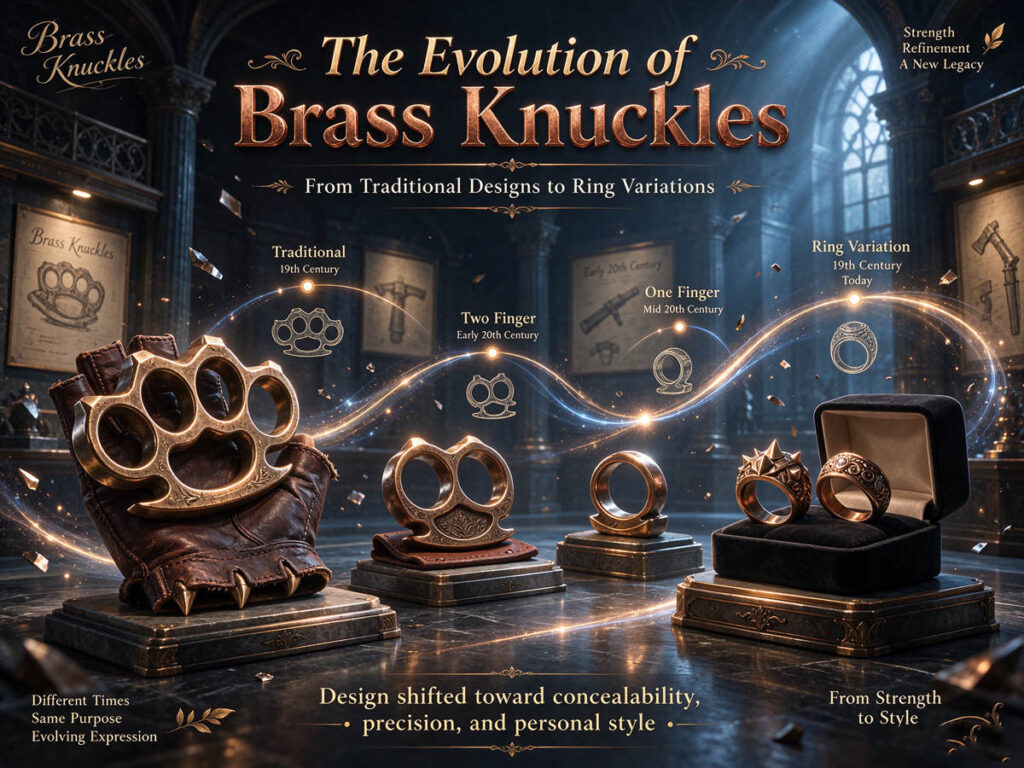
Brass knuckles have undergone a fascinating transformation in appearance, materials, and cultural significance, evolving from recognizable metal hand weapons into a much broader category of objects that includes historical reproductions, decorative collectibles, compact variations, and ring-inspired designs. Although the traditional four-finger model remains the image most people associate with the name, modern interpretations demonstrate how manufacturing techniques, changing aesthetic preferences, and popular culture have influenced the way these objects are designed and discussed.
For collectors and anyone interested in the history of metal accessories, understanding this evolution means looking beyond the familiar shape and considering the historical periods, craftsmanship, and design choices behind each variation. From traditional brass construction to the distinctive appearance of a 1 finger Brass Knuckle or a 2 finger Brass Knuckle, every format reflects a different stage in the development of this recognizable design. This article explores that journey while also considering the legal and safety issues that remain important when examining weapon-associated collectibles.
1. The Origins of Traditional Brass Knuckle Designs
The history of brass knuckles is connected to a much older human interest in protective equipment and hand-held objects used in close combat. Long before the modern metal knuckle duster became recognizable, different societies developed reinforced gloves, hand guards, and other forms of equipment intended for combat or physical competition. These historical objects were not necessarily direct ancestors of modern brass knuckles, but they illustrate how people experimented with materials and equipment designed to protect or reinforce the hand.
Ancient Greek boxing, for example, included the use of leather hand coverings commonly associated with the himantes, while later forms of combat equipment became increasingly elaborate. The Roman caestus is another frequently mentioned example of reinforced hand protection, although its construction and historical purpose differed considerably from the compact metal frame associated with modern brass knuckles. These distinctions matter because the history of reinforced hand equipment is much broader than the history of one particular weapon.
The recognizable metal design developed much later, with examples becoming more familiar during the nineteenth century. Brass was a practical material for many small metal objects because it could be cast into detailed shapes, offered reasonable resistance to corrosion, and had an attractive appearance. Nevertheless, historical examples were not exclusively made from brass, with other metals and alloys also appearing in different periods and locations.
The traditional four-finger silhouette
The traditional design generally consists of a connected metal frame with four openings and a continuous outer shape. Its distinctive outline became widely recognizable through historical references, military-related artifacts, newspaper illustrations, and later popular entertainment.
For modern collectors, the traditional model is important because it provides a useful reference point when studying subsequent variations. Its proportions, surface finish, material, and manufacturing characteristics can help distinguish one historical example from another, although appearance alone cannot establish an object’s age or authenticity.
2. Traditional Materials and the Influence of Manufacturing
As metalworking and manufacturing technologies developed, the production of small metal objects became more consistent, allowing designers and manufacturers to experiment with different finishes, shapes, and construction methods. Brass remained an important material in the traditional image of knuckle dusters, but the wider development of industrial metalworking introduced additional possibilities.
Brass, steel, and aluminum
Brass is an alloy primarily composed of copper and zinc, and its warm golden appearance has made it particularly recognizable in traditional decorative metalwork. Depending on its composition and exposure to the environment, brass can gradually develop a darker surface patina, which some collectors appreciate because it gives older objects a distinctive appearance.
Steel offers a different visual character, generally appearing cooler and more industrial, while aluminum is associated with a lighter metallic appearance. Modern decorative examples may also feature coatings, polished surfaces, or colored finishes that change the object’s overall presentation without necessarily changing its underlying material.
When evaluating an item, it is important to distinguish between its actual material and its surface treatment. A gold-colored finish, for instance, does not automatically mean that an object is made from solid brass, and a dark coating does not necessarily indicate that the underlying material is steel.
From handcrafted appearance to industrial consistency
Older metal objects can display small differences in surface texture, casting marks, and finishing details, while modern manufacturing may produce more uniform surfaces and repeated patterns. These differences are useful subjects for historical comparison, but they should not be treated as definitive proof of an item’s age.
Collectors interested in craftsmanship often examine the quality of the casting, the consistency of the finish, the presence of manufacturing marks, and the accuracy of the material description. A well-documented object with reliable provenance is generally more meaningful than one supported only by an attractive photograph or an unsupported claim of historical rarity.
3. The Development of One-Finger and Two-Finger Variations
As the traditional design became familiar, alternative formats began appearing in modern product catalogs and collectible discussions. Rather than following the complete four-opening outline, these variations use smaller or visually simplified forms, creating a different appearance that is easy to distinguish from the conventional model.
The development of these designs reflects a broader trend in contemporary product styling: familiar shapes are frequently reinterpreted through changes in scale, proportion, and decorative treatment. However, a smaller design should not automatically be regarded as a harmless accessory, since legal classification may depend on its construction and intended function rather than its size.
The 1 finger Brass Knuckle format
A 1 finger Brass Knuckle is generally recognized by its compact, ring-like appearance and single finger opening. Compared with the traditional full-frame silhouette, this format looks more like a small metal ornament, making it visually distinctive in collections that include different historical and contemporary designs.
From a design-history perspective, the one-finger variation is interesting because it demonstrates how the recognizable visual language of traditional brass knuckles can be reduced to a much simpler form. Some examples emphasize smooth surfaces and polished finishes, while others feature geometric details, textured patterns, or more industrial styling.
Collectors examining this category should pay attention to material descriptions, dimensions, surface quality, and manufacturing consistency. It is also important to remember that a ring-like appearance does not automatically make an object ordinary jewelry. Depending on its design and local regulations, it may still be treated as a weapon.
The 2 finger Brass Knuckle format
The 2 finger Brass Knuckle represents another recognizable variation, sitting visually between the compact one-finger style and the traditional four-finger model. Its appearance generally includes two openings within a connected frame, producing a shape that retains more of the traditional design language while introducing a noticeably different overall silhouette.
This variation is particularly useful for understanding how designers have experimented with the proportions of familiar objects. The number and arrangement of openings, the overall outline, and the surface finish can all influence how a particular example is classified visually within a collection.
For a more detailed overview of the different formats, readers can explore Two-Finger Brass Knuckle Explained and The Ultimate Guide to Brass Knuckles: One-Finger, Two-Finger & Four-Finger Options in 2026. These resources provide additional background for comparing the terminology and appearance of different designs.
4. Ring Variations: Where Metalwork Meets Jewelry-Inspired Styling
One of the most noticeable developments in contemporary brass knuckle design is the appearance of ring-inspired variations. These objects borrow visual elements from conventional jewelry, including wide bands, polished surfaces, sculpted patterns, and decorative detailing. The result is a category that can look quite different from the traditional four-finger frame, even when its overall design references the same historical object.
The influence of jewelry design is not surprising. Metal accessories have long combined practical construction with personal expression, and rings in particular offer a familiar platform for experimenting with shape, texture, engraving, and surface treatments. Modern designers frequently apply these aesthetic principles to objects that draw inspiration from historical equipment.
The appeal of ring-shaped designs
Ring-style variations attract attention because they combine a familiar jewelry silhouette with a distinctive industrial or historical design language. Some examples use simple geometric surfaces, while others incorporate engraved motifs, raised details, contrasting finishes, or decorative elements inspired by vintage metalwork.
For collectors, these differences create opportunities to compare how design traditions overlap. A polished ring-shaped object may emphasize ornamentation, while a heavier-looking sculptural piece may be intended to resemble historical metal equipment. In either case, the quality of the finish and the accuracy of the product description are more useful evaluation points than promotional claims.
Decorative details and contemporary aesthetics
Modern metalworking makes it possible to produce a wide range of visual effects, from smooth mirror-like surfaces to brushed textures and darker finishes. Engraving and decorative patterns can also give otherwise similar objects noticeably different identities.
Some designs draw inspiration from vintage jewelry, industrial hardware, fantasy artwork, or historical motifs. Others use minimal styling, allowing the material and overall shape to remain the main visual features. These choices demonstrate that the evolution of brass knuckle-inspired objects is not simply a matter of reducing or increasing their size; it is also a story about changing tastes in metal accessories and collectible design.
Readers interested in this crossover between jewelry-inspired styling and traditional forms can visit the Brass Knuckle Ring Buying Guide, which discusses the appearance and variety of ring-style designs.
5. Modern Design Trends, Collecting, and Popular Culture
Today, brass knuckles occupy a complicated position in public perception. They are historical artifacts, recognizable symbols in popular entertainment, subjects of metalworking and design discussions, and objects that may be restricted by law. Their continued presence in films, television, video games, and online product catalogs has helped preserve their visual recognition, even as attitudes toward weapon ownership and public safety have changed.
In older films and crime stories, the traditional four-finger model frequently appeared as a visual shorthand for street culture, organized crime, or dangerous characters. More recent entertainment has continued to use the familiar outline, while contemporary product design has expanded the range of styles audiences encounter. Ring-like variations, unusual finishes, and stylized decorative pieces have all contributed to the broader visual vocabulary associated with the category.
Collecting as an interest in design history
A responsible collection can focus on the historical and artistic characteristics of an object rather than its potential use as a weapon. Collectors may compare manufacturing periods, material composition, decorative treatments, provenance, and differences between traditional and modern interpretations.
Documentation is particularly important when an item is advertised as antique, rare, or historically significant. Photographs, purchase records, maker information, and credible descriptions can help establish what is actually known about a piece. Without reliable documentation, claims about age or origin should be treated cautiously.
The website brassknucklesmaster.com provides additional articles discussing traditional forms, modern variations, and the history of these objects. Its Types of Brass Knuckles: A Complete Breakdown is another useful starting point for readers who want to understand the differences in appearance across the category.
The importance of separating style from function
A decorative finish or jewelry-inspired shape does not necessarily change the legal status of an object. Likewise, descriptions such as novelty accessory, collectible, or fashion item should not be accepted as proof that possession or public carry is permitted.
For anyone considering a purchase for display or historical interest, checking the applicable laws before acquiring or transporting an item is essential. Regulations can differ significantly between countries, states, and municipalities, and they may distinguish between ownership, possession, sale, transportation, and carrying in public.
6. What the Evolution of Brass Knuckles Tells Us About Design
The development of brass knuckles from traditional metal frames to compact variations and ring-inspired forms illustrates how a recognizable design can change as materials, manufacturing methods, and cultural preferences evolve. The traditional four-finger model remains an important historical reference, while the one-finger and two-finger formats demonstrate how contemporary interpretations have introduced different proportions and visual identities.
Ring variations add another dimension to this story by bringing jewelry-inspired details into a category traditionally associated with industrial metal objects. Polished finishes, engraved patterns, sculptural surfaces, and alternative materials show how modern styling can reinterpret familiar forms without erasing their historical associations.
For collectors, the most rewarding approach is to consider these objects through the lens of craftsmanship, historical context, and responsible ownership. Material descriptions should be verified, claims of rarity should be supported by documentation, and local legal restrictions should be understood before purchasing or transporting any weapon-associated item.
Ultimately, the evolution of brass knuckles is not simply a progression from one shape to another. It reflects changing ideas about metalwork, ornamentation, popular culture, and the relationship between an object’s appearance and its social meaning. Whether examining a traditional brass example, a 1 finger Brass Knuckle, a 2 finger Brass Knuckle, or a contemporary ring-style variation, understanding that broader context makes the subject far more interesting than appearance alone.