
Nov
History of Weapons, Knowledge of Weapons
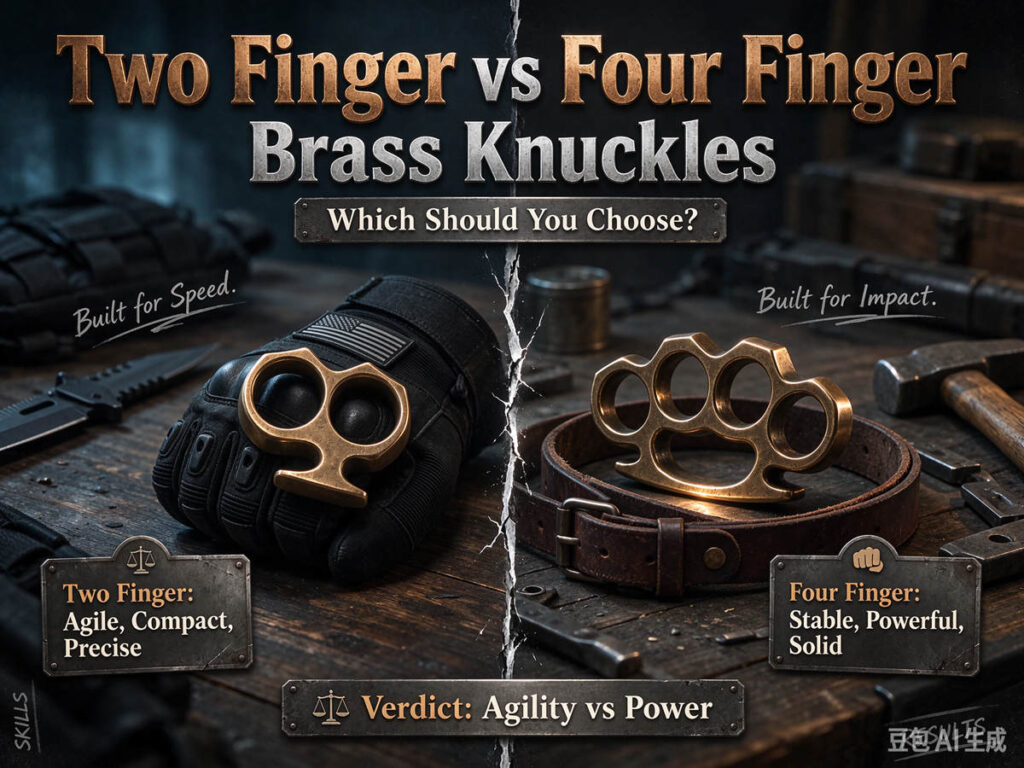
Two Finger vs Four Finger Brass Knuckles: Which Should You Choose?
Brass Knuckles for EDC: One Finger, Two Finger, and Keychain Comparison
Everyday carry, commonly known as EDC, is about choosing useful items that fit naturally into daily routines without creating unnecessary weight, inconvenience, or complications. For some collectors and enthusiasts, compact metal accessories have become an interesting part of this broader category, particularly because they combine distinctive designs, different materials, and recognizable historical associations. Among the products frequently discussed in this area are the One Finger Brass Knuckle, two-finger brass knuckle, and keychain-style brass knuckle, three variations that may look similar at first glance but differ considerably in appearance, construction, and intended presentation.
When researching Brass Knuckle designs for EDC, it is important to look beyond product photographs and marketing descriptions. Size, weight, material composition, finishing quality, storage requirements, and local legal restrictions all deserve attention before anyone considers purchasing an item. A compact design is not automatically an ordinary keychain accessory, and attaching a weapon-associated object to a keyring does not change its legal classification.
In this guide, we compare the one-finger, two-finger, and keychain formats from a product-design, collecting, and everyday-accessory perspective. We also explore what buyers should examine when evaluating manufacturing quality and introduce several practical alternatives for people who want a more straightforward everyday carry setup.
1. Understanding Brass Knuckles in the EDC World
Everyday carry has evolved considerably over the years, moving beyond traditional wallets, watches, and pocket knives to include compact flashlights, multitools, tactical pens, emergency accessories, and other practical objects. The purpose of a well-organized EDC collection is to make frequently needed items accessible while keeping the overall setup manageable.
Brass knuckles occupy a different category from ordinary utility accessories because they are generally designed or associated with use as impact weapons. Their distinctive appearance has made them recognizable in historical collections, popular culture, and modern product catalogs, but their legal status and potential safety implications should not be overlooked.
What Makes an Item an EDC Accessory?
An everyday carry accessory is generally something a person incorporates into a regular routine because it provides a useful function, serves a particular personal preference, or addresses a common daily inconvenience.
For example, a compact flashlight can help when searching for something in a poorly lit area, a multitool can assist with minor household tasks, and a reliable pen can be useful during meetings or while traveling. These products have clearly identifiable utility functions that do not depend on their use as weapons.
Brass knuckle-style products are sometimes marketed alongside EDC accessories because of their compact dimensions and keychain-inspired designs. However, their classification should be considered separately from ordinary utility products, especially when researching ownership, transportation, and public-carry regulations.
Why Are Different Designs Popular?
The three formats discussed in this article have different visual characteristics, which explains why they attract different levels of interest among collectors.
– One-finger designs: Recognized for their simplified appearance and single finger opening.
– Two-finger designs: Characterized by a two-opening frame and a distinctive intermediate size.
– Keychain-style designs: Often feature an attachment point or decorative arrangement intended to connect with a keyring.
Understanding these differences provides a useful starting point for comparing products without assuming that any particular format is automatically more appropriate for everyday possession.
2. One Finger Brass Knuckle: Compact Design and Minimalist Appearance
The One Finger Brass Knuckle is one of the more unusual variations in the broader brass knuckle category because it departs from the traditional multi-opening design. Instead of a conventional frame accommodating several fingers, this style features a single opening and a smaller overall visual profile.
Its distinctive proportions make it interesting to people who study alternative metal designs, collectible accessories, and the evolution of traditional objects into more contemporary forms.
Design Characteristics
One-finger variations can differ considerably between manufacturers, with some featuring smooth rounded surfaces, while others incorporate decorative patterns, engraved details, or more industrial-looking finishes.
Material selection also plays an important role in determining the appearance of individual products. Brass-colored finishes, polished stainless steel, aluminum alloys, and other metal treatments can create noticeably different visual effects.
When evaluating these products as collectibles, buyers should examine:
– The accuracy of the manufacturer’s material description.
– The overall dimensions and stated weight.
– The consistency of the surface finish.
– The presence of visible casting or manufacturing defects.
– The quality of product photographs and documentation.
These details provide a more meaningful basis for comparing individual examples than simply describing one design as smaller than another.
Advantages and Disadvantages from a Collecting Perspective
One-finger models may appeal to collectors who appreciate unusual proportions and alternative interpretations of traditional brass knuckle designs. Their distinctive appearance can also add variety to a display containing more conventional metal accessories.
However, the smaller profile can make product details difficult to assess from photographs alone, particularly when manufacturers do not provide accurate measurements or clear material specifications.
Another important consideration is legal classification. A compact one-finger design should not automatically be considered a harmless ring, novelty accessory, or ordinary keychain item. Applicable laws may regulate it based on its physical construction and intended function.
For a more detailed discussion of this particular design, readers can explore the article One Finger Brass Knuckle Review, which provides additional background on its appearance and product characteristics.
3. Two Finger Brass Knuckle: A Distinctive Middle-Sized Format
Two-finger brass knuckles have a different visual identity from both one-finger and traditional four-finger variations. As their name suggests, the design incorporates two finger openings within a single metal frame, creating a recognizable shape that occupies a middle position in the broader design category.
For collectors, this format offers another example of how manufacturers reinterpret familiar metal objects through changes in proportions, construction, and decorative details.
Construction and Visual Characteristics
A typical two-finger design has a more substantial frame than a one-finger variation, although its exact dimensions depend on the individual manufacturer and product specification.
Some examples feature a relatively simple metal surface, while others incorporate decorative patterns, polished finishes, colored coatings, or distinctive exterior shapes.
The most useful specifications to examine include:
– Material: Whether the item is manufactured from brass, stainless steel, aluminum alloy, or another material.
– Dimensions: The manufacturer’s stated length, width, and thickness.
– Finish: Whether the exterior is polished, brushed, coated, or treated with an antique-style finish.
– Manufacturing quality: Whether the product has consistent surfaces and clearly documented specifications.
– Authenticity: Whether the manufacturer and product description can be independently verified.
These characteristics help collectors understand what distinguishes one example from another without making unsupported claims about its performance.
What Makes This Design Different?
The two-finger format is visually more recognizable than many minimalist alternatives because its frame has a more developed structure. At the same time, it differs from traditional four-finger examples, which have a wider and more familiar silhouette.
However, a middle-sized format should not be interpreted as a compromise that automatically offers better everyday suitability. Physical dimensions do not establish whether a product is lawful to possess or carry, and a smaller frame does not eliminate the safety concerns associated with weapon-style accessories.
For additional background, see Two-Finger Brass Knuckle Explained, which discusses the construction and design characteristics of this variation.
4. Keychain Brass Knuckles: Portability, Appearance, and Practical Considerations
Keychain-style brass knuckles are frequently discussed in EDC product comparisons because their designs are associated with an accessory that many people already use every day: a keyring.
Unlike a conventional standalone model, a keychain-style variation may include an attachment hole, decorative loop, or other feature intended to connect the product to a set of keys. Some designs also incorporate additional decorative elements, making them visually different from traditional examples.
Nevertheless, the presence of a keyring attachment does not automatically make an object an ordinary keychain or remove it from weapon regulations.
Understanding Keychain-Style Construction
Keychain-style products vary considerably in their appearance and construction. Some feature a relatively simple metal body with an attachment point, while others incorporate decorative shapes or additional non-weapon features.
When examining a product, consider the following details:
Attachment design: Check whether the product has a clearly documented keyring attachment and whether the connection components are included in the manufacturer’s specifications.
Material information: Determine whether the item is made from solid brass, stainless steel, aluminum, zinc alloy, or another material rather than assuming its composition from its color.
Overall finishing: Look for consistent polishing, clean decorative details, and an absence of obvious manufacturing defects.
Additional features: Some keychain accessories incorporate bottle openers or other utility elements, although these should be evaluated independently from any weapon-associated construction.
Is Every Keychain Design an Ordinary EDC Accessory?
No. This is an important distinction that buyers should understand before making a purchasing decision.
A product does not become legally equivalent to an ordinary keyring simply because it includes a hole for attaching keys. If its physical design falls within a legal definition of brass knuckles or another regulated weapon, the same restrictions may apply regardless of its marketing category.
For people who want a genuinely practical keychain accessory, conventional products such as bottle openers, compact flashlights, and multitools offer everyday functions without relying on weapon-associated designs.
5. One Finger vs Two Finger vs Keychain: Complete Comparison
Although these three designs are often discussed together, they should not be treated as interchangeable products. Their visual characteristics, construction details, and intended presentation can be quite different.
The following table provides a general comparison from a design and collecting perspective.
Comparison Factor One Finger Two Finger Keychain Style
Basic design Single-opening frame Two-opening frame Keyring-oriented design
Visual profile Minimalist Intermediate Accessory-oriented
Construction Product-dependent Product-dependent Product-dependent
Material options Brass, steel, alloys Brass, steel, alloys Brass, steel, alloys
Decorative options Varies by model Varies by model Varies by model
Attachment feature Not always included Not always included Often included
Collector interest Alternative designs Distinctive variations Novelty and accessory styles
Legal considerations Jurisdiction-dependent Jurisdiction-dependent Jurisdiction-dependentAppearance and Product Identity
The one-finger variation generally has the most simplified visual structure, while the two-finger design has a more recognizable frame. Keychain versions are distinguished by their attachment-oriented appearance, although the underlying product may still resemble a conventional brass knuckle.
Material and Manufacturing Differences
All three categories can be manufactured using different metals and finishing processes. Consequently, it would be inaccurate to assume that one format always has better construction or material quality than the others.
A well-documented product with accurate specifications is generally easier to evaluate than an item advertised through vague descriptions and heavily edited photographs.
Storage and Ownership
Storage requirements depend on the item’s actual dimensions, weight, and construction. Regardless of the format, weapon-associated products should be stored securely and kept away from children and unauthorized users, with all applicable ownership and transportation regulations observed.
6. How to Evaluate Quality When Researching Brass Knuckle Products
Product quality is an important consideration for collectors, particularly when comparing metal accessories that may appear almost identical in online photographs.
A reliable evaluation should focus on verifiable product characteristics rather than promotional language. Words such as premium, professional-grade, heavy-duty, and precision-made are not substitutes for clear material descriptions or manufacturing information.
Material Transparency
The first step is understanding what the product is actually made from.
Brass is traditionally associated with the category and is recognized for its distinctive golden appearance. Stainless steel has a different surface character and is often selected for its corrosion resistance, while aluminum alloys generally have a lighter appearance and different material properties.
Zinc alloys and decorative metal coatings may also appear in product listings. Buyers should distinguish between the underlying material and the surface treatment because a gold-colored finish does not necessarily indicate solid brass construction.
Surface Finish and Manufacturing Consistency
A quality inspection should include the visible surfaces, decorative details, and consistency of the manufacturing process.
Look for clear photographs that show the entire product from several angles. Inconsistent finishes, visible casting defects, incomplete product descriptions, and missing manufacturer information are all reasons to investigate further.
Accurate Product Documentation
A responsible product listing should provide meaningful information about dimensions, materials, finish, manufacturer, and applicable restrictions.
Buyers should also be cautious about unsupported claims concerning historical authenticity, rarity, or collectible value. A product described as a limited edition is not necessarily valuable unless its origin and production history can be verified.
At brassknucklesmaster.com, readers interested in understanding the wider category can also explore Types of Brass Knuckles: A Complete Breakdown, which introduces different designs and their visual characteristics.
7. Legal Awareness and Better Alternatives for Everyday Carry
Any discussion of brass knuckles in an EDC context should include legal awareness, because ownership and transportation rules can differ significantly depending on location.
In the United States, individual states and local jurisdictions may impose different restrictions on brass knuckles, including rules concerning possession, purchasing, sales, concealed carry, and transportation. Some locations prohibit possession, while others regulate particular activities or circumstances.
The same considerations apply to one-finger, two-finger, and keychain-style variations. A smaller design is not necessarily exempt from restrictions, and a seller’s willingness to ship a product does not establish that the buyer can legally receive or possess it.
Check Applicable Laws Before Purchasing
Before acquiring any weapon-associated metal accessory, research the current rules in the relevant state and municipality.
Pay particular attention to restrictions that apply to schools, workplaces, government buildings, airports, public transportation, and private properties. Traveling between states or across national borders can introduce additional legal requirements.
Official government resources are preferable to outdated online discussions, and qualified legal advice may be necessary when a product’s classification is uncertain.
Practical Alternatives for an Everyday Carry Setup
For people whose primary goal is everyday preparedness, several conventional accessories provide useful functions without making a weapon-associated object the center of their EDC arrangement.
Tactical pen: A dependable metal-bodied writing instrument can be useful for taking notes, signing documents, and keeping important information organized. Some models include additional emergency-oriented features, so buyers should review their specifications and applicable restrictions.
Compact flashlight: A small flashlight is a practical addition for commuters, drivers, travelers, and anyone who occasionally needs additional visibility in poorly lit environments.
Keychain multitool: Depending on the model, a conventional multitool may include a bottle opener, screwdriver, small wrench, or other useful components for everyday tasks.
Personal safety alarm: A compact alarm provides an accessible way to attract attention when someone feels threatened or needs assistance.
Emergency contact preparation: Keeping important phone numbers accessible, sharing travel plans with trusted contacts, and understanding local emergency services are simple but valuable parts of everyday preparedness.
These alternatives focus on practical daily functions and can help create a more balanced EDC setup without relying on an impact weapon.
For readers interested in exploring the wider subject, brassknucklesmaster.com provides additional articles about different product designs, materials, and collecting considerations. Its Ultimate Guide to Brass Knuckles: One-Finger, Two-Finger and Four-Finger Options offers another useful reference for understanding how these variations differ.
Ultimately, the one-finger, two-finger, and keychain formats represent different approaches to the appearance and construction of brass knuckle-style accessories. Their differences are worth understanding from a historical, manufacturing, and collecting perspective, but size and attachment features should never be mistaken for proof of legal suitability or everyday practicality. A thoughtful EDC collection should prioritize useful functions, reliable product information, secure storage, and compliance with local regulations, ensuring that every item has a clearly understood purpose.