
Nov
Knowledge of Weapons, Whether Weapons Are Illegal
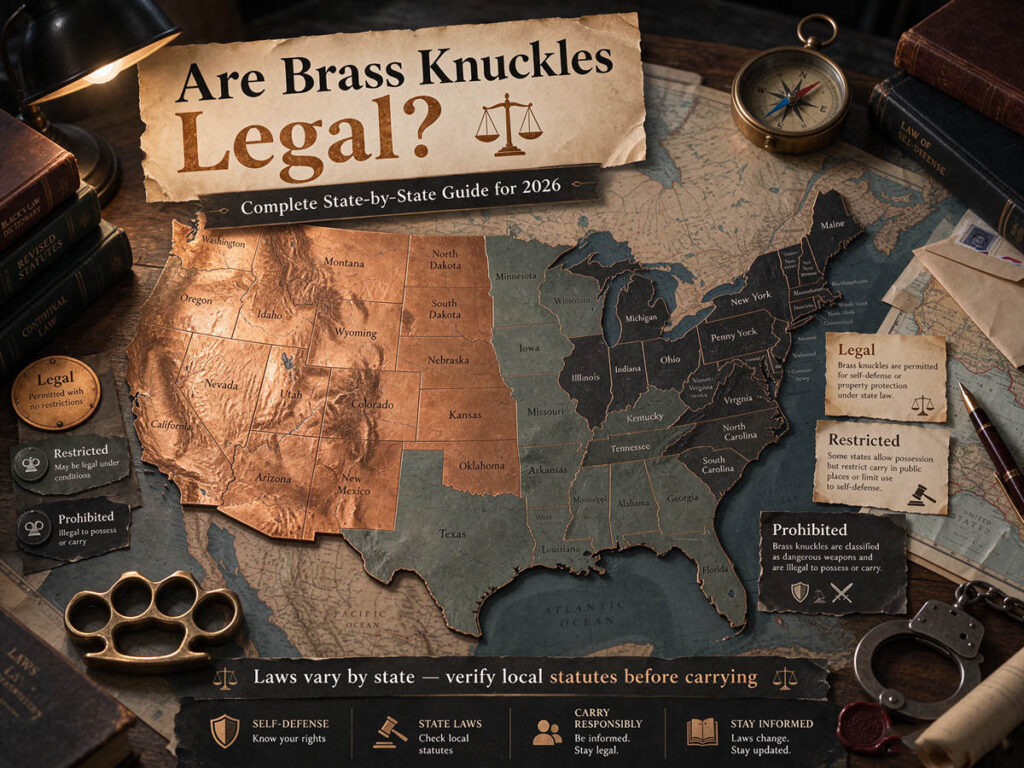
Are Brass Knuckles Legal? Complete State-by-State Guide for 2026
Brass knuckles have long been associated with self-defense discussions, historical weapon collections, and distinctive metal accessories, but their legal status in the United States is considerably more complicated than many people realize. While some states permit adults to possess them under relatively permissive conditions, others prohibit possession entirely, and several jurisdictions distinguish between owning an item at home, carrying it openly, carrying it concealed, manufacturing it, or selling it to another person.
For anyone researching Brass Knuckle products in 2026, understanding these distinctions is particularly important because the same item can be lawful in one state and a criminal offense in another. Furthermore, state laws do not always depend on whether an item is made from traditional brass. Some statutes also cover steel, aluminum, plastic, composite materials, or other hard substances, depending on how the object is designed and legally defined.
This guide provides an overview of federal restrictions, a state-by-state comparison covering all 50 states and Washington, D.C., and an explanation of the legal differences that buyers and collectors should understand before making decisions about ownership or transportation. It also considers whether a 1 finger Brass Knuckle or 2 finger Brass Knuckle receives different legal treatment from a traditional four-finger design.
Legal research cutoff: October 2026. This article provides general educational information, not individual legal advice. Always verify the current official statutes and local regulations before purchasing, possessing, selling, or transporting any weapon-associated item.
1. Are Brass Knuckles Legal in the United States? Understanding Federal Law
The first thing to understand is that the United States does not have one simple nationwide rule that makes all brass knuckles either legal or illegal for civilian ownership. The primary restrictions generally come from state statutes, while federal law establishes additional limitations in particular locations and circumstances.
Does Federal Law Prohibit Brass Knuckles?
The principal federal firearms and dangerous-weapons statutes do not establish a general nationwide prohibition on ordinary private possession of brass knuckles. Consequently, the legal answer usually depends on the state where the individual possesses or carries the item.
However, this does not mean that brass knuckles can be transported or carried anywhere without restrictions.
For example, 18 U.S.C. § 930 prohibits possessing dangerous weapons in federal facilities, subject to specific statutory exceptions. Federal courthouses and certain government buildings also have additional security requirements. Airport screening areas are subject to federal aviation security regulations, and the Transportation Security Administration does not allow brass knuckles in carry-on baggage.
National parks and other federally controlled locations can also involve additional rules, so a person should never assume that an item permitted under state law is automatically permitted on every type of federal property.
Why State Laws Matter More Than Product Descriptions
State legislation frequently uses terms such as:
- Metal knuckles.
- Metallic knuckles.
- Brass knuckles.
- Knuckle dusters.
- Knuckle weapons.
- Artificial or false knuckles.
These definitions are important because they can cover products that do not contain any actual brass. A manufacturer may advertise an item as a novelty accessory, collectible, keychain, or alternative metal design, but the legal classification depends on the applicable statute rather than the product’s marketing name.
The number of finger openings is not necessarily decisive either. A 1 finger Brass Knuckle, a 2 finger Brass Knuckle, and a conventional four-finger model may all fall within the same legal definition if their physical characteristics meet the relevant statutory requirements.
For additional background on different product designs, readers can explore Types of Brass Knuckles: A Complete Breakdown. Understanding the differences between designs is useful, but product appearance should never be treated as a substitute for legal research.
2. Complete Brass Knuckle Laws by State in 2026
The following comparison summarizes the principal state-level rules identified in the October 2026 legal review. It distinguishes between outright possession prohibitions, restrictions on carrying, and states where no general statute specifically names brass knuckles.
Importantly, a state described as permitting ownership may still prohibit possession in schools, government buildings, correctional facilities, or other restricted locations. Restrictions involving minors, prohibited persons, sales, and concealed weapons can also apply.
Northeast States
| State | General legal position in 2026 |
|---|---|
| Connecticut | Home possession is not separately prohibited, but carrying on the person is banned, whether open or concealed. Vehicle possession is also restricted. |
| Maine | Ownership is generally permitted; concealed carry and threatening display are prohibited. |
| Massachusetts | Carrying on the person or having them under control in a vehicle is prohibited; manufacturing and selling are also restricted. |
| New Hampshire | Ordinary home possession is not separately prohibited, but carrying on the person and selling are prohibited. |
| New Jersey | Possession without an explainable lawful purpose is prohibited; sale is also restricted. |
| New York | Possession of metal or plastic knuckles is prohibited, including at home. |
| Pennsylvania | Possession and carrying are prohibited under the offensive-weapons statute, subject to limited legal exceptions. |
| Rhode Island | Possession is generally prohibited, with exceptions for qualifying curio collections and certain lawful purposes; carrying is also restricted. |
| Vermont | Ordinary possession is not generally prohibited, but possession with intent to use against another person and commercial distribution are criminalized. |
Midwest States
| State | General legal position in 2026 |
|---|---|
| Illinois | Possession, carrying, and sale are prohibited; the statute covers knuckle weapons regardless of composition. |
| Indiana | No general statute specifically prohibits brass knuckles, although dangerous-weapon restrictions apply in certain locations and circumstances. |
| Michigan | Possession, manufacture, and sale are prohibited; possession can be a felony. |
| Ohio | General possession and open carry are not prohibited by a brass-knuckle-specific statute, but concealed carry may be prohibited when the item qualifies as a deadly weapon. |
| Wisconsin | Adult possession is generally permitted, but concealed-carry restrictions and prohibitions on transfers to minors apply. |
Plains States
| State | General legal position in 2026 |
|---|---|
| Iowa | No general brass-knuckle-specific prohibition, but dangerous-weapon rules and judicial interpretations may apply. |
| Kansas | Possession, carrying, and sale are prohibited. |
| Minnesota | Possession and transfer are prohibited, with limited museum and collector exceptions. |
| Missouri | Possession, carrying, and sale are prohibited, subject to limited statutory exceptions. |
| Nebraska | Adult ownership is generally permitted; concealed-carry restrictions apply to people under 21 and prohibited persons. |
| North Dakota | Ownership is generally permitted; concealed carry requires compliance with the state’s dangerous-weapon licensing rules. |
| South Dakota | No general brass-knuckle prohibition, although concealment with intent to commit a felony and restricted-location rules apply. |
Southern States
| State | General legal position in 2026 |
|---|---|
| Alabama | Ownership is generally permitted, but concealed carry is prohibited. |
| Arkansas | Possession, manufacture, and sale are prohibited, with specific statutory provisions addressing transfers to minors. |
| Delaware | Ownership is generally permitted, but concealed carry without the required authorization is prohibited. |
| Florida | Ownership is not generally prohibited, but concealed carry is restricted and manufacturing or selling metallic knuckles is prohibited. |
| Georgia | Adult possession is generally permitted, but school-zone, State Capitol, and sales-to-minors restrictions apply. |
| Kentucky | Adult ownership is generally permitted; concealed carry is subject to statutory eligibility and exceptions. |
| Louisiana | No general statute specifically names brass knuckles; broader concealed-weapon provisions may apply, and their application can depend on circumstances. |
| Maryland | Ownership is generally permitted, but concealed carry is prohibited and open carry with intent to injure is restricted. |
| Mississippi | Adult ownership is generally permitted, but concealed carry and transfers to minors are restricted; additional restrictions apply to prohibited persons. |
| North Carolina | Ownership is generally permitted, but concealed carry away from one’s own premises is prohibited. |
| Oklahoma | Home possession is generally permitted, but carrying openly or concealed is prohibited. |
| South Carolina | Adult ownership and ordinary carry are generally permitted under the absence of a general brass-knuckle carry ban, but school-property restrictions are significant. |
| Tennessee | Possession, carrying, and sale are generally prohibited, subject to limited statutory exceptions. |
| Texas | General adult possession and carry are not prohibited by a brass-knuckle-specific statute following the 2019 repeal, but restricted-location and transfer-to-minor provisions require attention. |
| Virginia | Ownership is generally permitted, but concealed carry and selling or furnishing brass knuckles are prohibited. |
| West Virginia | Eligible adults may generally possess and carry them, including concealed carry, subject to age, eligibility, and restricted-location requirements. |
Western States
| State | General legal position in 2026 |
|---|---|
| Alaska | Possession, manufacture, transportation, and sale of metal knuckles are prohibited. |
| Arizona | No general statute specifically names brass knuckles, but dangerous-weapon rules and restrictions for minors and certain locations can apply. |
| California | Possession, manufacture, importation, and sale of metal knuckles and certain other knuckle weapons are prohibited. |
| Colorado | Possession of metallic knuckles is prohibited. |
| Hawaii | Ownership is generally permitted, but concealed carry is prohibited, subject to statutory exceptions. |
| Idaho | No general brass-knuckle-specific prohibition, although dangerous-weapon and location-based restrictions apply. |
| Montana | Adult ownership is generally permitted, but school-building restrictions apply. |
| Nevada | Possession and carrying are prohibited. |
| New Mexico | Ownership is generally permitted, but concealed carry is restricted, with specified exceptions. |
| Oregon | Ownership is generally permitted, but concealed carry is prohibited. |
| Utah | No general brass-knuckle-specific prohibition, although dangerous-weapon rules and restrictions involving minors and particular locations apply. |
| Washington | Possession, carrying, and sale of brass knuckles are prohibited. |
| Wyoming | Ownership is generally permitted, but concealed carry can be prohibited when the item qualifies as a deadly weapon. |
District of Columbia
| Jurisdiction | General legal position in 2026 |
|---|---|
| Washington, D.C. | Possession, carrying, and sale of knuckles are generally prohibited, including designs made from materials other than metal. |
This comparison is intended as a practical starting point rather than a substitute for reading the applicable legislation. The underlying definitions, exceptions, and penalties can change, and certain states have legal provisions that are more complicated than a simple permitted-or-prohibited classification.
3. States Where Brass Knuckles Are Completely Prohibited or Heavily Restricted
Some jurisdictions take a particularly strict approach because their laws criminalize possession itself rather than regulating only the manner in which an item is carried.
In these states, keeping brass knuckles at home may be an offense even when the owner has no intention of carrying or using them.
States With General Possession Prohibitions
The October 2026 comparison identifies the following 16 states as having general possession prohibitions, alongside Washington, D.C.:
- Alaska
- Arkansas
- California
- Colorado
- Illinois
- Kansas
- Michigan
- Minnesota
- Missouri
- Nevada
- New Jersey
- New York
- Pennsylvania
- Rhode Island
- Tennessee
- Washington
Some of these jurisdictions provide narrow exceptions, including qualifying museum collections, theatrical productions, or certain curio collections. However, these exceptions should never be interpreted as general permission for ordinary private ownership.
For example, California Penal Code § 21810 addresses the manufacture, importation, sale, and possession of metal knuckles, while Michigan Compiled Laws § 750.224 prohibits specified activities involving metallic knuckles. Pennsylvania’s 18 Pa.C.S. § 908 addresses offensive weapons, including brass knuckles.
New Jersey also deserves particular attention because its statute addresses possession without an explainable lawful purpose, making the circumstances surrounding possession important.
States That Prohibit Carrying Rather Than Ordinary Home Possession
Another group of states distinguishes between keeping an item in a private residence and carrying it on the person.
Connecticut, Massachusetts, New Hampshire, and Oklahoma are particularly important examples because their statutes restrict carrying whether the item is concealed or openly visible, although the precise statutory language and penalties differ.
Other states, including Alabama, Florida, Maryland, North Carolina, Oregon, and Virginia, focus more heavily on concealed possession or carrying.
This distinction matters because an item that is not independently prohibited inside a private residence may still become illegal when carried in public, placed in a vehicle, or brought into a restricted location.
4. Do One Finger Brass Knuckles and Two Finger Brass Knuckles Have Different Legal Rules?
A frequent question among people researching alternative brass knuckle designs is whether products with fewer finger openings are treated differently from traditional four-finger models.
The answer is that there is no universal rule establishing that one-finger or two-finger designs are automatically legal.
1 Finger Brass Knuckle: Does a Smaller Design Change Its Legal Status?
A 1 finger Brass Knuckle may have a different appearance and construction from a traditional model, but a state’s legal definition may focus on the object’s purpose, shape, material, and intended function rather than the number of openings.
Some statutes specifically define knuckles through their physical characteristics, while others use broader terms covering devices designed to increase the force of a blow.
Consequently, calling an item a ring, compact accessory, collectible, or novelty product does not necessarily remove it from a weapons statute.
2 Finger Brass Knuckle: Is It Treated Like a Traditional Model?
A 2 finger Brass Knuckle may also fall within existing restrictions even when its dimensions and appearance differ from a conventional four-finger design.
For example, Illinois prohibits knuckle weapons regardless of composition, while New York expressly addresses metal and plastic knuckles. Other jurisdictions use material-specific definitions or broader dangerous-weapon provisions.
Collectors should therefore avoid assuming that changing the number of openings, choosing a different metal, or selecting a smaller design creates a legal exemption.
What About Plastic, Aluminum, and Other Materials?
Material is another important consideration.
Some state laws specifically mention metal knuckles, while others cover devices made from plastic, wood, or other durable materials. California, for example, has separate statutory provisions addressing metal knuckles and certain composite or hard wooden knuckles.
Illinois and Washington have broader language that can reach products beyond traditional brass construction.
For a more detailed explanation of the visual and construction differences, readers can refer to the One Finger Brass Knuckle Review. The important legal point is that product dimensions and advertising descriptions cannot independently establish whether a particular object is lawful.
5. Important Legal Differences: Ownership, Carrying, Selling, and Transportation
One of the most common mistakes in researching Brass Knuckle laws is treating ownership, public carry, concealed carry, transportation, and commercial sales as though they were all governed by exactly the same rule.
In reality, a state may permit one activity while prohibiting another.
Possession at Home
Possession laws determine whether an individual can legally own or keep a particular object. In states with outright possession prohibitions, storing brass knuckles in a private home does not necessarily provide an exemption.
Some states allow ownership but impose additional requirements concerning the age of the owner, the purpose of possession, or the location where the item is stored.
Open and Concealed Carry
Open carry means that an object is carried visibly, while concealed carry generally refers to carrying it in a manner that hides it from ordinary observation.
Certain states specifically prohibit concealed brass knuckles, while others prohibit carrying them in any form. A concealed-handgun license should not automatically be assumed to authorize carrying other weapon categories.
The applicable statute must be examined to determine exactly which objects and activities are covered.
Selling, Manufacturing, and Transferring
Commercial regulations are another important part of the legal picture.
Florida Statute § 790.09, for example, criminalizes manufacturing or selling metallic knuckles. Virginia Code § 18.2-311 also restricts selling or furnishing brass or metal knuckles.
Other jurisdictions impose additional restrictions on transferring these items to minors, even when adult possession is otherwise permitted.
Transportation in a Private Vehicle
Vehicle possession deserves separate attention because some states treat an item in a glove compartment, center console, or under a seat differently from an object stored in a closed trunk.
Connecticut, for example, has a specific vehicle-related prohibition. Massachusetts also addresses possession under a person’s control in a vehicle, while other states provide particular exceptions for securely stored weapons.
In states where possession itself is prohibited, placing the item in a vehicle does not solve the underlying legal problem.
Air Travel and Federal Property
The TSA prohibits brass knuckles in carry-on baggage. Its guidance permits them in checked baggage under federal screening rules, but this does not override state laws that prohibit possession or transportation.
Similarly, federal facilities, courthouses, schools, and other restricted locations may impose additional restrictions even when the surrounding state generally permits ownership.
6. How to Check Brass Knuckle Laws Before Purchasing in 2026
Because legislation can change, the most responsible approach is to verify the actual statute rather than relying exclusively on an online retailer, an old blog article, or a general statement that a product is legal in a particular state.
Use Official Government Sources
Start with the relevant state legislature or official statutory database. Search for terms such as metallic knuckles, metal knuckles, brass knuckles, dangerous weapons, and offensive weapons.
For example, the following statutes are useful starting points:
- California Penal Code § 21810 and § 16920.
- Florida Statutes § 790.001 and § 790.09.
- Illinois Compiled Statutes 720 ILCS 5/24-1.
- Michigan Compiled Laws § 750.224.
- New York Penal Law § 265.01.
- Texas Penal Code § 46.05.
- Virginia Code § 18.2-308 and § 18.2-311.
- Washington Revised Code § 9.41.250.
These references illustrate why reading the exact statutory wording is more useful than relying on a simplified legal ranking.
Check Local and Restricted-Location Rules
Even where state law generally allows ownership, local ordinances and location-specific restrictions may still apply.
Pay particular attention to:
- Public and private schools.
- College campuses.
- Government buildings.
- Courthouses.
- Airports and secure transportation facilities.
- Correctional facilities.
- Private businesses with weapons policies.
Traveling between states introduces another layer of complexity because the laws of the destination jurisdiction may be substantially different from those of the starting location.
Do Not Rely on Retailer Claims
A product being available for purchase online does not prove that it is lawful for every customer. Similarly, descriptions such as collectible, novelty, tactical accessory, or keychain do not override the legal definition of a regulated weapon.
Readers researching the broader category can also visit brassknucklesmaster.com and review its Brass Knuckles Laws by Region: What You Need to Know Before Carrying article for additional background. Because legal information can become outdated, older articles should always be cross-checked against current official legislation.
7. Final Verdict: Know Your State’s Laws Before Making a Decision
So, are brass knuckles legal in 2026? The answer depends on the state, the specific product, and the activity being considered.
Some states prohibit possession entirely, while others distinguish between ownership at home and carrying in public. Certain jurisdictions restrict only concealed carry, and others regulate manufacturing, commercial sales, transfers to minors, or possession in particular locations.
The same principles apply to a 1 finger Brass Knuckle, a 2 finger Brass Knuckle, and a traditional four-finger model. A smaller design, different material, or keychain-style appearance does not automatically create an exemption from weapons legislation.
For collectors and anyone researching these products, the most important steps are to identify the relevant statutory definition, distinguish possession from carrying and selling, check local restrictions, and verify the current law before making any purchase or transportation decision.
At brassknucklesmaster.com, readers can explore additional information about product styles, historical designs, and the broader legal discussion surrounding brass knuckles. Nevertheless, no product description or general online guide should replace official legal sources or qualified advice when a particular situation is unclear.
Ultimately, responsible research is more important than assumptions about what is permitted. Understanding the law in your own jurisdiction, as well as every jurisdiction through which you plan to travel, is the best way to avoid unnecessary legal problems in 2026.