
Aug
Knowledge of Weapons
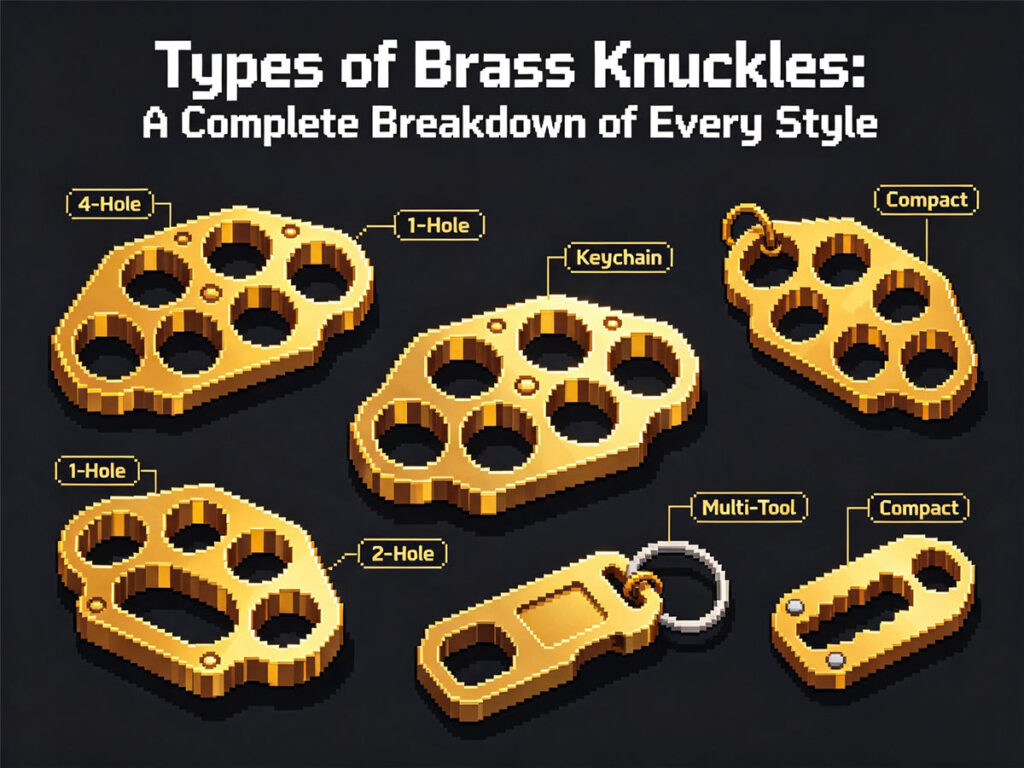
Types of Brass Knuckles: A Complete Breakdown of Every Style
Most people think of brass knuckles as a single, monolithic thing — one design, one purpose, one way to carry it. That assumption misses what makes this category so interesting. The reality is that types of brass knuckles span a surprisingly wide spectrum, from full-frame powerhouses built for maximum impact to slim, disguised pieces that hang quietly on a keyring and look like nothing at all.
Each style exists because someone, somewhere, had a different need. Maybe they wanted something they could wear to work without raising eyebrows. Maybe they needed raw striking force and didn’t care about discretion. Maybe they just wanted a conversation starter that happened to double as a self-defense tool. At Brass Knuckles Master, we carry every major style because we’ve learned that the “best” brass knuckle is the one that actually fits your life — not someone else’s.
This guide walks through every major type, what each one does well, and who it’s really for.
1. The Four-Finger Brass Knuckle — Maximum Power, No Compromises
When you close your fist around a four-finger knuckle duster, you immediately understand why this design has been the standard for over two centuries. Four finger holes. A full-width striking bar that spans your entire knuckle line. Solid metal transferring every ounce of your punch force into a single, concentrated contact point. There’s no ambiguity about what this tool is or what it does.
Why the Four-Finger Still Dominates
The physics haven’t changed since blacksmiths first forged these for Civil War soldiers. A bare fist distributes impact across soft, compressible tissue — your hand absorbs punishment right alongside your target. A four-finger brass knuckle eliminates that waste. The rigid bar doesn’t flex. Your hand stays protected inside the frame. Every bit of kinetic energy you generate goes where you aim it.
For sheer stopping power, nothing in the brass knuckle varieties lineup matches the four-finger. It’s the reason this design showed up in trench warfare, the reason it’s the image that comes to mind when anyone says “brass knuckles,” and the reason serious collectors almost always start here.
Who Should Choose This Style
If your priority is raw effectiveness and you don’t need to hide what you’re carrying, the four-finger is the obvious pick. It’s bulkier than the alternatives — there’s no getting around that — but the trade-off is undeniable confidence in your grip. BKM’s four-finger brass knuckle collection includes polished brass, matte black, and gold-plated finishes, each one precision-machined for a secure, comfortable fit.
2. The Two-Finger Brass Knuckle — Balanced and Versatile
Strip away two finger holes and suddenly you have a completely different carry experience. The two-finger brass knuckle sits in that sweet spot between capability and portability. It’s lighter, slimmer, and slides into a pocket without creating a noticeable bulge — but it still gives you a real, tangible advantage over a bare fist.
The Middle Ground That Works for Most People
A lot of first-time buyers gravitate toward the two-finger because it doesn’t demand a lifestyle adjustment. You don’t need a dedicated pouch. You don’t need to think about where it sits in your pocket. It just… fits. The reduced frame means less material, less weight, and a lower profile, while the two-finger grip keeps the striking bar locked securely across your index and middle fingers — the two fingers that naturally lead a punch.
At BKM, we’ve noticed that the two-finger style attracts people who already carry a few other EDC items. They’re used to thinking about pocket real estate. They want something effective that doesn’t compete with their knife, their phone, and their wallet for space. If that sounds like you, our two-finger brass knuckle selection is worth a close look.
Where It Falls Short
Honesty matters here. A two-finger design distributes impact across fewer fingers, which means the force concentration isn’t quite as broad as a four-finger frame. Your hand also bears more of the load on just two contact points. It’s a meaningful trade-off — you gain portability but give up some of that full-fist stability. For most self-defense scenarios, the difference is negligible. For pure punching power, the four-finger still wins.
3. The One-Finger Brass Knuckle — Stealth and Simplicity
The one-finger brass knuckle is the minimalist’s answer. A single finger hole — usually the middle finger — with a compact striking surface that sits right on top of your knuckle. It’s small enough to disappear in a closed fist, light enough to forget you’re carrying it, and focused enough to deliver a sharp, targeted strike when you need it.
Discretion Is the Whole Point
This is the style you choose when being seen is not an option. The one-finger fits inside your palm with zero visible footprint. No frame sticking out between your fingers. No telltale shape under fabric. It’s the closest thing to invisible that a brass knuckle can get while still being a functional tool.
People who carry one-finger designs often describe them as “just in case” tools — the thing they keep on them during late-night walks, unfamiliar neighborhoods, or any situation where they want an option but don’t want to broadcast it. BKM’s one-finger brass knuckle collection reflects that philosophy with slim, low-key designs that prioritize function over flash.
The Trade-Off: Focused Force, Narrower Grip
One finger means one point of contact. The impact zone is smaller. Your grip relies entirely on that single finger holding the frame steady under force. For a quick, sharp defensive strike, that’s plenty. For sustained engagement, it’s not the tool you want. Understanding this distinction is what separates someone who’s actually thought about their carry from someone who just grabbed the cheapest option online.
4. The Ring-Style Brass Knuckle — When Self-Defense Wears a Disguise
Here’s where the category gets creative. Ring-style brass knuckles look like jewelry. Heavy, bold jewelry — but jewelry nonetheless. A wide band wraps around one or two fingers, and the outer surface carries enough mass and rigidity to function as a striking tool. Some designs are ornate enough to pass as statement rings at a dinner party. Others are more obviously tactical, with textured surfaces and aggressive geometry.
The Most Covert Option
If one-finger knuckles are stealth, ring-style pieces are full camouflage. Nobody looks at a thick ring and thinks “weapon.” That’s the entire appeal. You can wear it all day — at the office, at the store, on a walk — and it draws zero attention. The moment you make a fist, you’ve got a hardened metal surface ready to go.
This style has exploded in popularity among the EDC community in recent years, partly because it doesn’t feel like you’re “carrying” anything. It’s just a ring. It’s part of your outfit. And yet it gives you an option that a bare hand simply doesn’t provide.
Not for Everyone
Ring-style designs are inherently compact, which means the striking surface is smaller than dedicated knuckle styles. They also require a good fit — a ring that slides around on your finger under impact is worse than useless. At BKM, we size our ring-style pieces carefully for exactly this reason, but it’s still something to think about before you buy.
5. The Keychain Brass Knuckle — Always Within Reach
The keychain style solves a specific problem: how do you keep a defensive tool accessible without putting it in your pocket? You attach it to the thing you already carry everywhere — your keys. A compact, usually two-finger frame clips onto your keyring, blending in with the rest of your everyday clutter.
The Carry-Ready Compromise
Keychain brass knuckles are designed for people who want to be prepared without thinking about it. You grab your keys, you’ve got your tool. No dedicated pocket. No pouch. No daily decision about whether to bring it. It’s just there, integrated into the one object you never leave home without.
The designs tend to be lighter and thinner than standalone knuckles — they have to be, since they’re sharing space with car keys, house keys, and whatever else lives on your ring. Some incorporate additional features like bottle openers or small blades, which adds utility beyond self-defense. It’s a pragmatic approach, and it works well for people who value convenience above all else.
What You Sacrifice
Lighter construction means less mass behind each strike. Smaller profiles mean less striking surface. And the fact that it’s attached to a jingling keyring means it’s not exactly silent to deploy. For a quick grab-and-react situation, it’s more than adequate. For anything more demanding, a dedicated knuckle is the better call.
6. Novelty and Collector Styles — Form Meets Personality
Not every brass knuckle exists purely for self-defense. A growing segment of the market is driven by collectors, enthusiasts, and people who simply appreciate bold, distinctive metalwork. Novelty brass knuckle styles range from themed designs — skulls, animals, fantasy motifs — to luxury materials like Damascus steel, titanium alloys, and 24K gold plating.
When the Aesthetic Is the Point
At Brass Knuckles Master, we see this all the time. Someone comes in looking for a “practical” piece and walks away with a hand-polished collector’s edition because it spoke to them. There’s nothing wrong with that. A well-made brass knuckle is, at its core, a piece of metal craftsmanship. Appreciating it as an object — as art, as a display piece, as something that makes your EDC tray look incredible — is a perfectly valid reason to own one.
Collector pieces also make excellent gifts. They’re unusual, they’re conversation starters, and they carry a certain weight — literally and figuratively — that a standard gift simply doesn’t.
Still Functional
Here’s what surprises some people: most novelty and collector brass knuckles are still fully functional. The materials are real. The construction is solid. The striking surface still works. They may be prettier than their utilitarian cousins, but they’re not toys. That’s an important distinction, and it’s one we take seriously in every piece we stock.
7. How to Pick the Right Type for Your Life
Choosing between these types of brass knuckles isn’t about finding the “best” one — it’s about finding the one that matches how you actually live. Here’s how we think about it at BKM.
Start With Your Carry Reality
Do you have a dedicated pocket or pouch for a self-defense tool? If yes, a four-finger or two-finger gives you the most capability. If you’re working with limited space or need something that blends into your existing carry, a one-finger or keychain style makes more sense. And if discretion is your top priority — if you need something that looks like it belongs on your hand but isn’t — the ring style is unmatched.
Think About When You’d Actually Use It
A four-finger knuckle sitting in a drawer at home does you no good during a parking garage confrontation. A keychain piece rattling on your belt loop might not be ideal in a quiet meeting. The best brass knuckle is the one you actually have on you, in a position to deploy, when the moment arrives. That’s not a philosophical point — it’s a practical one, and it should drive your decision more than any feature comparison.
Don’t Overthink It
Here’s the truth that seasoned carriers already know: you’ll probably end up with more than one. The person who buys a two-finger for daily carry often picks up a four-finger for the collection. The ring buyer grabs a keychain for gym days. Your needs change, your preferences evolve, and having options is part of the fun.
Whatever style catches your eye, the most important step is the first one — exploring what’s out there and finding the piece that feels right in your hand. Every type covered here serves a real purpose, for a real kind of person, in a real set of circumstances. At BKM, we built our brass knuckle collection around that principle: not one-size-fits-all, but something for everyone who takes their personal readiness seriously. Take a look. Find your fit. And carry with confidence.