
Aug
Knowledge of Weapons
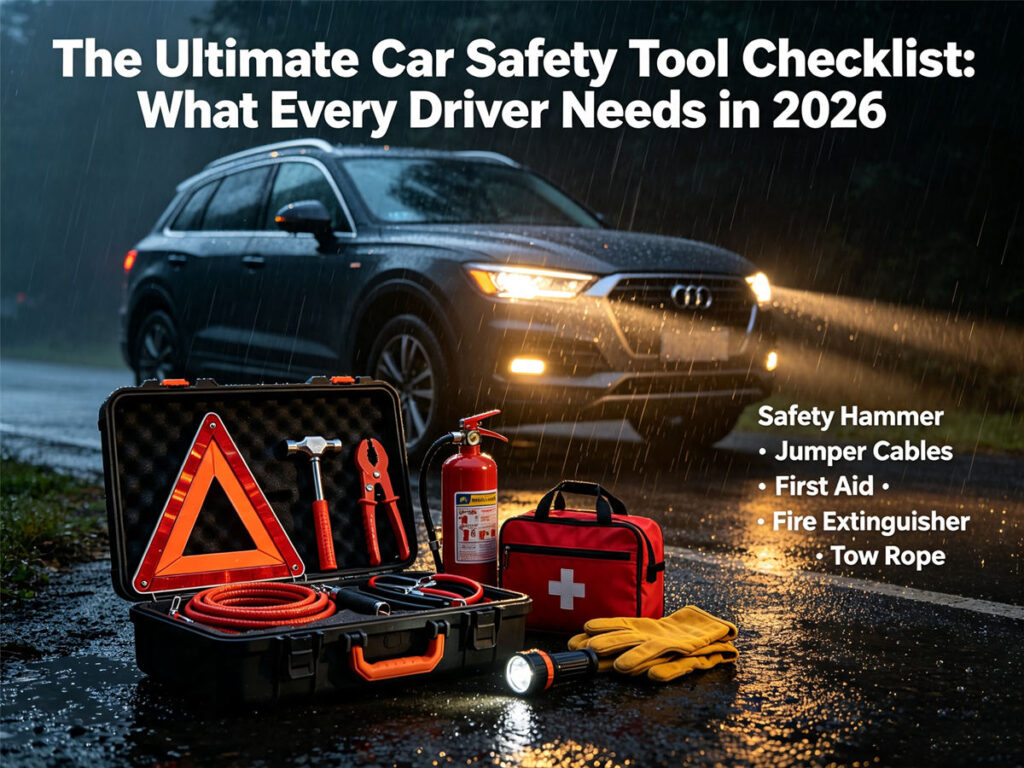
The Ultimate Car Safety Tool Checklist: What Every Driver Needs in 2026
A seatbelt jammed shut. A window that won’t break. Water rising fast around the doors. In a moment like that, your survival depends on what’s within arm’s reach — not what’s sitting on a store shelf. Most drivers carry a phone, a charger, and maybe a half-empty water bottle. Almost none of them carry a dedicated car safety tool. At Brass Knuckles Master, we’ve spent years studying what separates prepared drivers from the rest, and it comes down to one thing: having the right tool in the right place before the emergency happens. This car safety checklist breaks down exactly what to keep in your vehicle, why each piece matters, and how to make sure it’s ready when you need it.
1. Glass Breaker — The First Tool You’ll Reach For
When a car goes into water or rolls onto its side, the doors often become impossible to open. Pressure differences, bent frames, and electrical window failures all conspire to trap you inside. A glass breaker is the single most critical car safety tool because it gives you a way out when every other exit fails. It doesn’t need batteries, it doesn’t need power, and it works in seconds. The entire design philosophy is brutal simplicity — one strike, one outcome.
Why Tempered Glass Demands a Dedicated Tool
Side and rear windows are made of tempered glass — designed to shatter into small pieces on impact. That sounds safe until you realize it also means you can’t punch through it with bare hands or kick it out with your shoes. A proper glass breaker uses a tungsten carbide tip that concentrates force into a single point, cracking the glass instantly. At BKM, we carry a dedicated glass breaker tool built for exactly this scenario — small enough to clip onto your visor, strong enough to go through a window in one strike. The difference between a purpose-built tool and a cheap knockoff shows up when you need it most.
Where to Mount It for Fast Access
Speed matters. If your glass breaker is buried in the glove box or tangled in a trunk organizer, it’s useless. Mount one within the driver’s reach — on the sun visor, in the door pocket, or clipped to the center console. Some drivers keep a second one on the passenger side for redundancy. The point is that you should be able to grab it without looking and without unbuckling your seatbelt. Practice the motion once. It should take less than two seconds from the moment you decide to use it.
2. Seatbelt Cutter — When the Buckle Won’t Budge
A jammed seatbelt is more common than people think. After a collision, the buckle mechanism can deform, the release button can crack, or the belt can become twisted and locked under body weight. A seatbelt cutter — usually a small hooked blade guarded by a plastic housing — lets you slice through the webbing in one motion without risking a slip. It’s the kind of tool you hope you never need, but once you’ve seen someone struggle against a stuck belt in a panic, you understand why it belongs in every car.
Most quality car escape tools combine a glass breaker on one end and a seatbelt cutter on the other. That’s the standard configuration for a reason: when you need one, you almost certainly need the other. Look for a blade that’s recessed deeply enough that you can’t accidentally cut yourself during storage, but exposed enough that it works through a wet, tension-loaded belt in a single pull. Cheap versions use dull steel that frays the webbing instead of cutting it cleanly.
3. Multi-Function Keychain Tools — Everyday Carry Meets Emergency Readiness
Not every car safety tool needs to be a dedicated emergency device. Some of the best vehicle safety tools are the ones you carry every day without thinking about them — because the emergency doesn’t wait for you to walk back to the garage. A keychain multi-tool puts a glass breaker, a flashlight, a bottle opener, and sometimes even a screwdriver on the same ring as your car keys.
The Advantage of Always Having It With You
The biggest failure in any car safety checklist is the tool you left at home. A keychain-sized multi-tool eliminates that problem entirely. It’s attached to your keys, which means it’s in your hand every time you start the car. At Brass Knuckles Master, our keychain multi-tool collection is designed around this philosophy — compact enough to forget it’s there, tough enough to work when it counts. We’ve seen too many “emergency kits” that live permanently in the trunk. The best car emergency tool is the one that’s actually on you.
What to Look for in a Keychain Safety Tool
Not all keychain tools are created equal. Focus on three things: a window punch tip that’s hard enough to break tempered glass (cheap novelty tools often fail here), a guarded blade for seatbelt cutting, and a construction that can survive the daily abuse of being tossed in pockets and cup holders. Avoid anything with plastic-only tips. You want metal-to-glass contact when it matters. A good keychain tool also needs to feel natural in your hand — if it’s awkward to grip, fumbling under stress becomes a real risk.
4. Flashlight — Visibility Is Survival
It’s easy to overlook a flashlight as a car safety tool, but consider the scenarios: a breakdown on an unlit road at two in the morning, a nighttime accident where you need to signal for help, or navigating a dark parking garage with a dead phone battery. A small, high-lumen flashlight does more than illuminate — it signals approaching traffic, it disorients a potential threat, and it keeps you aware of your surroundings when visibility drops. Pair it with a red-light mode and you preserve your night vision while checking under the hood or reading a map.
Rechargeable vs. Battery-Powered
For a vehicle-stored flashlight, battery-powered models often make more sense. Rechargeable units can lose their charge sitting idle in a hot glove compartment for months. A flashlight that takes common AAA or CR123A batteries will fire up whenever you need it, even after a long period of disuse. Keep a spare set of batteries in the center console and rotate them once a year. The cost of two spare batteries is nothing compared to being caught without light during a roadside emergency.
5. First Aid Kit — The Non-Negotiable Addition
Every car safety checklist worth reading includes a first aid kit, and for good reason. Cuts from broken glass, minor burns from a radiator hose, and scrapes from road debris are the most common injuries in non-critical accidents. A basic kit with adhesive bandages, antiseptic wipes, gauze pads, medical tape, and a pair of nitrile gloves fits easily in a door pocket or under a seat.
You don’t need a paramedic-level setup. You need enough to clean and cover a wound until you can get proper help. Check your kit twice a year — replace expired antiseptics, restock used bandages, and make sure the packaging hasn’t degraded from heat exposure. A first aid kit that looks complete but has dried-out wipes and cracked bandage wrappers is worse than no kit at all, because it gives you false confidence.
6. Reflective Warning Devices — Be Seen Before You’re Hit
A disabled vehicle on the shoulder of a highway is a magnet for secondary collisions. Flares, reflective triangles, or LED road flares give other drivers advance warning that something is wrong ahead. This is the kind of car emergency tool that protects not just you but the people stopped behind you. Place them at 50, 100, and 150 feet behind your vehicle to give approaching traffic enough reaction time.
LED Flares vs. Traditional Flares
Traditional pyrotechnic flares burn bright but last only 15 to 30 minutes and carry a fire risk if stored improperly. LED flares are reusable, visible for up to a mile, and many are magnetized so you can stick them to your trunk lid or the side of your vehicle. They’re the modern standard for road-side visibility, and they store flat in any trunk compartment. At BKM, we favor LED options for their reliability and the fact that they don’t expire or degrade sitting in a hot car through summer.
7. Putting Your Car Safety Checklist Together
Having the tools is only half the equation. Knowing where they are and making sure they work is the other half. We recommend a simple routine: once every six months, open your glove box, check your door pockets, and verify that every piece of gear is where you left it, still functional, and still accessible. Batteries die, blades dull, and mounting clips break — especially in the temperature extremes of a parked car that bakes at 140°F in July and freezes in January.
A good car safety tool is one you trust completely. It doesn’t need to be expensive. It needs to work the first time, every time, without hesitation. That’s the difference between a tool that saves a life and one that just makes you feel prepared. A car safety tool from BKM is built to that standard — tested, compact, and ready for the moment you hope never comes.
Preparation isn’t about fear. It’s about respecting the fact that roads are unpredictable, and the best car safety tool is the one that’s actually in your hand when the unexpected happens. The tools on this checklist aren’t luxuries — they’re the bare minimum for anyone who spends time behind the wheel. If you’re ready to build your own vehicle safety tool kit, explore the collection at Brass Knuckles Master. Every piece is designed to be the tool you reach for when it matters most.