
Dec
Knowledge of Weapons, Weapons What
Brass Knuckles Laws by Region: What You Need to Know Before Carrying
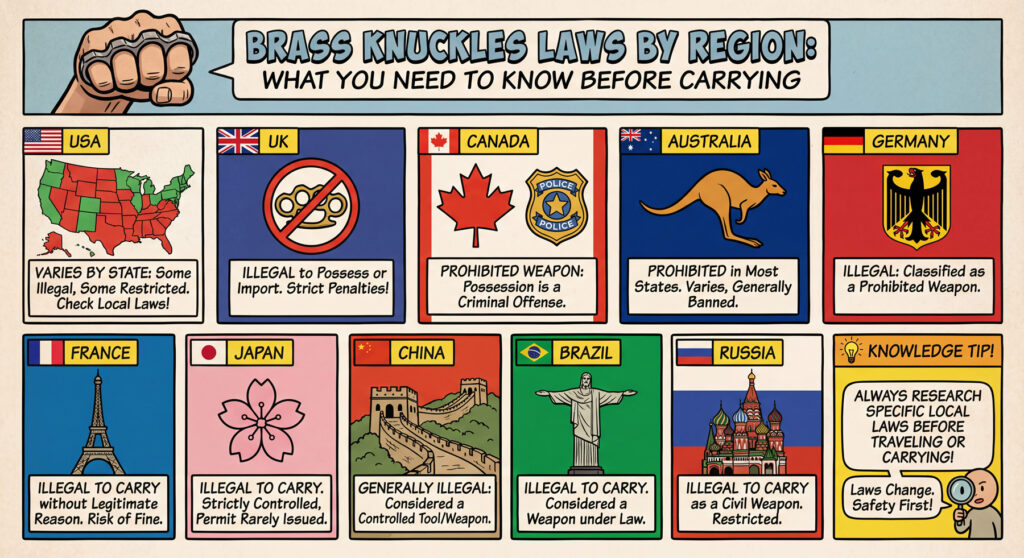
Carrying a self-defense tool demands not only confidence in its use but, crucially, a thorough understanding of its legal status. Brass knuckles, also known as knuckle dusters, occupy a particularly complex and often prohibited space within weapon laws across the United States and internationally. Possessing or carrying them without clear knowledge of local statutes can lead to severe criminal penalties, transforming a perceived tool of protection into a source of significant legal jeopardy. This guide provides a critical overview of the legal landscape governing brass knuckles, emphasizing the paramount importance of verifying regulations specific to your exact location before even considering acquisition or carry.
Part 1: The Federal Landscape – A Baseline with Gaps
Unlike firearms, brass knuckles are not primarily regulated at the federal level in the U.S. There is no overarching federal statute explicitly banning their mere possession nationwide. However, significant federal restrictions do exist in specific contexts. Crucially, brass knuckles are strictly prohibited in all areas under federal jurisdiction where weapons bans apply, most notably within airport secure zones (sterile areas and boarding gates) and aboard commercial aircraft, enforced rigorously by the Transportation Security Administration (TSA). Furthermore, transporting brass knuckles across state lines can become a federal offense if it violates the laws of either the originating or destination state, potentially falling under statutes regulating interstate commerce of dangerous weapons. Importing brass knuckles into the United States is also generally illegal under federal customs regulations, classifying them as prohibited weapons.
Part 2: The Patchwork Quilt of State Laws – Where the Real Restrictions Lie
The most critical and varied regulations governing brass knuckles occur at the state level. Laws differ dramatically, ranging from outright bans to conditional allowances, making it imperative to research the specific statutes in your state and any state you plan to visit. Understanding the nuances of terms like “possession,” “carry” (open vs. concealed), “intent,” and definitions of prohibited weapons (“metal knuckles,” “knuckle dusters,” etc.) within each state’s penal code is essential. This patchwork creates significant legal risk for uninformed individuals, as crossing a state line can instantly transform a legal item into contraband.
- 2.1 Prohibition States (Examples): Numerous states enforce near-total bans. California (Penal Code § 21810) explicitly prohibits the manufacture, sale, possession, and carry of metal knuckles. New York classifies them as per se illegal weapons under Penal Law § 265.01, making mere possession a felony offense without requiring proof of intent. Illinois (720 ILCS 5/24-1), Massachusetts (Ch. 269 § 10), and Michigan (MCL § 750.224) also maintain strict prohibitions.
- 2.2 States with Restrictions or Nuances: Some states don’t ban possession outright but impose significant restrictions. Texas (Penal Code § 46.05) prohibits the carry of brass knuckles (classified as illegal knives/knuckles), but not necessarily their possession within one’s home. Florida law (Statute § 790.001(3)(a)) defines metal knuckles as a “concealed weapon,” meaning carrying them concealed without a permit is illegal, while open carry might be less restricted (though local ordinances vary widely, and enforcement can be unpredictable). Virginia (§ 18.2-308) prohibits concealed carry without a permit.
- 2.3 Relatively Permissive States (Rare): A very small number of states have less restrictive laws, but even here, local ordinances (county or city) may impose stricter bans. Arizona generally allows possession, but restrictions apply near schools or for individuals with felony convictions. Always verify county and city codes.
Part 3: County and Municipal Ordinances – The Local Layer
Even within states where brass knuckles might be technically legal under state law, county or city ordinances can impose stricter prohibitions. A tool legal under Texas state law, for instance, could be banned outright within the city limits of Houston, Austin, or Dallas through local weapons ordinances. Overlooking this local layer of regulation is a common and costly mistake. Before carrying anywhere, consult the specific municipal codes for your city and any city you plan to enter. Relying solely on state law is insufficient and legally perilous.
Part 4: International Considerations – A Global Minefield
Traveling internationally with brass knuckles is strongly discouraged and often illegal. Many countries classify them strictly as prohibited weapons with zero tolerance. In the United Kingdom, brass knuckles are categorized as offensive weapons under the Prevention of Crime Act 1953 and the Criminal Justice Act 1988; their possession in public is illegal, and possession in private generally requires proving it was for lawful purposes, which is exceptionally difficult. Canada prohibits them under the Criminal Code as prohibited weapons. Australia has stringent prohibitions, classifying them as controlled weapons or prohibited items in all states and territories. Penalties abroad can be severe, including substantial fines and lengthy imprisonment. Never assume the laws of your home country or state apply elsewhere in the world.
Part 5: Navigating Legality and Considering Alternatives
Given the widespread legal restrictions and severe penalties associated with brass knuckles, legal research is non-negotiable. Never rely on anecdotal evidence or vendor claims. Consult the official penal codes for your state, county, and city. If uncertain, seek qualified legal counsel specializing in weapons laws. The legal risks of carrying prohibited knuckles – including arrest, felony charges, fines, and imprisonment – far outweigh any perceived benefits for self-defense. For individuals seeking a legally accessible and generally less restricted personal safety tool, consider exploring tactical pens. These discreet instruments are explicitly designed as writing tools first, satisfying the “dual-use” principle favored in many jurisdictions. While still subject to local laws (especially concerning intent or use as a weapon), tactical pens are typically legal to carry almost anywhere standard pens are allowed, providing a pragmatic and compliant alternative for those prioritizing personal security within the bounds of the law, offering a way to enhance preparedness without inadvertently violating statutes governing prohibited weapons like brass knuckles.