
Nov
Knowledge of Weapons, Weapons How
How Do Brass Knuckles Work?
Brass knuckles are among the most recognizable examples of compact metal weapons, with a distinctive shape that has appeared in historical collections, films, television, and discussions about personal protection for generations. Although their basic appearance is relatively simple, the design raises several interesting questions: What are brass knuckles made of? Why do traditional models have multiple finger openings? How do modern variations differ from the original design, and what makes a Brass Knuckle ring look different from a conventional model?
Understanding how brass knuckles work requires looking at their physical construction and the basic principles of rigid materials, force, and impact, while also recognizing the serious safety and legal concerns associated with these objects. This guide explores their mechanical characteristics, historical development, material choices, and modern variations from an educational and design-focused perspective.
1. Understanding the Basic Structure of Brass Knuckles
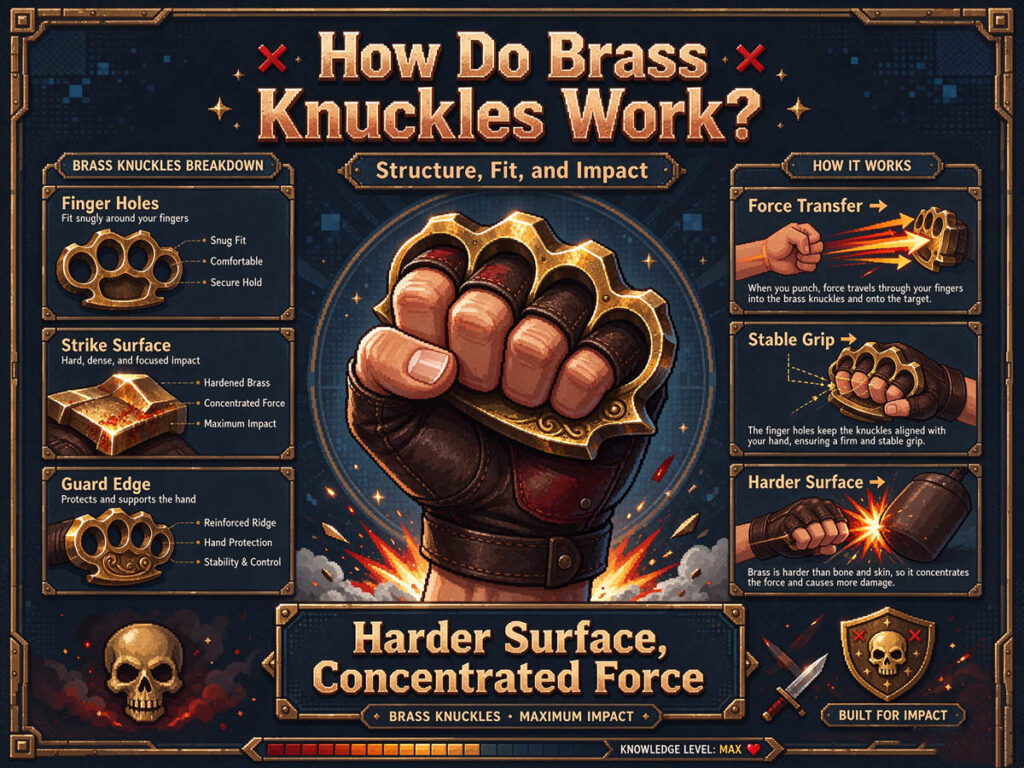
Brass knuckles, also known as knuckle dusters, are rigid objects traditionally manufactured with openings or spaces corresponding to the fingers and a connected metal frame. Their recognizable design is different from ordinary jewelry because the structure is associated with an impact weapon rather than simply serving as an ornamental accessory.
The traditional model generally has several identifiable components, including a frame, finger openings, an outer profile, and a connecting section across the front. Although individual products differ in shape and proportions, these structural elements create the familiar appearance that has become closely associated with brass knuckles.
The frame and overall construction
The frame is the main structural element of a traditional design, connecting its different sections into one solid object. Unlike fabric gloves or flexible hand coverings, a metal frame does not behave like soft material when pressure is applied, which is one reason these objects are classified differently from ordinary protective clothing.
The frame may have a smooth, rounded, angular, or decorative exterior, depending on the manufacturer and intended presentation. Historical examples often have relatively straightforward outlines, while contemporary versions may include engraved patterns, sculpted surfaces, and more elaborate finishes.
Finger openings and visual identification
Finger openings are among the most recognizable characteristics of traditional brass knuckles. They distinguish the conventional full-frame design from many other metal accessories, including ordinary rings and decorative hand ornaments.
The number, size, and arrangement of these openings vary between product categories. Traditional examples are commonly associated with four openings, while modern designs may feature fewer openings or use a much more compact ring-shaped appearance.
It is important to understand that these differences are primarily structural and visual distinctions, not reliable indicators of legal status. A compact object can still be classified as a weapon, even when it looks considerably different from a traditional model.
2. The Basic Mechanical Principles Behind Brass Knuckles
The phrase “How do brass knuckles work?” is often answered by discussing their relationship with rigid materials and physical impact. At a general level, their design uses a solid structure rather than flexible padding, creating an object with mechanical properties that differ significantly from those of an unprotected hand.
Understanding the basic science does not require practical instructions for using the object. Instead, it is useful to examine concepts such as material stiffness, mass, contact surfaces, and the way mechanical energy can produce injury.
Rigid materials and deformation
When an object experiences physical pressure, its material may bend, compress, deform, or remain relatively rigid, depending on its composition, shape, and construction. A metal object generally maintains its overall form under conditions that would cause softer materials to compress, although every material has limits and can eventually bend, crack, or break.
This difference helps explain why metal objects are treated differently from padded protective equipment. A soft glove is designed primarily to provide cushioning, while a rigid metal object has a fundamentally different relationship with physical contact.
The word “brass” also deserves some clarification. Brass is an alloy primarily composed of copper and zinc, and its properties vary according to the precise composition. Not every product marketed as brass knuckles is necessarily made from brass, since modern examples may use stainless steel, aluminum alloys, or other materials.
Mass, contact surfaces, and impact
Mass and contact area are important concepts in the study of physical impacts. When objects collide, the outcome depends on several interacting factors, including their mass, velocity, geometry, material properties, and the characteristics of the surfaces involved.
A rigid metal object can create serious injury because it does not provide the same cushioning as soft materials. The consequences of impact may include cuts, fractures, bruising, and damage to underlying tissues.
However, it would be misleading to describe brass knuckles as a scientifically reliable way to protect the hand or control the outcome of an altercation. Their use can injure both another person and the person holding the object, and the severity of an injury cannot be predicted simply by looking at the product’s size or material.
Why the design creates safety concerns
A compact metal structure can appear simple, but its physical properties make it potentially dangerous. Even decorative products may have hard edges, substantial weight, or rigid surfaces that create risks when they come into contact with the human body.
For this reason, brass knuckles should not be treated as ordinary fashion accessories or harmless novelty items without considering their construction and applicable regulations.
3. Why Are Brass Knuckles Made from Brass and Other Metals?
The choice of material has a major influence on the appearance, weight, surface finish, corrosion behavior, and manufacturing characteristics of brass knuckles. Historically, brass became closely associated with the category because it was suitable for metalworking and offered a distinctive golden appearance.
Modern manufacturers have expanded the available material choices, creating products with different visual characteristics and manufacturing costs. For collectors, these differences can be more interesting than marketing descriptions that focus exclusively on a product’s appearance.
Brass: The traditional material
Brass is an alloy made primarily from copper and zinc. Its warm color, workability, and resistance to corrosion have made it useful in many applications, including decorative hardware, musical instruments, fittings, and historical metal accessories.
One characteristic of brass is that its surface can gradually change over time. Exposure to air, moisture, handling, and environmental conditions may produce tarnishing or a darker patina, which can give older objects a distinctive appearance.
This natural change is sometimes appreciated by collectors, although a darkened surface should not automatically be interpreted as evidence that an object is antique. Modern products can be artificially aged, and genuine historical examples may have been polished or restored.
Stainless steel and aluminum
Stainless steel is another material frequently associated with modern metal accessories. Its appearance is generally cooler and more reflective than traditional brass, and its resistance to corrosion makes it attractive for products that require a consistent metallic finish.
Aluminum is comparatively lightweight and can be finished in different colors and surface treatments. It is used in many contemporary manufactured objects because it can be shaped into different forms and offers a distinct balance of weight and appearance.
| Material | General characteristics | Common visual appearance |
|---|---|---|
| Brass | Copper-zinc alloy; may develop patina | Warm golden tone |
| Stainless steel | Corrosion-resistant steel alloy | Silver or polished metallic |
| Aluminum | Lightweight metal | Silver, colored, or coated |
| Other alloys | Properties vary by composition | Depends on material and finish |
Why material descriptions matter
Product photographs do not always reveal the actual material used in an object. A gold-colored coating, for example, does not establish that the underlying product is solid brass, while a silver-colored surface does not necessarily mean it is stainless steel.
Collectors should therefore look for clear material specifications, reliable manufacturing information, and consistent product documentation. When a seller makes claims about a particular alloy, those claims should be supported by more than a photograph or a promotional description.
4. Traditional Designs, One-Finger Models, and Brass Knuckle Rings
Over time, the traditional four-opening design has inspired a variety of alternative shapes. Some modern products retain the familiar metal frame, while others adopt smaller, more decorative outlines that resemble jewelry or contemporary metal accessories.
These variations demonstrate how an established visual concept can be reinterpreted through different proportions, materials, and manufacturing styles. They also make it especially important to distinguish between an object’s appearance and its potential legal classification.
Traditional four-finger designs
The traditional full-frame model remains the best-known version of brass knuckles. Its recognizable silhouette typically includes four openings connected by a continuous structure, creating a distinctive appearance that is frequently reproduced in historical illustrations and popular entertainment.
Collectors may compare traditional examples according to their material, finish, manufacturing marks, and historical documentation. Some have relatively plain surfaces, while others feature decorative patterns or unusual exterior shapes.
The 1 finger Brass Knuckle variation
A 1 finger Brass Knuckle is a compact variation that looks noticeably different from the traditional full-frame design. Its smaller outline and single opening may give it a ring-like appearance, and some contemporary examples feature polished surfaces or decorative details associated with metal jewelry.
From a design perspective, this category illustrates how manufacturers have adapted a recognizable form into a smaller object. Its appearance may be minimalist, industrial, or ornamental, depending on the particular product.
Nevertheless, a smaller size does not automatically make an item harmless or legally equivalent to ordinary jewelry. Its construction and classification should be considered carefully.
The Brass Knuckle ring
A Brass Knuckle ring combines the visual language of conventional jewelry with the distinctive styling associated with knuckle-shaped metal objects. Some designs feature wide bands, sculpted surfaces, skull motifs, geometric patterns, or polished decorative finishes.
The difference between an ordinary ring and a weapon-associated ring is not necessarily obvious from appearance alone. A decorative metal band may simply be jewelry, while another design may have structural characteristics that bring it within a regulated weapon category.
For a closer look at the design differences, readers can explore the Brass Knuckle Ring Buying Guide, which discusses the appearance and variety of ring-style products.
5. How Modern Manufacturing Has Changed Brass Knuckle Design
Modern manufacturing has introduced more options for shaping, finishing, and decorating small metal objects. Compared with older handcrafted examples, contemporary products may display more consistent surface textures, repeated patterns, and a wider selection of finishes.
These developments have changed the appearance of brass knuckles and related collectibles, although they have not removed the safety concerns associated with rigid metal objects.
Casting, machining, and finishing
Metal casting is a manufacturing process in which molten material is placed into a mold and allowed to solidify into a particular shape. It has historically been important for producing objects with complex outlines and decorative details.
Machining, by contrast, involves removing material from a workpiece to achieve particular dimensions or surface characteristics. Modern metalworking can combine different processes to produce objects with varied appearances and levels of finish.
After the main manufacturing stage, a product may receive polishing, brushing, coating, engraving, or other surface treatments. These finishing choices can significantly influence its appearance, particularly when the object is intended for display or collectible purposes.
Modern decorative styles
Contemporary designs often borrow visual influences from several different areas, including industrial hardware, vintage metalwork, gothic jewelry, and fantasy-inspired artwork.
Some products emphasize simple shapes and understated surfaces, while others include more elaborate decorative elements. The popularity of unusual metal accessories has also encouraged manufacturers to experiment with contrasting colors, polished finishes, and sculptural details.
For collectors, these differences provide an opportunity to study how modern manufacturing has transformed a historically recognizable object into a much wider range of visual interpretations.
For additional background on the different formats, see Types of Brass Knuckles: A Complete Breakdown.
6. Safety, Legal Considerations, and Responsible Collecting
Understanding the mechanical principles behind brass knuckles also means recognizing why these objects are regulated in many places. Their rigid construction and association with physical violence create concerns that are different from those associated with ordinary jewelry or decorative metal accessories.
Laws can vary considerably between countries, states, and municipalities. Some jurisdictions restrict possession, while others regulate carrying, sale, manufacture, or transportation. In certain places, the legal classification may depend on the object’s design or intended function rather than the name used in an online product listing.
Do not assume that a decorative design is legally unrestricted
A ring-shaped product is not automatically exempt from weapon regulations simply because it resembles jewelry. Similarly, descriptions such as collectible, novelty accessory, or fashion item do not establish that possession is lawful.
Before purchasing or transporting any brass knuckle-style object, check the current laws that apply to the relevant location. When the legal classification is unclear, consulting a qualified legal professional is more reliable than relying on a seller’s description.
Collecting and displaying responsibly
For people interested in the history and craftsmanship of these objects, collecting can focus on material composition, historical background, manufacturing techniques, and decorative design.
Useful considerations include:
- Material documentation: Check whether the stated metal or alloy is clearly identified.
- Manufacturing quality: Examine the consistency of the surface finish and the accuracy of the product description.
- Historical provenance: Treat claims of age, rarity, or historical origin cautiously unless supporting documentation is available.
- Storage and display: Keep weapon-associated objects secured and away from children or anyone who might handle them irresponsibly.
- Legal compliance: Verify applicable ownership, possession, and transportation restrictions before acquiring an item.
Anyone interested in personal safety should also consider non-weapon alternatives, such as a personal alarm, a flashlight, or other lawful safety products, alongside practical measures such as staying aware of surroundings and seeking assistance when necessary.
7. Why Understanding the Design Matters
Brass knuckles may appear mechanically simple, but their design brings together several important ideas in materials science, manufacturing, product history, and public safety. Their rigid construction distinguishes them from flexible hand coverings, while their materials and surface treatments influence their appearance, weight, and long-term condition.
The traditional four-finger model remains the most recognizable example, but modern interpretations have expanded the category to include compact variations, ring-inspired designs, and decorative metal objects. A 1 finger Brass Knuckle and a Brass Knuckle ring may look quite different from a conventional model, yet both demonstrate how familiar visual elements can be reinterpreted through contemporary styling.
For readers who want to explore these subjects further, brassknucklesmaster.com offers additional articles about historical background, product categories, and modern design variations. The history of brass knuckles provides another perspective on how these objects developed and became recognizable across different periods.
Ultimately, learning how brass knuckles work is not simply about understanding a metal frame or its physical properties. It is also about recognizing the relationship between material design, mechanical impact, historical context, and legal responsibility. Approaching the subject from these perspectives provides a more complete understanding of an object that continues to attract attention while carrying significant safety implications.