
Jun
History of Weapons
What is the History of Brass Knuckles?
The Origins of Brass Knuckles in Ancient Hand Combat
The history of brass knuckles is far older than many people realize. Although the modern version is often associated with the nineteenth and twentieth centuries, the basic concept of reinforcing the hand during close-quarters combat can be traced back thousands of years. Throughout human history, warriors, soldiers, and civilians have sought ways to increase the effectiveness of a punch while protecting their own hands from injury.
In ancient civilizations, combat often involved hand-to-hand fighting when swords, spears, or other weapons were unavailable or impractical. Historical records and archaeological discoveries suggest that various cultures experimented with hand-mounted fighting implements made from leather, bone, iron, and other materials. These devices were designed to concentrate impact force and improve striking power.
One of the earliest examples can be found in ancient Greece, where fighters used the “cestus,” a type of reinforced glove worn during combat sports and military training. While not identical to modern brass knuckles, the cestus demonstrated the same fundamental idea: strengthening the fist to create a more powerful strike.
As civilizations advanced, metalworking techniques improved, allowing craftsmen to create more durable and effective hand weapons. These developments laid the groundwork for what would eventually become the recognizable brass knuckle design known today.
The Evolution of Reinforced Fighting Weapons
As warfare and personal defense evolved, so did hand-held and hand-worn weapons. Medieval and early modern societies frequently developed equipment intended to provide an advantage during close combat situations.
Metalworking Advances and New Designs
The development of stronger metals allowed weapon makers to create compact devices that could fit comfortably around the fingers while providing increased striking force. Unlike larger weapons, reinforced hand weapons were relatively easy to carry and conceal, making them attractive to soldiers, travelers, and civilians living in uncertain times.
During this period, many weapon designs blurred the line between tools and defensive equipment. Some incorporated finger holes, protective guards, or reinforced striking surfaces that shared characteristics with later brass knuckle designs.
Military Influence on Development
Military conflicts often accelerate innovation, and close-combat equipment was no exception. Soldiers engaged in trench warfare, naval boarding actions, and urban combat frequently required compact weapons that remained effective in confined spaces. These practical needs encouraged experimentation with hand-protection devices and striking tools.
Although exact historical timelines vary, many historians believe that the transition from simple reinforced gloves to dedicated metal knuckle weapons occurred gradually rather than through a single invention.
Brass Knuckles in the Nineteenth Century
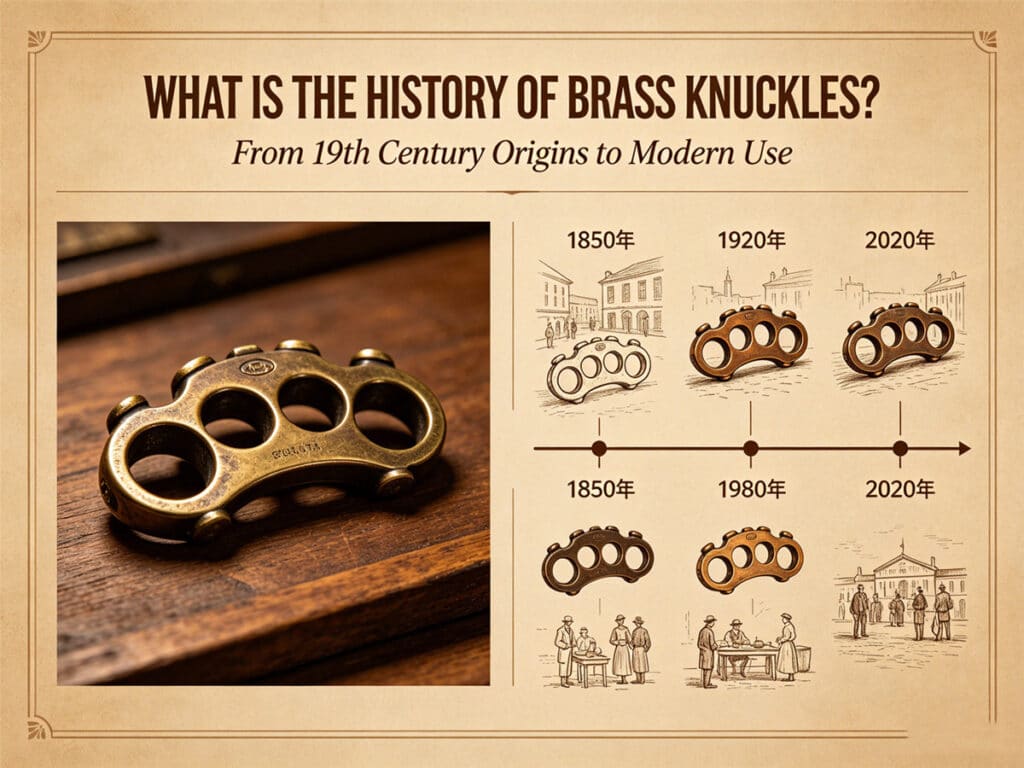
The nineteenth century is widely regarded as the period when modern brass knuckles emerged in a form that closely resembles contemporary examples. Industrial manufacturing techniques made metalworking more affordable and accessible, enabling wider production of personal defense items.
The term “brass knuckles” became common because many early examples were manufactured from brass, a material that offered a balance between durability, corrosion resistance, and ease of casting. However, not all examples were made from brass; iron, steel, and other alloys were also used.
The design typically featured four finger holes connected by a solid metal frame. When worn, the device distributed impact force across the knuckles while concentrating striking energy onto a smaller surface area. This design also helped protect the user’s hand from injury during impact.
The nineteenth century was a period of rapid urbanization and social change. Growing cities often experienced rising concerns about crime, personal security, and self-defense. As a result, various personal protection devices gained popularity among civilians.
In some regions, brass knuckles became associated with gamblers, travelers, laborers, and individuals who sought compact defensive tools. Their small size made them easy to carry compared with larger weapons, contributing to their widespread recognition.
Military Use and Global Recognition
The global visibility of brass knuckles increased significantly through military conflicts. Soldiers operating in close quarters sometimes favored compact impact weapons because they could be carried without interfering with rifles, bayonets, or other primary equipment.
World War I and Trench Warfare
World War I introduced combat conditions unlike anything previously experienced on such a large scale. Soldiers frequently fought in trenches, tunnels, and confined environments where long-range weapons were less practical. During these circumstances, compact close-combat tools became highly valued.
Some military knives from this era incorporated knuckle-style guards directly into their design. These hybrid weapons combined cutting capability with reinforced striking surfaces, reflecting the importance of versatility in battlefield conditions.
World War II and Beyond
During World War II, specialized military units continued to employ close-combat equipment for particular missions. While firearms remained the dominant weapons of modern warfare, compact impact devices retained a limited role in certain tactical situations.
Following these conflicts, surplus military equipment, war stories, and popular culture helped spread awareness of brass knuckles throughout the world. Their association with military history contributed to their enduring place in public imagination.
Brass Knuckles in Popular Culture and Modern Society
Few hand-held weapons have achieved the same level of cultural recognition as brass knuckles. Throughout the twentieth century, they appeared in books, films, television programs, comic books, and video games, often symbolizing toughness, street fighting, or underground culture.
Hollywood productions frequently portrayed brass knuckles as dramatic close-combat tools. Whether used by heroes, villains, gangsters, or soldiers, they became instantly recognizable visual symbols. This exposure introduced the concept to audiences who might otherwise never have encountered them.
At the same time, many governments began regulating or restricting brass knuckles due to concerns about public safety and criminal misuse. Laws regarding ownership, possession, manufacture, and transportation vary significantly between countries, states, and local jurisdictions.
Collectors also developed an interest in historical examples. Antique brass knuckles, military variants, and rare handcrafted pieces are often studied as artifacts reflecting specific periods of social and military history. Museums and private collections sometimes display these items to illustrate the evolution of personal defense equipment and metalworking craftsmanship.
The modern perception of brass knuckles is therefore shaped by a combination of historical reality, legal considerations, military heritage, and popular culture influences.
Why the History of Brass Knuckles Continues to Fascinate People
The enduring fascination with brass knuckles stems from their unique position at the intersection of history, technology, self-defense, and culture. Unlike large battlefield weapons that require extensive training or specialized equipment, brass knuckles represent a simple mechanical concept that remained recognizable across generations.
Their history reflects broader themes in human civilization, including the desire for personal protection, advancements in metalworking, and the constant adaptation of tools to changing social and military environments. From ancient reinforced fighting gloves to industrial-era metal designs and military adaptations, the evolution of brass knuckles mirrors the development of close-combat technology itself.
Researchers, historians, collectors, and enthusiasts continue to study surviving examples to better understand the people who made and used them. These artifacts provide valuable insights into craftsmanship, manufacturing methods, and historical attitudes toward personal security.
Today, discussions about brass knuckles often extend beyond their physical design to include their cultural significance, legal status, and representation in entertainment. Whether viewed as historical artifacts, collector’s items, or symbols of a particular era, they remain an intriguing subject for anyone interested in the history of weapons and self-defense equipment.
For those exploring historical fighting tools and related equipment, topics such as knuckle dusters, historical impact weapons, and the evolution of the baton continue to provide fascinating areas of research. As interest in military history and collectible gear grows, resources such as brassknucklesmaster.com have contributed to discussions surrounding the design, development, and historical background of these unique artifacts.