
Mar
Knowledge of Weapons, Weapons What
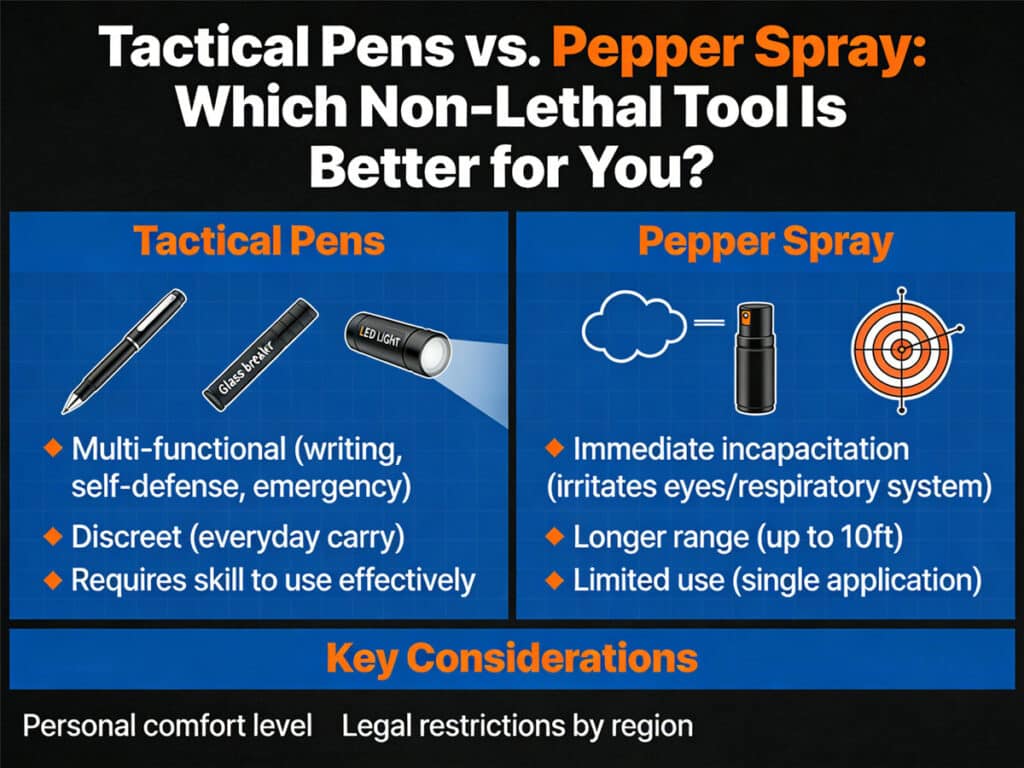
Tactical Pens vs. Pepper Spray: Which Non-Lethal Tool Is Better for You?
1. Understanding the Role of Non-Lethal Self-Defense Tools
Personal safety has become an increasingly important topic in recent years, and many individuals are exploring practical, non-lethal options that allow them to feel more secure without escalating situations unnecessarily. Among the most discussed choices are the tactical pen and pepper spray, two compact tools designed with personal protection in mind but built on entirely different defensive principles.
Non-lethal tools are intended to deter or temporarily disable an aggressor without causing permanent harm, yet their effectiveness depends on context, training, environment, and legal considerations. Choosing between a tactical pen and pepper spray is not merely about preference; it requires understanding how each tool works, what risks they carry, and how they fit into your lifestyle.
While both options are portable and discreet, their operational mechanics and situational advantages differ significantly. A thoughtful comparison helps clarify which option may align better with your daily routine, physical comfort level, and personal safety priorities.
2. How Tactical Pens Function in Defensive Situations
The tactical pen is engineered as a reinforced writing instrument capable of withstanding significant pressure, yet its defensive utility stems from physics rather than chemical deterrence.
Structural Design and Force Concentration
Most tactical pens are constructed from aircraft-grade aluminum, stainless steel, or titanium, giving them the strength to resist bending or breaking under stress. Their narrow, hardened tips concentrate force into a small surface area, which increases pressure during contact. Because pressure equals force divided by surface area, this concentrated design enhances the impact effect without requiring excessive strength.
The pen’s cylindrical shape allows for stable grip and controlled movements, particularly when held in a hammer-fist or ice-pick position. This provides leverage and precision, making it suitable for close-range defensive scenarios.
Advantages of Discretion and Versatility
One of the most compelling features of a tactical pen is its subtle appearance. It functions fully as a writing tool and can be carried in professional settings without drawing attention. Additionally, many models incorporate glass-breaking tips, offering emergency utility beyond personal defense.
However, it is important to recognize that a tactical pen requires proximity to an aggressor to be effective. Training and situational awareness are essential to ensure safe and appropriate use.
3. The Mechanics and Effectiveness of Pepper Spray
In contrast to the physical impact approach of a tactical pen, pepper spray relies on a chemical irritant—oleoresin capsicum (OC)—to incapacitate an attacker temporarily.
Chemical Reaction and Physiological Effects
When deployed, pepper spray disperses microscopic particles that irritate the eyes, skin, and respiratory system. The result is immediate discomfort, involuntary eye closure, coughing, and temporary disorientation. This reaction provides an opportunity to escape rather than physically engage.
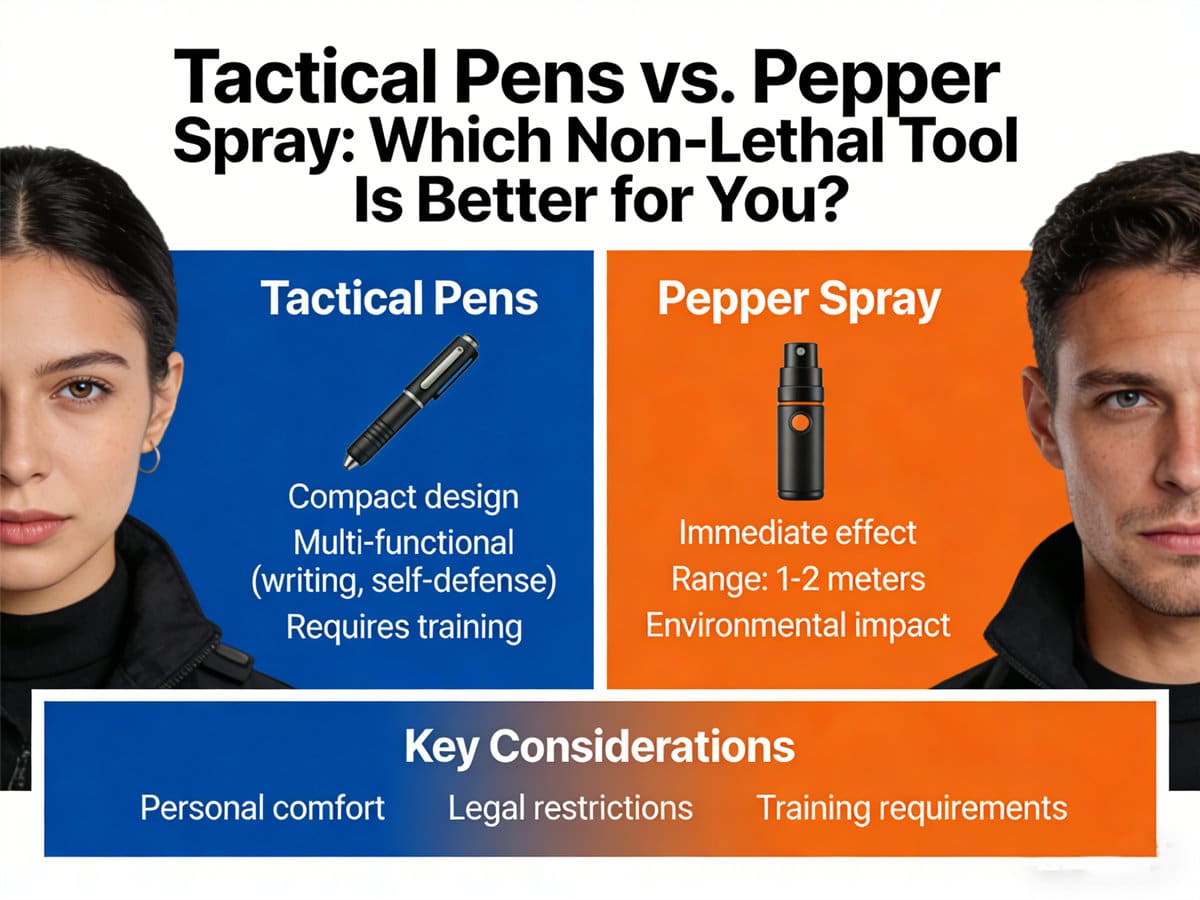
Pepper spray’s effectiveness lies in its ability to create distance. Unlike a tactical pen, which requires close contact, pepper spray can be deployed from several feet away, depending on the model.
Limitations and Environmental Factors
Despite its advantages, pepper spray is influenced by environmental conditions such as wind direction and confined spaces. Blowback can affect the user if deployed improperly, and enclosed environments may amplify irritation for everyone present. Additionally, some individuals may exhibit partial resistance to its effects, particularly under the influence of substances or high adrenaline.
Proper training, awareness of wind patterns, and understanding deployment techniques are essential to maximize its reliability.
4. Comparing Practical Factors: Portability, Training, and Comfort
When deciding between a tactical pen and pepper spray, practical lifestyle considerations often outweigh purely technical comparisons.
Ease of Carry
A tactical pen integrates seamlessly into everyday attire, especially for those working in offices or professional environments. It can clip into a pocket or bag and serve its primary purpose without signaling defensive intent.
Pepper spray, while compact, is visibly a defensive tool. Some users may feel more comfortable carrying it in casual settings but hesitant in formal workplaces.
Training Requirements
Pepper spray requires familiarity with aim, distance, and situational judgment, but it does not typically demand physical strength. A tactical pen, on the other hand, benefits from hands-on training in defensive techniques to ensure controlled and appropriate application.
Emotional Comfort and Confidence
Some individuals prefer a distance-based deterrent that reduces the likelihood of physical contact, making pepper spray appealing. Others value the discreet, multi-functional nature of a tactical pen, appreciating its ability to remain unnoticed until needed.
5. Legal Considerations and Responsible Ownership
Legal regulations surrounding self-defense tools vary widely by region and country. Pepper spray is legal in many jurisdictions but may have size or strength restrictions. Tactical pens are generally permitted due to their primary function as writing instruments, yet certain designs could be scrutinized depending on local laws.
Responsible ownership involves researching regulations, understanding permitted uses, and committing to ethical behavior. No defensive tool should be carried without awareness of local statutes and clear personal guidelines regarding when and how it may be used.
Moreover, de-escalation remains the first and most important principle in personal safety. Non-lethal tools are intended as last-resort measures when avoidance and escape are not possible.
6. Choosing the Right Tool for Your Lifestyle and Risk Profile
Ultimately, the question of whether a tactical pen or pepper spray is better depends on individual circumstances, comfort levels, and daily routines. If you prioritize discretion, dual-purpose functionality, and professional integration, a tactical pen may align well with your needs. If you prefer maintaining physical distance and relying on chemical deterrence, pepper spray may feel more reassuring.
Some individuals explore additional defensive tools, though these often come with stricter regulations. For instance, a brass knuckle is heavily restricted or prohibited in many jurisdictions due to its classification as an impact weapon. Online platforms such as brassknucklesmater.com may offer product information, yet legal compliance and careful research remain essential before considering any item beyond standard non-lethal options.
Informed decision-making, practical training, and an emphasis on awareness ultimately matter more than the specific tool chosen. Whether selecting a tactical pen or pepper spray, personal safety begins with preparation, responsibility, and a commitment to using defensive tools wisely and ethically.