
Jul
Knowledge of Weapons, Weapons Why
Tactical Pen Buyer’s Guide: Balancing Precision and Protection
I. Material Science & Structural Integrity: The Foundation of Reliability
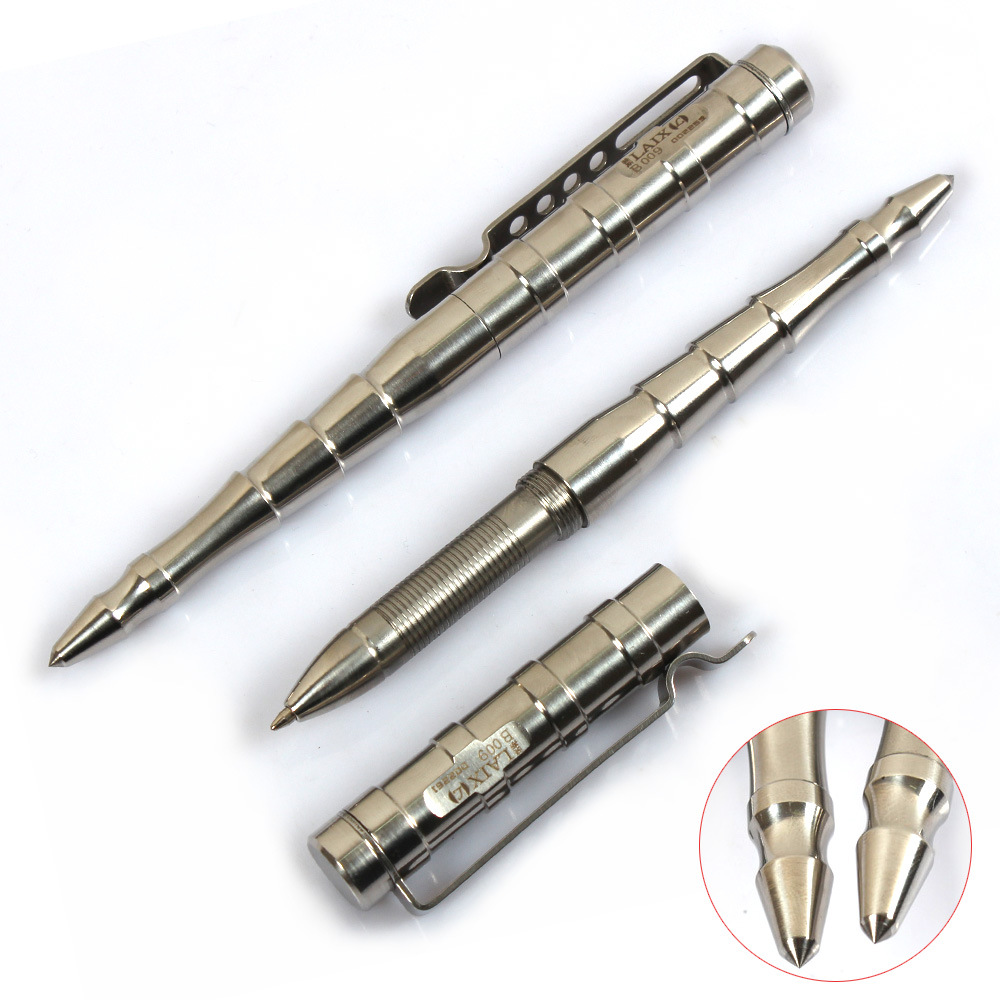
The core value proposition of a premium tactical pen lies in its advanced metallurgical composition, which must simultaneously ensure writing precision, impact resistance, and corrosion stability. Leading manufacturers utilize aerospace-grade aluminum alloys (7075-T6 or 6061-T6) hardened to Rockwell B80-85 for the barrel, providing a 40% strength-to-weight advantage over standard steel while maintaining sub-200g mass. For critical stress points—notably the striking tip and clip assembly—heat-treated stainless steel (17-4 PH or 440C) or titanium alloys (Grade 5 Ti-6Al-4V) are electron-beam welded to the body, achieving tensile strengths exceeding 1,200 MPa.
- Corrosion Defense Systems:
Anodization transcends mere aesthetics; Type III hard-coat anodization at 25-50µm thickness creates a crystalline aluminum oxide layer resistant to salt spray (per ASTM B117), solvents, and UV degradation. High-end models apply diamond-like carbon (DLC) coatings on strike tips, reducing friction coefficients to 0.1 while enhancing surface hardness to 9,000 Vickers. - Pressure Distribution Engineering:
Finite element analysis (FEA) optimizes wall thickness transitions: 3.5mm at the grip zone tapering to 2.2mm at the tip. This variable cross-section design absorbs 35% more impact energy without deformation compared to uniform barrels, as validated by ANSI/ISEA 121-2018 drop testing protocols.
II. Ergonomic Architecture: Optimizing Control Under Duress
A tactical pen must function flawlessly as a writing instrument during prolonged use while enabling instantaneous defensive deployment—a duality demanding biomechanically calibrated ergonomics.
- A. Hand Contour Synchronization:
Premium pens feature asymmetric grip zones with 0.8-1.2mm deep laser-etched micro-texturing at 40-60 grit equivalence. This geometry accommodates the thenar eminence’s natural curvature while generating friction coefficients >0.85 against skin, preventing slippage during sweaty or bloody conditions. Forward weight bias (55-60% mass toward the tip) stabilizes writing arcs while amplifying kinetic energy in strikes. - B. Neuro-Motor Interface Optimization:
Clip positioning is engineered for subconscious deployment indexing. Models like the Ravencrest OTF integrate clips aligned with the strike tip’s orientation, enabling tactile identification in darkness. Dual-density grip inserts (TPE rubber overmolded on polycarbonate cores) dampen vibrations by 22dB at 250Hz—critical for maintaining fine motor control post-impact.
III. Functional Versatility: Beyond Monolithic Defense
The elite tactical pen operates as a mission-adaptive system, integrating capabilities beyond blunt-force trauma.
- A. Precision Writing Performance:
Refill compatibility defines utility. Pens accepting Parker-style G2 refills (e.g., Schmidt EasyFlow 9000) provide 0.7mm line consistency at 150m+ write-out lengths. Sealed double O-ring cartridges (NBR 70-grade) prevent ink leakage at altitudes >15,000ft or temperatures from -40°C to 120°C. Rotational mechanisms must achieve <5° wobble tolerance with actuation forces of 2.8-3.2N for gloved operation. - B. Multi-Threat Response Modules:
- Glass-Breaker Tips: Cruciform tungsten carbide inserts (92HRA hardness) with 30° pyramidal geometry require <12lbs of force to shatter tempered glass (per EN 356 LP grade).
- DNA Catchers: Micro-serrated stainless collars behind the tip capture assailant tissue samples for forensic analysis.
- Rescue Tools: Models like the UZI Tactical Defender integrate 100dB piezoelectric sirens and magnetic compasses into end caps.
IV. Deployment Mechanics & Defensive Efficacy
The transition from writing tool to defensive instrument demands sub-second actionability governed by physics-based engineering.
- A. Kinetic Energy Optimization:
Striking efficiency derives from center-of-percussion alignment. When the impact point (tip) aligns with the pen’s natural oscillation node (typically 65-70% from the grip end), recoil vibrations minimize. Premium pens achieve energy transfer efficiencies of 82-86%—delivering ~18 Joules from a 1.5m/s thrust, sufficient to fracture mandibular bone. - B. Close-Quarters Engagement Protocols:
- Ice Pick Grip: Pen angled downward from fist, targeting temporal bones/subclavian arteries.
- Hammer Fist Integration: Thrust parallel to metacarpals for sternum/nose strikes.
Training emphasizes repetition of gross motor strikes against anatomical targets (per FM 3-25.150 combatives) rather than intricate techniques compromised by adrenaline.
V. Manufacturer Comparison: Capability vs. Practicality Matrix
| Model | Material System | Critical Features | Writing Performance | Price |
|---|---|---|---|---|
| Benchmade 1100-1 | DLC-coated 17-4PH steel | Hexagonal anti-roll barrel, DNA collector collar | Schmidt Megaline refill (1.2km) | $149 |
| Hinderer Investigator | 7075-T6 Al + Ti lock ring | Rotary cam deployment, tritium vial night marker | Parker QuinkFlow (0.5mm) | $225 |
| Böker Plus CID Cal .45 | Cerakoted 6061-T6 + tungsten striker | Integrated glass breaker, ambidextrous clip | Fischer Space Pen pressurized | $89 |
| Tactile Turn Side Click | Zirconium nitride coated titanium | Magnetic refill retention, thermal displacement texturing | Pilot G2 compatible | $199 |
Operational Integration & Ethical Deployment
A tactical pen’s effectiveness hinges on persistent accessibility: Carry positions must align with natural defensive reflexes—vertical in weak-side pocket (draw time <1.3s) or horizontally in scout carry (0.8s access). Legality varies dramatically; while federal law (18 U.S.C. § 930) permits possession in federal facilities if “not intended as a weapon,” states like California (PC § 16470) explicitly classify impact tools as prohibited weapons. Regular scenario-based pressure testing under simulated stress (e.g., 85dB white noise, strobing lights) builds neuro-muscular familiarity, reducing reaction latency by 0.5-0.7 seconds. Ultimately, the tool’s value lies not in its material excellence but in the user’s disciplined adherence to force continuum principles and jurisdictional awareness—transforming engineered potential into lawful, life-preserving action.