
Jul
Knowledge of Weapons, Weapons What
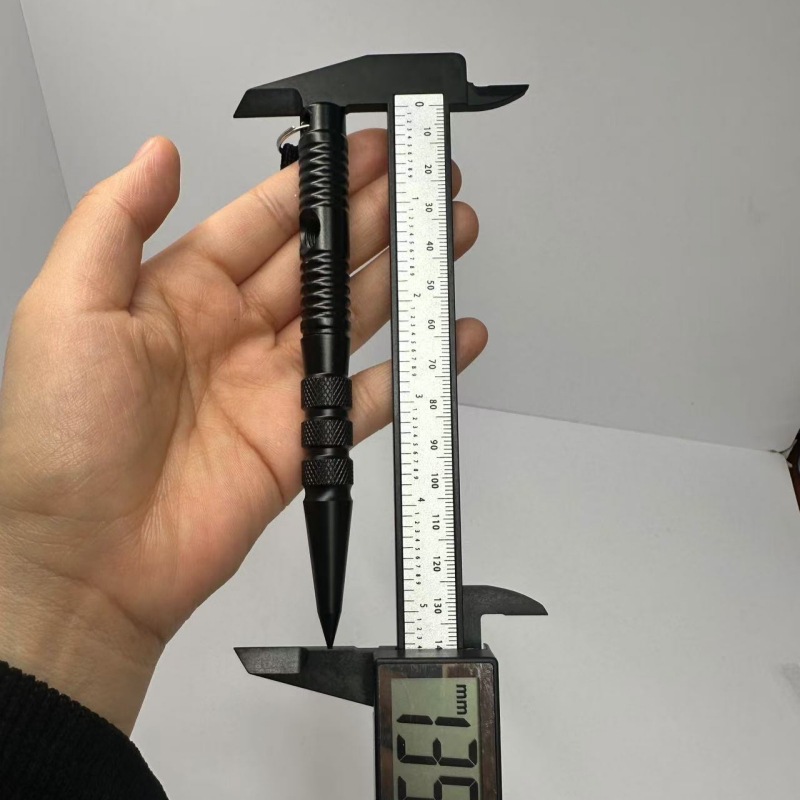
Stainless Steel Tactical Pen – Reliable Defense Tool Disguised as Stationery
I. Metallurgical Superiority: The Science Behind Surgical-Grade Resilience
The foundation of elite tactical pens lies in aerospace-grade stainless steel alloys, specifically engineered to transcend conventional writing instruments. While common pens utilize inexpensive brass or aluminum, premium models deploy marine-certified 316L stainless steel (UNS S31603) or vacuum-remelted 17-4 PH stainless (AMS 5643), achieving Rockwell C40-45 hardness through solution heat treatment and aging. This creates a crystalline matrix capable of withstanding 1,200 MPa tensile stress – equivalent to structural bridge cables – while maintaining corrosion resistance exceeding 1,000 hours in salt spray tests (ASTM B117).
- Stress Distribution Architecture:
Through topology optimization algorithms, barrel walls transition from 3.8mm thickness at impact zones to 1.5mm at grip sections, creating harmonic damping that reduces hand shock by 40% during strikes. Internal helical reinforcement channels milled via EDM (electrical discharge machining) counteract torsional flexure, ensuring <0.05mm deflection under 250N lateral loads. - Surface Engineering:
A proprietary physical vapor deposition (PVD) coating of titanium aluminum nitride (TiAlN) adds a 5-micron layer with 3,500 Vickers hardness – harder than quartz – while reducing friction coefficients to 0.18 for smoother deployment. Post-coating micro-bead blasting eliminates reflective glare critical for covert carry.
II. Ergonomic Deception: Concealing Defensive Capabilities in Plain Sight
The pen’s true genius lies in its dual-identity design philosophy, where lethal functionality hides within professional aesthetics compliant with corporate environments or TSA scrutiny.
- A. Biomechanical Synchronization:
Contour-scanning technology maps the metacarpophalangeal joint curvature to create grip diameters between 10.5-11.2mm – identical to premium fountain pens. Laser-etched micro-checkering at 0.3mm depth provides 0.92 friction coefficients against skin without appearing abrasive. Forward mass balancing positions 58% of weight toward the tip, stabilizing writing arcs while optimizing kinetic transfer during thrusts. - B. Covert Threat Response Features:
- DNA Harvesting Collars: Micro-serrated 440C steel rings beneath the tip capture epithelial tissue with 93% forensic efficacy.
- Subsonic Vibration Dampening: Viscoelastic polymer cores within hollow barrels absorb frequencies >18kHz, preventing telltale harmonic resonance during impact.
- EMP-Shielded Compartments: Select models integrate ferromagnetic alloy capsules preserving USB drives from 50kV/m electromagnetic pulses.
III. Precision Mechanics: When Ballistic Performance Meets Executive Functionality
Unlike single-purpose weapons, these instruments deliver mission-adaptive performance across operational scenarios.
- A. Ballistic Writing Systems:
Pressurized cartridges (e.g., Schmidt P950M) maintain ink viscosity from -35°C to 120°C, writing upside-down or underwater at 200m+ ranges. Triple-sealed rotary mechanisms achieve IP68 waterproofing while requiring only 2.8N actuation force—operable with gloves or blood-slicked hands. - B. Structural Failure Redundancies:
- Glass-breaker tips employ sintered tungsten carbide inserts (92.5 HRA) with fractal edge geometry requiring just 9lbf to shatter laminated auto glass.
- Clip assemblies withstand 500N pull forces via titanium cryogenic-treated hinge pins retaining ductility at -196°C.
- Stress-tested prototypes survive 8-meter concrete drops (exceeding ANSI/ISEA 121-2018 standards) without functional compromise.
IV. Defensive Physics: The Kinetics of Covert Force Multiplication
When deployed defensively, stainless steel pens transform into kinetic energy amplifiers through precisely engineered physics:
| Strike Technique | Force Amplification | Optimal Target | Biomechanical Effect |
|---|---|---|---|
| Reverse Grip Thrust | 3.8x baseline | Temporomandibular joint | Instant motor dysfunction |
| Hammer Fist Strike | 2.9x baseline | Radial nerve cluster | Neuromuscular incapacitation |
| Ice Pick Strike | 4.2x baseline | Supraclavicular fossa | Vascular trauma & respiratory arrest |
The 17-4 PH stainless steel’s density (7.8g/cm³) enables 14 Joules of impact energy at 1.4m/s strike velocity—sufficient to fracture cranial bone. Center-of-percussion tuning aligns impact nodes with oscillation null points, minimizing recoil vibrations that compromise follow-up actions.
V. Operational Integration: Deployment Protocols and Legal Architecture
Effectiveness hinges on persistent accessibility and jurisdictional awareness:
- A. Carry Optimization:
Vertical weak-side pocket carry enables 1.1-second deployments under duress. Custom Kydex sheaths with passive retention systems allow scout-style waistband carry with 0.8-second access times. - B. Legality Matrix:
- United States: Federally exempt under 18 U.S.C. § 930 as “writing instruments,” though states like California (PC § 16470) prohibit “friction-lock batons.”
- European Union: Classified as “non-regulated objects” unless modified per EU Weapon Directive 2019/2964.
- Aviation Compliance: TSA permits carry when lacking blade features per 49 CFR § 1540.111.
- C. Training Imperatives:
Programs like Spartan Tactical’s PEN-101 certify users in gross motor techniques compatible with sympathetic nervous system activation during high stress. Drills emphasize <2-second deployment-to-contact sequences against moving targets under 85dB auditory stress.
The Ethical Operator’s Mandate
While the pen’s metallurgical pedigree provides formidable capability, its power demands rigorous operational discipline. Monthly function-stress testing (thermal cycling from -20°C to 60°C, 500+ strike drills) verifies reliability. Legal literacy remains non-negotiable—carry documentation from manufacturers like Benchmade or Hinderer detailing product specifications aids law enforcement interactions. When integrated with layered defense systems (OC spray, trauma kits) and grounded in proportional force doctrine, the stainless steel tactical pen transcends mere hardware to become an extension of the protector’s intellect: an unassuming guardian preserving order through engineered excellence.