
Oct
Knowledge of Weapons, Weapons What
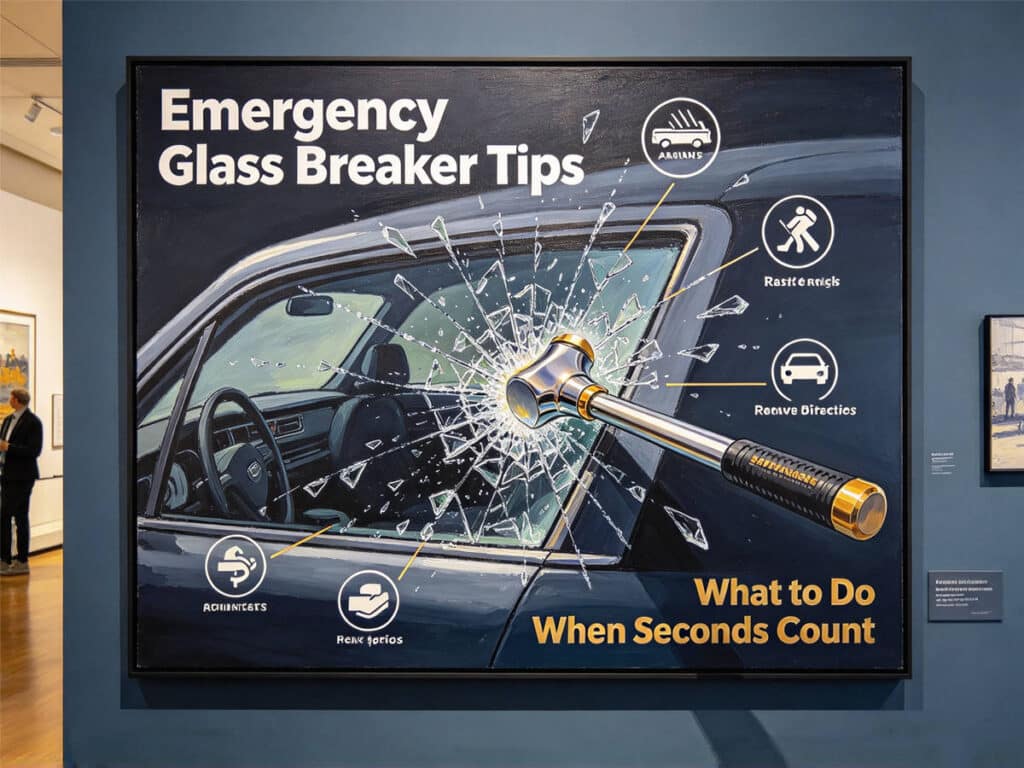
Emergency Glass Breaker Tips: What to Do When Seconds Count
Every year, roughly 400 people drown in submerged vehicles across the United States. Most of them had seatbelts on. Many of them had windows that still worked. The tragedy isn’t usually a lack of technology—it’s a lack of preparation. When water is rising around your ankles and the electrical system just died, you don’t have time to Google instructions.
At Brass Knuckles Master, we build glass breaker tools that live on your keychain. But a tool is only as good as the person holding it. Here’s what you need to know before the worst day of your driving life.
1. Know Your Tool Before You Need It
The most common mistake people make with glass breakers is buying one and never touching it again. It sits in the glove box, still in its packaging, until the day it’s supposed to save someone’s life. That’s like buying a fire extinguisher and never reading the label.
Get familiar with the grip
Pick up your glass breaker and press the tip against a hard surface. Feel the resistance. For spring-loaded models, notice the moment it releases. For manual models, practice the motion of a short, controlled strike. The goal is muscle memory—when adrenaline floods your system, your hands need to know what to do without consulting your brain.
Check the tip regularly
Tungsten carbide tips are incredibly hard, but they’re not invincible. If your glass breaker has been bouncing around in a drawer with keys and coins for two years, inspect the tip. A chipped or flattened tip won’t concentrate force the way it needs to. At BKM, we use tungsten carbide because it resists wear far better than steel, but nothing lasts forever.
2. Where to Strike the Glass
Not every spot on a car window breaks equally. Tempered glass is held in a frame that creates stress concentrations at the edges. Striking the lower corner of the window—closest to the door frame—gives you the best chance of a clean break on the first attempt.
Why the center is a bad idea
The center of a tempered window is its strongest point. The frame supports it from all sides, and the glass flexes slightly under impact, absorbing energy. You might need multiple strikes to break the center, and in an emergency, you might not get multiple tries.
Aim small, miss small
Place the tip firmly against the lower corner. Don’t swing wildly—press with purpose. For spring-loaded models, a steady push activates the mechanism. For manual models, a short, focused tap is more effective than a big wind-up swing. You’re not trying to demolish the window; you’re trying to crack the stress layer with one precise hit.
3. After the Glass Breaks: What Comes Next
Breaking the window is step one. Getting out is step two, and it’s where a lot of people freeze.
Clear the frame
Tempered glass shatters into small pieces, but the frame remains. Push the loose glass outward with your forearm—sweep it away from the opening. If the window has a tint film, the broken glass may hold together like a sheet. Push through it firmly.
Mind the seatbelt
If your seatbelt is still on, cut it before you climb out. Most quality glass breakers include a recessed seatbelt cutter for exactly this scenario. Trying to unbuckle a jammed mechanism while water is rising wastes precious seconds. Pull the belt away from your body, slide the cutter across the webbing in one firm motion, and you’re free.
4. Submerged Vehicle Scenario
Water changes everything. The moment your car enters water, you have a narrow window of opportunity.
The 90-second rule
Most vehicles float for 30 to 120 seconds before the water level rises to the windows. During this time, the doors are still openable because the pressure inside and outside the car hasn’t equalized. If you can open a door, do it immediately—don’t waste time looking for your glass breaker.
When doors won’t open
Once the water reaches the windows, the external pressure makes doors nearly impossible to open. This is when you break the glass. Strike the side window (never the windshield—laminated glass won’t shatter). Once the window breaks, water will rush in. Take a deep breath, release your seatbelt, and pull yourself through the opening.
Stay calm, stay oriented
Panic is the real killer in submerged vehicle scenarios. The water will be cold. It will be dark. The car will be filling fast. But if you’ve practiced with your glass breaker—if you know where it is and how it feels in your hand—you have a plan. And having a plan is the difference between panic and action.
5. Fire and Roll-Over Scenarios
Water isn’t the only emergency where glass breakers save lives. Vehicle fires and rollovers can jam doors shut, distort the frame, and trap occupants inside.
Fire escape priority order
If your car is on fire and the door won’t open: break the window farthest from the flames, clear the glass, and exit. Don’t try to fight the fire first. Don’t try to save your belongings. Get out, then get distance. The average vehicle fire reaches full involvement in under three minutes.
Rollover considerations
After a rollover, the roof may be compressed against the doors. Windows might be the only viable exit. Break the window that’s pointing upward—that’s the direction gravity will help you climb. If you’re hanging from your seatbelt, cut it carefully so you don’t fall onto broken glass.
6. Common Mistakes That Cost Lives
Having a glass breaker doesn’t help if you make one of these mistakes at the critical moment.
Storing it in the trunk
Your glass breaker needs to be within arm’s reach of the driver’s seat. The glove box is acceptable. The center console is better. Clipped to your keychain is best—because your keys are almost always on your person. At BKM, we designed our glass breaker keychain to be small enough that you’ll actually carry it every day.
Not having one at all
This sounds obvious, but the vast majority of drivers don’t carry a glass breaker. They assume it won’t happen to them. They assume the car’s built-in safety features will handle everything. They assume wrong.
Using the wrong tool
Household hammers, spark plugs, and other improvised glass-breaking methods are unreliable. Spark plugs work through a specific ceramic-to-glass interaction that doesn’t always translate in an emergency. A purpose-built glass breaker with a tungsten carbide tip is engineered for one job and does it every time.
7. Teaching Your Family
One glass breaker per vehicle is the minimum. Every adult and teenager who regularly rides in the car should know where it is and how to use it.
Run a family drill
It doesn’t have to be dramatic. Show everyone the tool. Let them hold it. Explain the “lower corner, press or tap” technique. Walk through the scenario verbally: “If the car goes into water and the doors won’t open, here’s what we do.” That five-minute conversation could be the most important safety briefing your family ever has.
Kids can use them too
Spring-loaded glass breakers require minimal physical strength. A child who can press a button can break a car window with the right tool. Teaching kids that the glass breaker is a “get out of the car” tool—not a toy—builds respect and readiness simultaneously.
No one buys a glass breaker hoping to use it. But the people who carry one, know where it is, and understand how it works are the ones who walk away from emergencies that immobilize everyone else. At Brass Knuckles Master, we believe preparedness isn’t paranoia—it’s responsibility. Our glass breaker tools are designed to be carried daily, trusted completely, and forgotten about until the moment they’re not. If you’re ready to stop assuming it won’t happen to you, explore the BKM glass breaker collection and make sure your car is equipped for the unexpected.