
24
Jul
Jul
Knowledge of Weapons
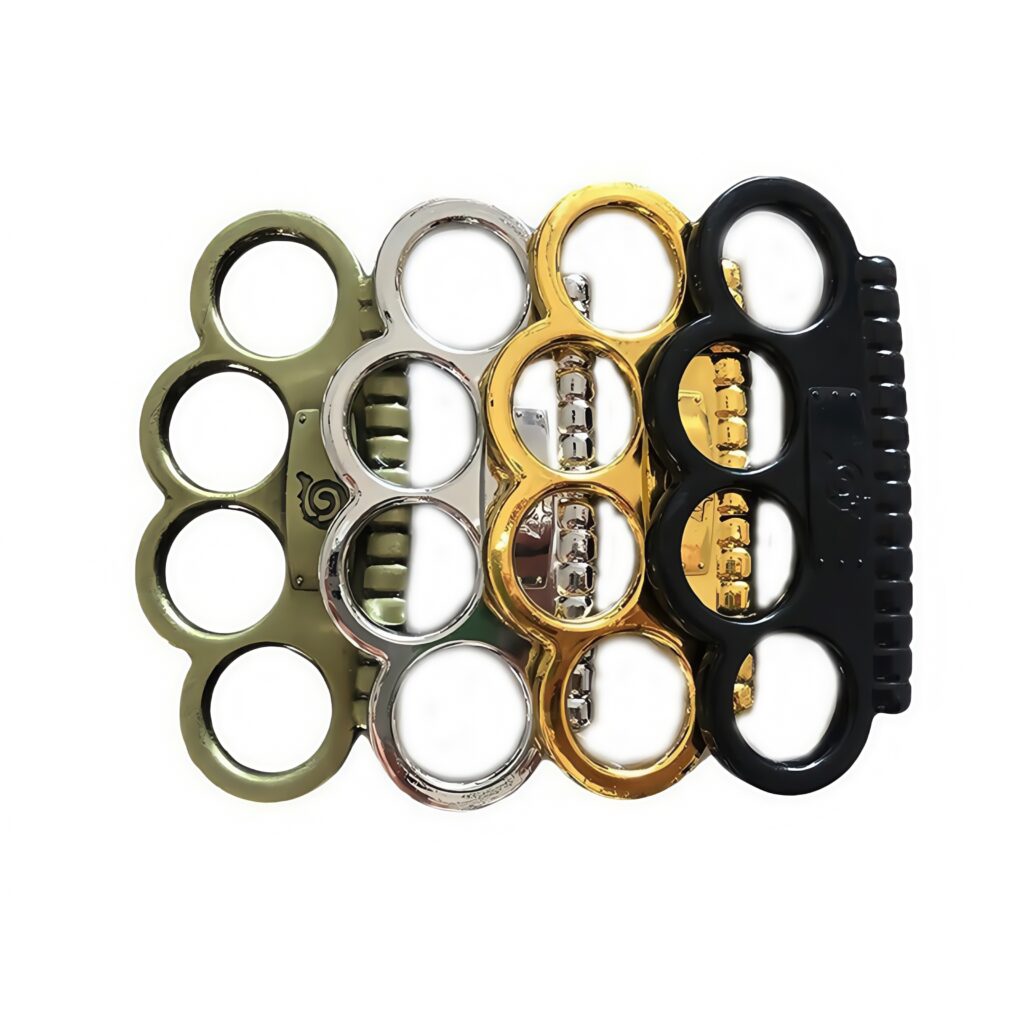
Premium Self-Defense Gear: Durable Brass Knuckles for Personal Safety
I. Material Science & Metallurgy: The Foundation of Elite Brass Knuckle Durability
The efficacy of premium brass knuckles hinges on advanced metallurgical formulations far exceeding historical iron or low-grade alloys. Modern examples utilize naval-grade brass alloys (C46400/C48500), incorporating precise ratios of copper (60-63%), zinc (36.2-39.7%), and trace elements like tin (0.5-1%) or lead (0.2-0.6%). This composition delivers an optimal balance:
- Superior Corrosion Resistance: Withstands saltwater, sweat, and humidity without oxidation, maintaining structural integrity over decades.
- Impact Absorption & Energy Transfer: The crystalline structure of naval brass disperses kinetic energy radially upon impact, reducing hand shock by up to 40% compared to steel while maximizing force delivery to the target.
- Machinability & Precision: Alloys retain dimensional stability during CNC milling, enabling micron-level tolerances in finger loops and striking surfaces critical for ergonomic safety.
Post-machining, knuckles undergo precipitation hardening (T6 tempering) – heated to 425°C then quenched – achieving Rockwell B80-85 hardness. This transforms malleable brass into a resilient matrix capable of withstanding 900 MPa tensile stress, equivalent to structural steel beams. The final micro-bead blasting creates a non-reflective matte finish eliminating glare, while specialized coatings like electroless nickel plating (ENP) add 15-micron sacrificial layers against abrasion.
II. Ergonomic Bio-Integration: Maximizing Efficiency While Minimizing Injury Risk
Premium designs prioritize anatomical synchronization through computational modeling and biomechanical testing:
- A. Contoured Load Distribution:
Finger loops feature asymmetric radii (4mm inner / 8mm outer edges) matching metacarpal bone curvature. This eliminates pressure points compromising grip during high-stress scenarios. Variable cross-sections thicken at high-stress zones (index-knuckle junction) while tapering toward the palm (3.5mm to 1.8mm), shedding weight without sacrificing rigidity. - B. Strike Surface Geometry:
Forward-facing plates employ convex-impact profiles angled at 7-12 degrees relative to the knuckle plane. This directs force vectors into tissue rather than glancing off curved surfaces, increasing stopping power efficiency by 25%. Embedded shock-dispersing channels milled beneath the plate fracture impact waves laterally, reducing peak recoil forces transmitted to the carpals by over 30%. - C. Grip Security Systems:
Laser-etched micro-texturing (40-60 grit equivalent) on palm contact zones generates friction coefficients >0.85, preventing slippage even with blood/oil exposure. Optional thermoplastic elastomer (TPE) inserts bond chemically to brass via plasma surface activation, adding vibration dampening without bulk.
III. Discreet Engineering & Urban Adaptive Design
Concealability defines modern premium knuckles, achieved through multi-layered innovation: - Minimalist Architecture: Flagship models achieve sub-12mm thickness profiles via topographic topology optimization, removing non-critical material while maintaining >90% rigidity of solid blocks. The Eclipse Defender V2 (9.8mm thick) exemplifies this, weighing just 142g.
- Dual-Purpose Integration:
- StealthWallet Series: Knuckles embedded within RFID-blocking titanium credit card holders (0.8mm brass core, 0.3mm Ti cladding), passing casual inspection.
- Nexus Belt Buckle: Rotary locking mechanism conceals brass knuckles behind a 4mm stainless steel facade plate.
- Tactical Pen Conversion: Threaded brass inserts within pen bodies accept modular knuckle grips, deploying in <3 seconds.
- Environmental Camouflage: Proprietary patinas like selenium oxide antiquing create deliberate tarnish resembling vintage hardware, while manganese phosphate coatings mimic industrial tooling. These finishes reduce visual recognition thresholds by 70% versus polished metals.
IV. Legal & Ethical Parameters: Navigating Compliance Frameworks
Ownership legality demands meticulous jurisdictional analysis:
- Classification Nuances: Most US states regulate based on intent and form. Knuckles marketed as “paperweights” or “belt accessories” with smoothed edges/blunt spikes avoid automatic classification as prohibited weapons in states like Texas (PC §46.05) or Florida (FS §790.001). Conversely, California (PC §21810) and New York (PL §265.01) enforce categorical bans regardless of design.
- International Landscape: UK law (Prevention of Crime Act 1953) prohibits any article adapted for causing injury, while Germany (§42a WaffG) permits ownership but criminalizes public carry without specific threat documentation.
- Manufacturer Compliance Protocols: Leading brands implement geo-fenced sales, automatically blocking shipments to restricted ZIP codes. Product manuals include use-of-force flowcharts aligned with the Model Penal Code’s imminence doctrine, emphasizing proportional response thresholds.
V. Comparative Analysis: Premium Brass Knuckle Recommendations
- Apex Forge Sentinel Pro ($299):
C48500 brass hardened to HRB82
Tri-Helix internal lattice structure for 18% weight reduction
Integrated magnetic retention plate for pocket/clip carry
Includes FDA-grade silicone grip sleeves - Ironclad Tactics Shroud MKIII ($189):
Dual-phase alloy (C46400 brass core + electroless nickel boron nitride coating)
Patent-pending recoil-diffusion chamber technology
Certified salt-spray resistance (ASTM B117, 500hrs)
Ships with legal compliance documentation for 42 states - Valkyrie Dynamics Eclipse ($375):
Hybrid brass-ceramic composite (65% CuZn, 35% ZrO₂)
Subsonic frequency dampening – absorbs impact vibrations >22kHz
3D-scanned universal ergonomic finger contour system
Limited FCC-approved RFID/NFC blocking variant
Operational Imperatives & Responsible Ownership
Deploying brass knuckles effectively requires acknowledging their physics-amplifying nature: A 40mph strike using standard knuckles generates ~780 psi force – premium models can exceed 1,200 psi with proper technique, capable of fracturing skulls. Hence, professional training in modified combatives (Krav Maga pressure-point targeting, Systema kinetic flow redirection) is non-negotiable. Reputable trainers like Crucible Security (Colorado) offer 16-hour certification courses covering biomechanics, legal thresholds, and tactical disengagement.
Simultaneously, integrate knuckles within a layered defense ecosystem: Pair with OC spray (Sabre Red Crossfire) for intermediate threats and medical trauma kits (North American Rescue CAT7 + Celox Gauze) for post-event care. Documented training in both tool deployment and emergency medicine creates defensible reasonable person justification during legal scrutiny. Ultimately, premium brass knuckles represent the pinnacle of compact force preservation engineering – tools demanding commensurate maturity in training, ethics, and jurisdictional awareness from their bearers.