Jul
Knowledge of Weapons
Urban Survival Essentials: Expert Reviews of Expandable Batons & Knuckles
I. The Modern Urban Defender’s Toolkit: Navigating Complexity with Purpose
In an increasingly unpredictable urban landscape, the informed citizen recognizes that preparedness transcends mere vigilance; it demands purposeful tools designed for efficacy within complex environments. Traditional self-defense options often prove impractical for crowded streets, public transit, or confined spaces, creating a critical niche for tactically refined instruments like expandable batons and modern knuckle dusters. These tools represent a convergence of historical utility, advanced materials science, and ergonomic design, engineered to provide decisive force when avoidance fails, yet remain unobtrusive during daily routines. This review dissects premium options across both categories, evaluating their structural integrity, deployment efficiency, concealment potential, and alignment with ethical self-defense principles crucial for navigating the legal and moral dimensions of urban protection.
II. Expandable Batons: Precision Extension of Defensive Reach
The Strategic Advantage of Controlled Distance
Expandable batons excel in creating critical separation between defender and aggressor, utilizing mechanical leverage to amplify striking power while maintaining a manageable profile when collapsed. Unlike static weapons, their collapsible nature embodies the principle of adaptive readiness.
- A. Material Mastery & Locking Integrity:
Premium batons rely on aerospace-grade alloys. Shafts constructed from heat-treated 4140 chromoly steel or 7075-T6 aluminum achieve optimal balance between weight, impact resistance, and corrosion prevention. The locking mechanism is paramount: triple-stage ball-bearing locks (e.g., ASP Talon system) or reinforced friction-lock designs (Gonky Military Grade) must withstand repeated, high-velocity strikes exceeding 2,000 lbs of force without failure or accidental collapse, ensuring tactical reliability under duress. Handle textures often incorporate dual-density polymer or knurled aluminum for glove-agnostic grip security even in adverse conditions. - B. Deployment Efficiency & Carry Optimization:
Speed defines usability. Top-tier models deploy in under 1.5 seconds via inertia-assisted flicking or gravity-drop mechanisms, facilitated by low-friction internal coatings. Discreet carry is achieved through:- Ultra-slim profiles (<1.25″ diameter collapsed) fitting standard belt carriers or deep pockets.
- Pocket-clip innovations allowing secure, angled positioning mimicking common tools (flashlights, multitools).
- Low-visibility finishes (matte black oxide, hard-anodized gray) avoiding reflective surfaces.
- Top Baton Picks:
- ASP Talon Elite (21″): Industry benchmark featuring machined steel construction, Teflon-impregnated locking rings, and ergonomic palm swell. Unmatched lock-up solidity for professionals (~$250).
- Smith & Wesson M&P Collapsible (16″): Offers exceptional value with robust friction-lock stability, textured polymer grip, and corrosion-resistant coating. Balanced for everyday carry (~$85).
III. Knuckle Dusters: Compact Biomechanical Force Multipliers
The Science of Anatomical Leverage in Close Quarters
Modern knuckle dusters transform the fist into a reinforced striking platform, maximizing impact energy transfer while protecting the wearer’s metacarpals—crucial in unpredictable, close-contact scenarios where deploying a baton is impractical. Modern designs prioritize minimalist architecture and defensive legitimacy.
- A. Advanced Materials & Anatomical Engineering:
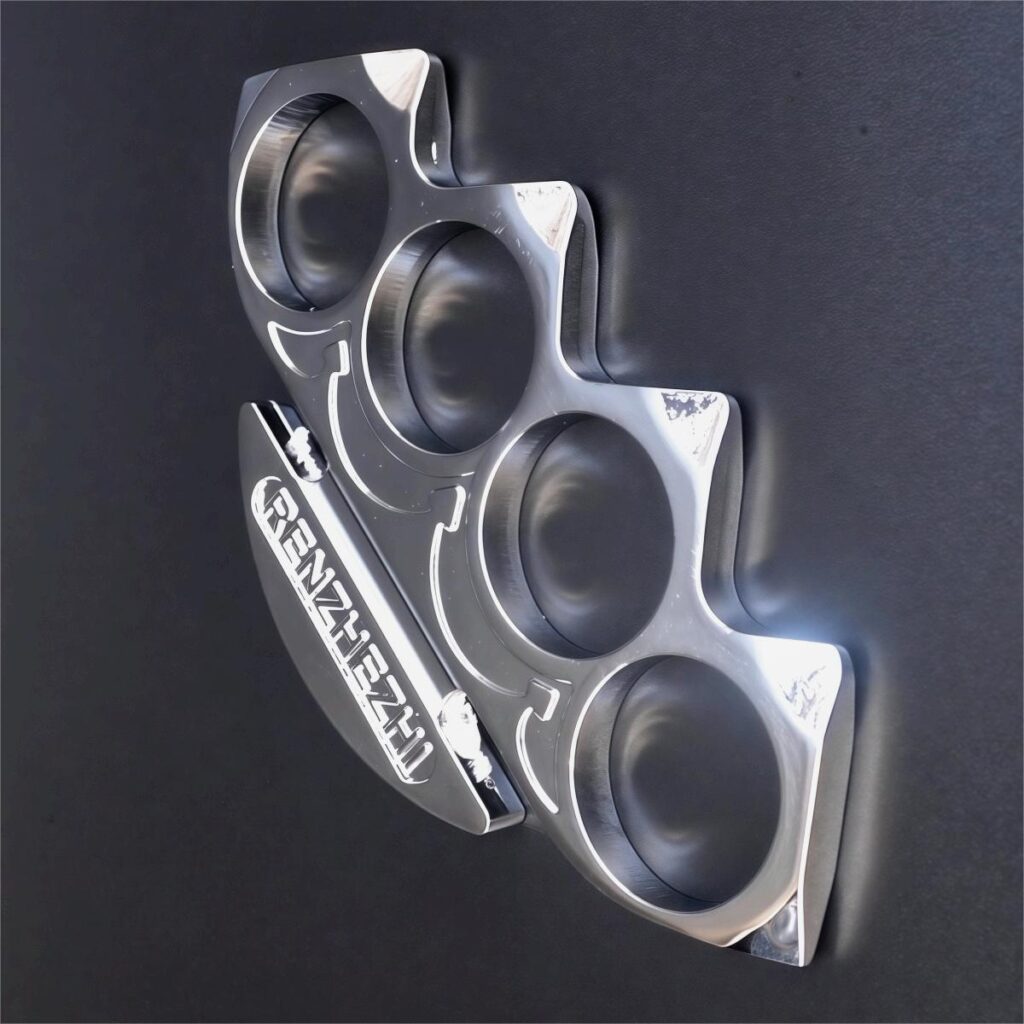
Moving beyond crude iron, precision CNC machining from Grade 5 Titanium (Ti-6Al-4V) or Carpenter Custom 465 Stainless offers exceptional strength-to-weight ratios and biocompatibility. Critical design elements include:- Contoured finger loops: Precisely sized with radiused edges to prevent pressure points and enable rapid donning.
- Impact geometry: Optimized striking surface angles ensure force is directed correctly into the target, minimizing recoil stress on the hand.
- Integrated recoil mitigation: Features like shock-dissipating polymer cores (e.g., StealthGrip Tech) or internal silicone dampeners reduce hand fatigue and injury risk.
- B. Urban Invisibility & Dual-Purpose Integration:
Legality hinges on discretion and non-aggressive appearance. Leading manufacturers embed knuckles into functional everyday objects:- Credit card wallets with reinforced titanium inserts (e.g., Titan Card Defender).
- Tactical pens featuring integrated hardened-strike plates.
- Minimalist belt buckles with concealed impact structures.
These achieve deep concealment while providing plausible non-weapon justification, adhering to nuanced legal frameworks.
- Top Knuckle Duster Picks:
- Bastinelli Knuckle Card (Credit Card Form): 0.08″ laser-cut titanium, hardened to 55 HRC. Fits seamlessly in any wallet, embodying ultimate covert readiness (~$150).
- Fox 599 Karambit Knuckles: Merges ergonomic knuckle guard with a non-lethal kerambit blade (blunt edge). Offers versatile grip options for control or impact (~$110).
IV. Critical Comparison: Matching Tool to Threat Profile & Environment
Choosing between a baton and knuckles demands situational analysis. Key comparative factors include:
- Effective Range & Spatial Constraints: Batons dominate in open areas or against multiple threats where maintaining stand-off distance (3-6 feet) is viable. Knuckles excel within confined quarters (elevators, alleyways, crowded transport) where contact-distance defense is unavoidable. Batons require swing space; knuckles operate effectively elbow-to-chest.
- Deployment Time & Readiness State: Quality knuckles worn on the hand offer instantaneous readiness. Batons, while rapidly deployable, require a deliberate access-draw-flick sequence (~1-3 seconds)—critical seconds in ambush scenarios. Knuckles provide persistent, passive readiness once donned.
- Force Profile & Legal Threshold: Batons deliver escalated force, capable of breaking bone or disabling through blunt trauma, demanding strict proportionality justification. Knuckles amplify existing fist strikes primarily enhancing pain compliance and biomechanical disruption with lower inherent lethality risk, often residing in legal gray zones rather than explicit prohibition.
- Training Imperative: Both tools demand regular, scenario-based practice. Baton users must master retention techniques, targeting (nerve motor points, limbs), and rapid deployment drills. Knuckle training focuses on modified close-quarters combatives (CQC), structural alignment, and rapid disengagement after striking.
V. Responsible Integration: Ethics, Legality, and Mindset
Owning these tools necessitates a profound commitment to ethical preparedness. Key pillars include:
- Jurisdictional Awareness: Laws vary drastically. Expandable batons are heavily regulated or banned outright in numerous municipalities (e.g., NY, CA, MA) and countries (UK, Australia); possession often requires law enforcement credentials. Knuckle dusters face similar or stricter prohibitions. Rigorous legal research specific to your location is non-negotiable before acquisition or carry. Ignorance is indefensible.
- Philosophy of Minimal Force: These are tools of last resort, justified only when facing imminent, unavoidable credible threat of grievous bodily harm. Training must emphasize de-escalation tactics, situational awareness, and escape prioritization over confrontation. Their purpose is creating an opportunity to disengage safely, not winning a fight.
- Progressive Skill Development: Mere possession is insufficient. Seek structured training from reputable instructors focusing on legal use-of-force doctrine, tool-specific mechanics, stress inoculation scenarios, and post-incident protocols. Integrate the tool into a holistic personal protection strategy encompassing avoidance, awareness, communication, and medical preparedness.
- Moral Accountability: Employing force, even defensively, carries significant psychological and legal consequences. Cultivate a defender’s mindset, prioritizing preservation of life – including, where possible, the aggressor’s. Documented training and a clear understanding of reasonable force thresholds are vital.
The Path Forward: As urban complexities evolve, so too must the defender’s toolkit—guided by unwavering discipline, technical proficiency, and an ethical compass ensuring these instruments serve solely as guardians of life and liberty within the bounds of the law and human dignity. Choose wisely, train relentlessly, and carry responsibly.