
Sep
Knowledge of Weapons, Weapons How
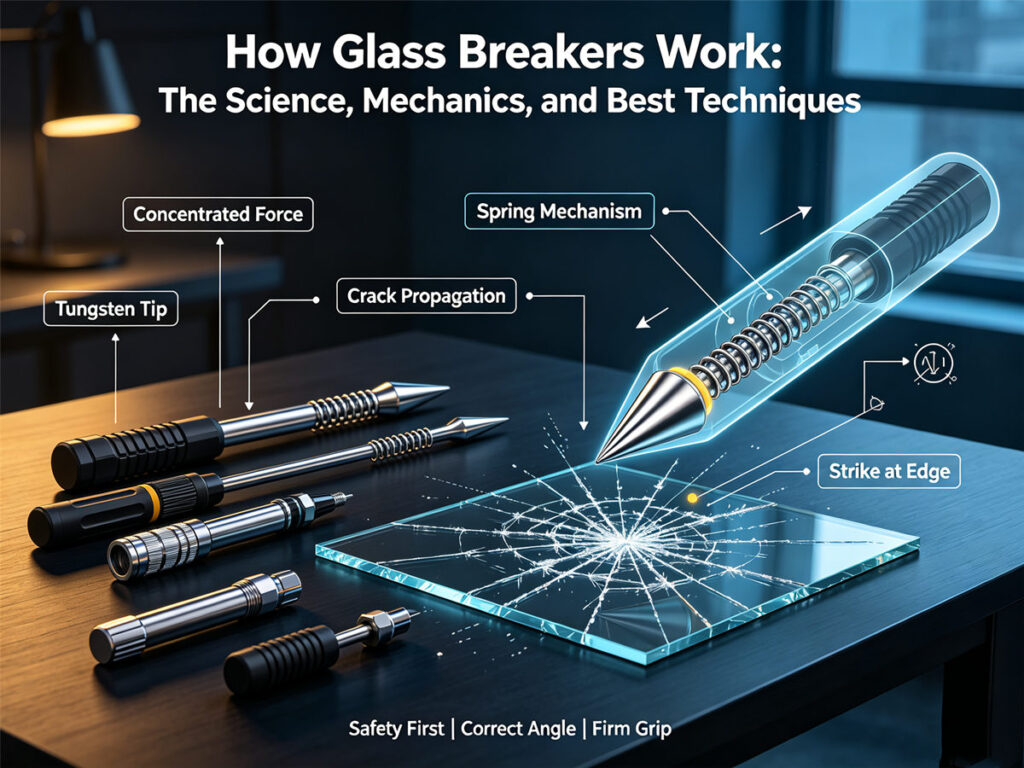
How Glass Breakers Work: The Science, Mechanics, and Best Techniques
Every year, thousands of people survive car accidents only to find themselves trapped inside a vehicle that’s filling with water or smoke. In those moments, the difference between escape and tragedy often comes down to a single tool — and whether you know how to use it.
A glass breaker is deceptively simple. You press it against a car window, and the glass shatters. But there’s real physics behind that instant break, and understanding how these tools work can mean the difference between a successful escape and fumbling in a panic. At Brass Knuckles Master, we build glass breakers into our everyday carry tools because we believe preparedness shouldn’t be complicated — it should be automatic.
1. Why Tempered Glass Breaks the Way It Does
Most car side windows are made from tempered glass — regular glass that’s been heated to over 1,100°F and then rapidly cooled. This process creates intense internal stress: the outer surface is compressed while the center is pulled tight under tension.
The Stress Web Effect
When something punctures the surface of tempered glass, all that stored energy releases at once. The crack doesn’t spread slowly like it would in regular glass. Instead, it propagates across the entire pane in a fraction of a second, turning the whole window into thousands of small, relatively harmless cubes. That’s why a glass breaker doesn’t need to be big or heavy — it just needs to concentrate enough force on one tiny point to trigger that cascade.
This is also why tempered glass is the ideal target. It’s strong enough to resist everyday impacts — rocks, hail, minor collisions — but it has a built-in failure mode that a sharp, hard point can exploit.
2. Spring-Loaded vs. Fixed-Tip: Two Ways to Crack Glass
Not all glass breakers work the same way. The two main designs each use a different mechanical principle to shatter tempered glass.
The Spring-Loaded Punch
A spring-loaded glass breaker works like an automatic center punch. You press the tip against the glass, and once you push hard enough to compress the internal spring, the mechanism snaps forward with a sudden burst of force. The advantage? You don’t need swing room. In a cramped car interior — especially if you’re injured or disoriented — you can simply press and hold. The spring does the work.
The Fixed-Tip Hammer
The second design relies on your own momentum. A fixed-tip glass breaker has a hardened point that you swing or slam into the glass. This style is common in emergency hammers mounted on buses and trains. It’s effective, but it requires enough space to build force — something you might not have if you’re pinned in a seatbelt or fighting against rising water.
At BKM, our Glass Breaker Tool uses a compact spring-loaded design that fits on your keychain. No swing, no setup — just press and go.
3. Why the Tip Material Matters More Than You Think
The tip of a glass breaker is the entire point — literally. If it’s not hard enough, it won’t puncture the glass surface, and the whole tool is useless.
Tungsten Carbide: The Gold Standard
Most high-quality glass breakers use tungsten carbide tips. This material ranks around 9 on the Mohs hardness scale — just below diamond. When you press a tungsten carbide point against tempered glass, the tip doesn’t deform or dull. It drives straight through the compressed outer layer and hits that tension core, releasing the stored energy in an instant.
Ceramic and Hardened Steel Alternatives
Some budget tools use hardened steel or ceramic points. Steel works but wears down faster with repeated use. Ceramic — specifically a small ceramic bead — can be surprisingly effective because it’s extremely hard and sharp, though it’s more fragile than tungsten carbide if dropped on concrete.
The takeaway: when you’re choosing a glass breaker, the tip material is the single most important feature. Everything else is secondary.
4. Where to Strike: Corners Are Your Best Friend
Here’s a detail most people miss: where you hit the glass matters almost as much as what you hit it with.
Target the Lower Corners
Tempered glass is weakest at its corners and edges. The center of a car window is actually the strongest part because of how the tempering stress distributes across the surface. Aim for a lower corner — ideally the one furthest from where you’re sitting. The lower corner gives you the best angle and the weakest point on the pane.
Why the Center Doesn’t Work as Well
If you press a glass breaker against the middle of a side window, it might take two or three attempts. The glass can flex slightly in the center, absorbing some of the force before the puncture triggers the full break. Corners don’t flex. They shatter on the first hit, almost every time.
This is one of those details that sounds small until you’re the one inside a sinking car. Practice the motion. Know where to aim.
5. What Glass Breakers Can’t Do: The Laminated Glass Problem
Here’s something that catches people off guard: not all car windows are tempered glass.
Windshields Are Different
Your windshield is laminated glass — two layers of glass bonded to a plastic interlayer. This design keeps the windshield from shattering into your face during an accident, which is great for safety but terrible for escape. No standard glass breaker on the market can punch through laminated glass. The plastic layer holds everything together even after the glass cracks.
Why Side Windows Are Still Your Target
Side and rear windows are almost always tempered, which is why every glass breaker instruction tells you to aim there. But as some manufacturers start using laminated glass in side windows for noise reduction and theft prevention, it’s worth knowing the difference. If a window doesn’t shatter on the first hit, don’t keep hammering — move to a different window.
At Brass Knuckles Master, we design our tools with real-world scenarios in mind. Our keychain multi-tools include glass breakers specifically because we know that in an emergency, you need something that’s already in your hand — your keys.
6. Making It Automatic: Practice Before You Need It
A glass breaker you’ve never used is a glass breaker you might fumble when it counts.
Build the Muscle Memory
Hold the tool, find the tip by feel, and practice pressing it against a hard surface. You want the motion to be instinctive — no looking, no adjusting, no second-guessing. In a real emergency, your hands will be shaking, the water might be rising, and smoke might be filling the cabin. The simpler the action, the more likely you are to complete it under stress.
Keep It Accessible
The best glass breaker is the one you actually have with you. That’s why keychain-sized tools matter. A full-size emergency hammer in your trunk does you no good when you’re trapped in the driver’s seat. A compact tool attached to your keys — the keys you used to start the car — is always within reach.
Understanding how glass breakers work isn’t about becoming an expert in materials science. It’s about removing the mystery from a tool that might save your life. The physics is simple: hard point meets stressed glass, energy releases, window disappears. What matters is that you’ve thought about it before the moment arrives.
If you’re ready to add a glass breaker to your everyday carry, explore BKM’s Glass Breaker Tool — compact enough for your keychain, tough enough for the moment you need it. At Brass Knuckles Master, we believe the best safety tools are the ones you never leave home without.