
Sep
Knowledge of Weapons, Weapons How
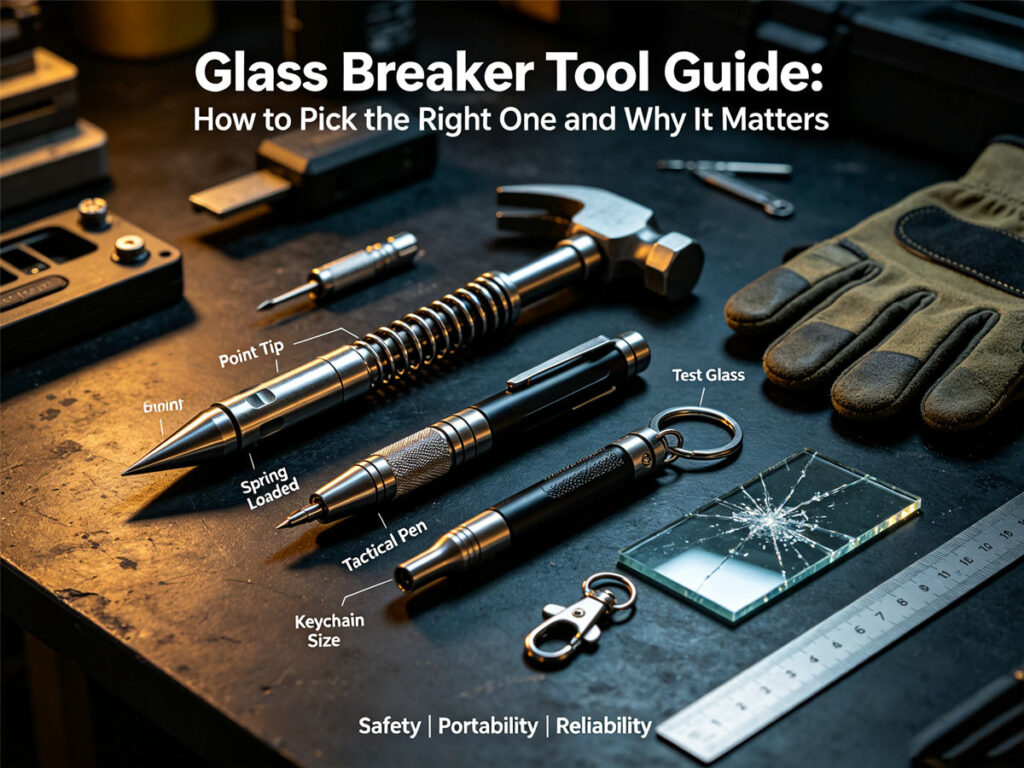
Glass Breaker Tool Guide: How to Pick the Right One and Why It Matters
Every year, thousands of drivers find themselves trapped inside a vehicle after a crash, a rollover, or a plunge into water. Tempered glass is engineered to resist everyday impacts, which means the same window that deflects road debris becomes an unyielding wall when you need to get out fast. A glass breaker tool — also called a window breaker — turns that equation around — a concentrated strike point shatters tempered glass in a single hit, giving you a way out when seconds decide the outcome.
At Brass Knuckles Master, we build emergency preparedness into everyday carry. Our Glass Breaker Tool collection is designed around one principle: the tool you actually carry is the one that saves you. This guide walks you through how these tools work, what separates a reliable one from a novelty, and how to choose the right fit for your daily routine.
1. How a Glass Breaker Tool Actually Works
The physics are deceptively simple. Tempered glass is pre-stressed — its surface is in compression while the core is in tension. When you apply a sharp, focused force to the surface, that stress balance collapses all at once, and the entire pane fractures into small, relatively safe granules. The key word is focused. A hammer spreads force across a wide area. A window breaker concentrates it onto a tiny contact point, usually a tungsten carbide or hardened steel tip, generating enough localized pressure to trigger catastrophic failure in the glass.
This is why a properly designed emergency glass breaker doesn’t need brute strength. The geometry does the work. You position the tip against a corner of the window — never the center, where the glass is most flexible — and push or strike. The pane goes. That’s it.
Why the Corner Matters
Tempered glass flexes most at its center and is anchored most rigidly near the edges and corners. Striking a corner maximizes the mechanical advantage because the glass cannot absorb the impact by flexing. Most training drills and real-world rescue accounts confirm this: corner strikes succeed on the first attempt far more often than center strikes. If you’re dealing with a side window, aim for one of the lower corners closest to the door frame. The glass is thickest and least flexible there, and shards will blow outward rather than toward your face.
2. Key Features That Separate Good from Gimmick
Not every tool marketed as a glass breaker will perform when you need it. The market is full of cheap keychain gadgets that look the part but fail under real stress. Here’s what to look for — and what to avoid.
Tip Material and Hardness
Tungsten carbide is the gold standard. It registers around 9 on the Mohs hardness scale, which means it can bite into tempered glass without dulling or chipping over years of carry. Some budget tools use standard steel tips that may corrode or lose their edge after a few months sitting in a humid car. At BKM, our keychain-style breakers use tungsten steel tips precisely because reliability degrades silently — you won’t know a tip has softened until the moment you need it and it fails.
Build Quality and Body Material
The tip is only as good as the body driving it. A flimsy plastic housing flexes under impact, absorbing energy that should transfer into the glass. Look for tools built from titanium alloy, stainless steel, or high-grade aluminum. These materials keep the tool light enough for pocket carry while providing the rigidity needed for a clean strike. Several products in our collection combine writing function with an integrated breaker tip — dual purpose without compromising either role.
Size and Accessibility
The best emergency window breaker is the one within arm’s reach when the crash happens. A tool buried in a trunk or a glovebox behind a jammed latch might as well not exist. This is why keychain-mounted and pen-format breakers have surged in popularity. They sit on your person or clipped to your visor, ready to deploy without fumbling or searching.
Grip and Ergonomics
Under stress, your hands may be wet, shaking, or gloved. A tool with textured grip surfaces or a contoured body gives you confidence that the strike will land clean. Smooth, cylindrical tools look sleek but can slip at the worst possible moment. Think about the conditions you’d actually face — rain, sweat, panic — and choose accordingly.
3. Where to Keep Your Glass Breaker
Placement is a strategic decision, not an afterthought. Where you store the tool determines whether it’s accessible in the three seconds you might have.
In the Car
The most common recommendation is the driver’s side visor or center console. Some drivers clip a breaker to the sun visor with a simple retainer so it’s always overhead and always visible. Others prefer the center console for easy reach with either hand. The important thing is that the tool is accessible even if you’re hanging upside down in a seatbelt or submerged in water. If your vehicle has power windows, remember: once the electrical system shorts out underwater, the windows won’t go down. A glass breaker tool becomes your only option.
On Your Keychain
For everyday carry enthusiasts, a keychain-mounted breaker rides with you everywhere — not just in your vehicle. If you’re a passenger in someone else’s car, in a taxi, or even near a building with tempered glass doors during an emergency, you have the tool on you. BKM’s keychain multi-tools are built with this philosophy in mind: compact tools that pack serious function into a form factor you’ll actually carry every day.
In a Go-Bag or Emergency Kit
If you keep a preparedness kit in your vehicle or home, a dedicated glass breaker belongs in it alongside a seatbelt cutter, a flashlight, and first-aid supplies. Redundancy isn’t overkill — it’s insurance. A spare breaker in the trunk costs under twenty dollars and weighs almost nothing. There’s no reason not to have one.
4. Glass Breaker vs. Multi-Tool: Do You Need Both?
Many BKM products combine a window breaker with other functions — bottle openers, wrenches, screwdrivers, even self-defense features like reinforced knuckle guards. The question is whether integration compromises the primary function.
The honest answer: it depends on the design. A well-engineered multi-tool positions the breaker tip as a dedicated feature, not an afterthought squeezed onto a corner. BKM’s Tactical Knuckle Keychain Window Breaker, for example, pairs a hardened window breaker with a compact knuckle form factor — both functions are primary, neither is an add-on.
When you’re choosing, hold the tool in your hand and ask: can I deploy the breaker function without thinking about which end is which? Can I grab it in the dark and know immediately where the strike point is? If the answer is yes, you’ve found a good multi-function option. If you have to fumble or rotate the tool to figure out orientation, keep looking.
5. Common Mistakes People Make
Even a great tool fails if you misuse it. Here are the errors we see most often — and how to avoid them.
Striking the Center of the Glass
As covered earlier, the center flexes and absorbs impact. Aim for a corner — lower corners are generally recommended because they’re farthest from the driver’s line of sight and least likely to send shards toward your face.
Practicing on the Wrong Glass
Tempered glass and laminated glass behave completely differently. Most side and rear windows are tempered and will shatter as expected. Windshields are laminated — two glass layers bonded to a plastic interlayer. A glass breaker will crack laminated glass but won’t clear an opening. Know which windows to target before an emergency forces the decision on you.
Letting the Tool Sit for Years Without Checking
Tungsten carbide doesn’t rust, but the housing might. Springs in auto-deploy mechanisms can lose tension over time. A quick visual check every few months costs nothing and ensures your tool is ready. Wipe down the tip, test the deployment action, and make sure nothing has seized up. Preparedness is a habit, not a purchase.
Assuming One Tool Covers Every Vehicle
Different vehicles use different glass types in different positions. Some newer models use laminated side windows for noise reduction. Others have thicker tempered glass on rear windows. If you drive multiple vehicles or rent cars frequently, carry your breaker with you rather than assuming the car’s built-in tool (if it has one) will work the same way.
6. Who Needs a Glass Breaker Tool?
The short answer is anyone who rides in a vehicle. But certain groups benefit even more.
Parents with young children need a breaker within the driver’s reach — you can’t climb into the backseat during a water submersion event. Rideshare and delivery drivers spend more hours on the road, which statistically increases exposure to collisions and road departures. People who live near flood-prone areas or frequently cross bridges face elevated water-landing risk. And everyday carry enthusiasts who already carry a tactical pen or keychain tool can add a breaker function without adding bulk to their pocket.
Commuters in urban areas face a different kind of risk: accidents involving multiple vehicles, construction zones, or debris on the highway. After a serious pileup, doors may jam from frame deformation. A glass breaker tool gives you an exit when the door won’t open. It’s the kind of everyday carry edge you carry hoping it collects dust — but you carry it anyway.
At BKM, we believe a glass breaker isn’t a niche gadget. It’s as fundamental as a seatbelt. You hope you never need it. But if you do, there’s no substitute.
If you’re ready to add one to your carry rotation, explore the Glass Breaker Tool collection. From dedicated keychain breakers to titanium pens with integrated tips, there’s a format that fits the way you already carry. Use code BKM15 to get 15% off when you pick up two or more — because preparedness is always better when it’s shared.