
Apr
Knowledge of Weapons
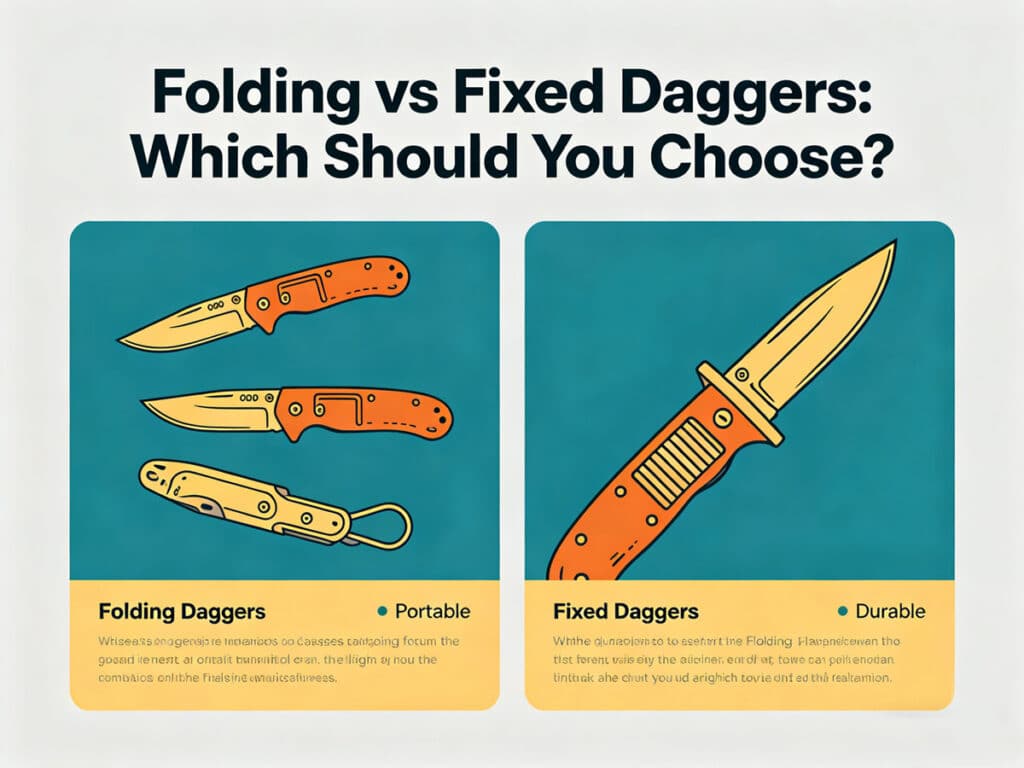
Folding vs Fixed Daggers: Which Should You Choose?
When it comes to selecting the right blade for personal defense, everyday carry, or tactical applications, the debate between folding daggers and fixed blade daggers remains one of the most discussed topics among enthusiasts, security professionals, and everyday citizens who prioritize personal safety. Each type of dagger offers distinct advantages and presents unique challenges that can significantly impact your experience when you actually need to rely on your weapon. Understanding these differences is crucial for making an informed decision that aligns with your specific needs, lifestyle, and intended use cases.
This comprehensive guide will walk you through everything you need to know about both types of daggers, examining their characteristics, strengths, weaknesses, and the scenarios in which each excels. By the end of this article, you’ll have a clear understanding of which type of dagger best suits your requirements and personal preferences.
Understanding Folding Daggers: Compact Convenience Meets Tactical Functionality
Folding daggers represent a fascinating intersection of portability and defensive capability, offering users the ability to carry a serious blade without the bulk and visibility associated with fixed blade weapons. These knives feature a pivoting mechanism that allows the blade to fold into the handle, creating a compact package that can be easily carried in pockets, bags, or concealed holsters without drawing unnecessary attention from the public.
The Mechanics Behind Folding Dagger Design
The engineering that goes into modern folding daggers has advanced dramatically over the past few decades, with manufacturers developing sophisticated locking mechanisms that ensure the blade remains securely open during use. From liner locks and frame locks to axis locks and compression locks, each design offers different levels of security, ease of operation, and durability under stress. The blade itself typically ranges from three to five inches in length, providing enough cutting surface for effective defensive applications while maintaining the compact profile that makes these knives so appealing for everyday carry.
One of the most significant advantages of folding daggers is their versatility in terms of carry options. They can be transported in front pockets, back pockets, coin pockets, or attached to keychains, making them accessible without requiring dedicated belt holsters or specialized carrying arrangements. This convenience factor cannot be overstated, as the best weapon is ultimately the one you have with you when you need it most.
Advantages and Limitations of Folding Designs
The primary strength of folding daggers lies in their concealability and ease of everyday carry, allowing users to maintain a defensive capability without significantly altering their appearance or comfort throughout the day. Modern folding mechanisms have become remarkably reliable, with quality knives from reputable manufacturers demonstrating consistent performance even after thousands of opening and closing cycles.
However, folding daggers do present certain limitations that serious users must consider. The moving parts inherent to folding designs introduce potential points of failure that simply don’t exist in fixed blade constructions. The locking mechanism, while generally reliable, can potentially fail under extreme stress or if the knife has been poorly maintained. Additionally, the handle construction must accommodate the blade when folded, which can sometimes result in less ergonomic grips compared to fixed blade designs.
Understanding Fixed Blade Daggers: Uncompromising Strength and Reliability
Fixed blade daggers represent the traditional approach to blade design, featuring a continuous piece of steel that extends from the handle through the blade itself. This construction eliminates moving parts entirely, creating a weapon that prioritizes strength, durability, and immediate readiness above all other considerations. For those who view their blade as a serious tool rather than merely an accessory, fixed blade daggers often emerge as the preferred choice.
The Engineering Excellence of Fixed Blade Construction
The absence of moving components in fixed blade daggers translates directly into superior structural integrity and reliability under demanding conditions. When you deploy a fixed blade dagger, you can be absolutely certain that it will perform exactly as designed, with no mechanical failures or unexpected closures to concern yourself with during critical moments. The full tang construction common to quality fixed blade daggers ensures that the blade and handle function as a single, unified piece of metal, capable of withstanding tremendous forces without risk of separation or failure.
Fixed blade daggers typically feature blades ranging from four to eight inches in length, with some tactical and military models extending even further. This additional blade length provides enhanced cutting capability and reach compared to most folding alternatives, which can prove decisive in defensive scenarios. The handles are designed purely for grip optimization, without the space constraints imposed by blade storage requirements, resulting in more ergonomic and secure hold options.
Advantages and Limitations of Fixed Blade Designs
The most compelling argument for fixed blade daggers centers on their reliability and strength, characteristics that cannot be matched by any folding mechanism regardless of engineering sophistication. Military personnel, law enforcement officers, and security professionals frequently choose fixed blade options specifically because there is no mechanical system to fail when the stakes are highest. The simplicity of design also means that fixed blade daggers are generally easier to maintain, requiring only basic cleaning and occasional oiling to remain in optimal condition.
The primary drawback of fixed blade daggers involves their carry requirements. These weapons cannot be conveniently pocket-carried like folding knives, necessitating belt holsters, sheaths, or other dedicated carrying solutions that may not suit all situations or clothing choices. The visibility factor also increases with fixed blade carry, as the weapon is constantly visible on your belt or hip, which may not be appropriate for all environments or personal preferences.
Key Differences Between Folding and Fixed Daggers
Understanding the fundamental distinctions between these two categories of daggers requires examining multiple factors that influence their practical performance and suitability for different users and situations. The choice between folding and fixed blade designs ultimately comes down to how you prioritize various characteristics and what compromises you’re willing to accept.
Portability and Concealment Considerations
Folding daggers clearly excel in the portability department, offering the ability to carry a capable blade without dedicated carrying equipment or significant lifestyle adjustments. A quality folding dagger can accompany you throughout your daily activities without anyone noticing its presence, making it ideal for environments where visible weapons might create social complications or legal concerns. Fixed blade daggers, conversely, announce their presence wherever you go, which may serve as a deterrent in some situations while creating complications in others.
Strength and Durability Factors
When evaluating raw strength and durability, fixed blade daggers maintain a decisive advantage that cannot be overlooked by serious users. The continuous steel construction eliminates stress concentrations at pivot points and locking mechanisms, allowing fixed blade daggers to handle extreme forces without concern for mechanical failure. Folding daggers, while certainly capable of handling normal use, introduce inherent vulnerabilities that become more concerning as stress levels increase.
Deployment Speed and Ease of Use
Both types of daggers can be deployed quickly when properly selected and practiced with, though the methods differ significantly. Folding daggers require the additional step of opening the blade before use, which takes only a fraction of a second but can feel like an eternity during high-stress encounters. Fixed blade daggers offer immediate readiness upon draw, with no opening mechanism to manipulate before the blade is ready for use.
Use Cases and Applications: Matching Your Dagger to Your Needs
The question of whether to choose a folding or fixed blade dagger cannot be answered definitively without considering the specific circumstances in which the weapon will be used. Different applications favor different designs, and understanding these preferences will help you make a more informed selection.
Everyday Carry Scenarios
For general everyday carry purposes, particularly in urban environments or professional settings where weapon visibility might create issues, folding daggers typically represent the more practical choice. Their ability to integrate seamlessly with normal clothing and activities makes them accessible in situations where fixed blade carry would be impractical or socially inappropriate. Many professionals who cannot openly carry larger weapons find folding daggers to be excellent alternatives that provide meaningful defensive capability without compromising their appearance or professional image.
Tactical and Professional Applications
Security professionals, outdoor guides, and individuals operating in higher-risk environments often gravitate toward fixed blade daggers for their superior reliability and strength characteristics. When your safety may depend on your weapon functioning perfectly under extreme stress, the mechanical simplicity of fixed blade designs provides invaluable peace of mind. These users typically have the ability to carry dedicated holsters and don’t face the same concealment requirements that limit everyday civilians.
Factors to Consider When Making Your Selection
Choosing between folding and fixed blade daggers requires honest self-assessment regarding your priorities, lifestyle, and the specific threats you might face. Several key factors should influence your decision-making process as you evaluate which type of dagger best matches your requirements.
Legal Considerations in Your Area
Before purchasing any type of dagger, you must thoroughly research the laws in your jurisdiction regarding blade length restrictions, carry methods, and prohibited weapon classifications. Some areas impose significant restrictions on fixed blade carry while permitting folding knives, while others regulate both types similarly. Understanding these regulations will prevent legal complications that could arise from improper carry and ensure that your chosen weapon remains legally defensible if you ever need to use it.
Training and Familiarity Requirements
Both folding and fixed daggers require practice to deploy effectively under stress, but the learning curves differ somewhat between the two types. Folding daggers require熟练掌握 opening techniques, whether using thumb studs, flipper mechanisms, or wave-style deployments, while fixed blade daggers demand proficiency in sheath draw and retention techniques. Consider what training resources are available to you and how much time you can dedicate to developing competence with your chosen weapon.
Quality and Budget Considerations
Quality varies enormously across both folding and fixed blade categories, with prices ranging from under twenty dollars to several hundred dollars depending on materials, construction quality, and brand reputation. Investing in a quality dagger from a reputable manufacturer ensures reliable performance and durability, while budget options may fail at critical moments or degrade rapidly with regular use. Determine your budget realistically and prioritize quality within that range, remembering that your safety may depend on your equipment.
Making Your Final Decision: Aligning Choice with Purpose
As you approach your final decision between folding and fixed daggers, remember that the “best” choice depends entirely on your specific circumstances, priorities, and intended applications. Neither type is universally superior; each offers a different balance of characteristics that will appeal differently to different users.
Consider how often you’ll actually carry your dagger, in what situations, and what level of concealment you require. Evaluate whether the superior strength of fixed blade designs genuinely matters for your anticipated use cases, or whether the convenience of folding carry better matches your actual lifestyle. Think about your willingness to invest in quality carrying solutions for fixed blade options, and whether you have access to appropriate training for either type of weapon.
Ultimately, the most important factor is selecting a dagger that you’ll actually carry consistently, practice with regularly, and trust completely when needed. Whether you choose a folding dagger for its unmatched portability or a fixed blade for its uncompromising reliability, ensure that your selection reflects honest assessment of your needs rather than theoretical preferences that may not align with your actual circumstances.
For those exploring additional self-defense tools, consider browsing options like a brass knuckle design or a tactical pen that can complement your primary blade choice, with resources available at brassknucklesmaster.com to help you find quality equipment that meets your specific requirements.