
Nov
Knowledge of Weapons, Weapons What
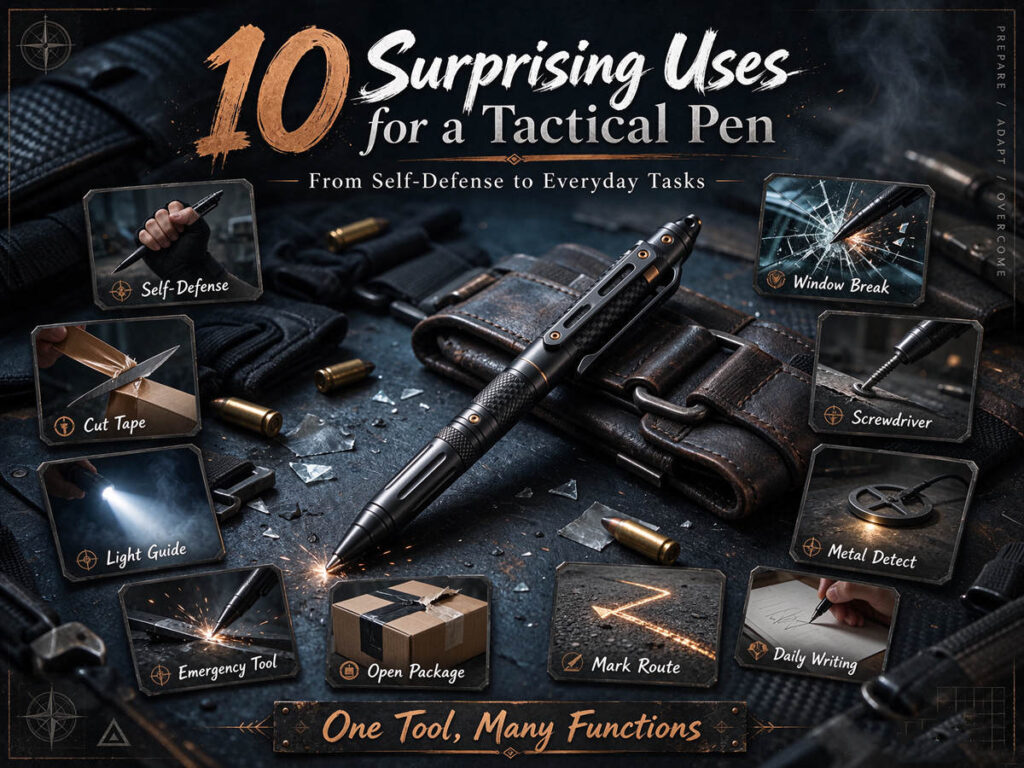
10 Surprising Uses for a Tactical Pen: From Self-Defense to Everyday Tasks
A pen is one of those everyday objects that most people carry without giving it much thought, yet a well-designed tactical pen can offer considerably more versatility than an ordinary plastic ballpoint. Built with a durable body, practical writing components, and sometimes additional emergency features, this specialized writing instrument combines familiar daily convenience with a construction intended to withstand more demanding conditions.
Although tactical pens are often discussed in connection with personal safety, their usefulness extends well beyond that subject. They can help with everyday note-taking, travel organization, outdoor activities, equipment identification, and certain emergency situations, making them an interesting option for people who appreciate practical everyday carry (EDC) accessories. Their design also raises questions about responsible ownership, particularly when a product includes reinforced components or features associated with self-defense.
In this guide, we explore 10 surprising uses for a tactical pen, ranging from ordinary writing tasks to emergency preparedness and personal safety awareness. We will also look at how tactical pens compare with other everyday accessories, including the Brass Knuckle and Brass Knuckle ring, and explain why practical utility, legal awareness, and responsible handling should always come first.
1. Everyday Writing and Professional Note-Taking
The most obvious use of a tactical pen is also the one that should matter most: writing. Regardless of how many additional features a product advertises, a pen that cannot write comfortably and consistently has limited value as an everyday accessory.
Many tactical pens feature metal bodies made from aluminum, stainless steel, or titanium, giving them a different feel from lightweight disposable pens. Depending on the design, they may use replaceable ink cartridges, capped writing tips, or retractable mechanisms, allowing owners to choose a format that fits their daily routine.
1. Taking meeting notes and recording information
A dependable pen is useful in professional environments where information needs to be recorded quickly, whether someone is attending a business meeting, reviewing a delivery schedule, documenting an inspection, or writing down important contact details. A durable metal pen can be a practical alternative to inexpensive disposable stationery, particularly for people who prefer to keep one writing instrument for an extended period.
2. Signing documents and completing forms
Contracts, invoices, delivery receipts, visitor registration forms, and other documents still require handwritten signatures in many workplaces. Keeping a reliable pen available can save time and prevent the inconvenience of searching for stationery when a document needs to be completed.
3. Maintaining a personal notebook
A tactical pen can also become part of a simple daily organization system, helping users record reminders, shopping lists, travel information, and personal observations. For students, field workers, business professionals, and people who prefer handwriting to typing, this familiar function may be more valuable than any specialized feature.
2. Travel and Outdoor Activities
Travel often involves unexpected situations in which a small, dependable writing instrument becomes surprisingly useful. Whether someone is checking into accommodation, organizing a journey, recording vehicle information, or spending time outdoors, a pen can serve several practical purposes without requiring a complicated setup.
4. Recording travel details
A tactical pen can be useful for writing down hotel addresses, transportation information, emergency contact numbers, and itinerary changes. Although smartphones provide convenient digital storage, handwritten information can still be valuable when a device runs out of battery, loses connectivity, or becomes inconvenient to use.
Travelers can also use a pen to complete paper forms, mark printed maps, and make notes about reservations or transportation arrangements. Its compact format makes it relatively easy to store alongside a notebook or travel document organizer.
5. Keeping outdoor activity records
For hiking, camping, fishing, and other outdoor activities, a pen can help record route information, weather observations, equipment checks, and important details about a trip. Some specialized writing instruments use pressurized ink cartridges that are designed to work in a wider range of orientations or environmental conditions than standard refills, although actual performance depends on the cartridge specification.
A tactical pen should not replace dedicated outdoor equipment, navigation devices, or emergency communication tools, but it can be a convenient addition to a well-organized outdoor kit.
6. Labeling and identifying equipment
Outdoor enthusiasts and professionals often carry multiple bags, storage containers, tools, and equipment cases that can look similar. A pen can help mark labels, identify personal belongings, and record inventory information, making organization easier during group activities or extended trips.
For people who regularly work with equipment, this simple function can be more useful than carrying an accessory that offers several complicated features but rarely serves a genuine purpose.
3. Emergency Preparedness and Practical Utility
Some tactical pens include additional features intended to support emergency preparedness. These features vary considerably between models, so it is important to check the manufacturer’s specifications rather than assuming that every product provides the same capabilities.
A good emergency accessory should be selected according to a specific need, and its limitations should be understood before an emergency occurs.
7. Supporting emergency vehicle preparedness
Certain tactical pens incorporate a hardened component marketed as a glass breaker. Such a feature is intended for specific emergency applications involving suitable vehicle glass, but its presence should not be treated as a guarantee that the pen can safely or reliably break every vehicle window.
Vehicle glazing differs considerably. Side windows are commonly made from tempered glass, while windshields are generally laminated, and these materials behave differently when damaged. A dedicated vehicle escape tool designed for the relevant glass type is usually a more appropriate choice for an emergency vehicle kit.
Anyone preparing for vehicle emergencies should also consider a seat-belt cutter, a purpose-built escape device, a charged phone, and an established emergency plan. A tactical pen may complement some preparedness arrangements, but it should not be the only escape tool someone relies on.
8. Helping with everyday equipment organization
A durable pen can be useful around the workplace, workshop, or home when recording maintenance dates, writing temporary labels, or keeping track of equipment inspections. Its metal construction may make it feel more substantial than an inexpensive plastic pen, although it should still be used according to the manufacturer’s intended purpose.
For example, someone managing a collection of storage boxes could use a tactical pen to label contents, while a technician might use it to record equipment identification numbers or inspection notes. These tasks are simple, but they demonstrate why a practical writing instrument can earn a permanent place in an everyday carry kit.
9. Serving as a backup writing instrument
Pens occasionally get lost, damaged, or left behind, and having a second writing instrument available can be useful during work, travel, or outdoor activities. A tactical pen stored in a bag or organizer can provide a backup when an ordinary pen is unavailable.
This is particularly relevant for people who work in environments where written records are important, such as delivery operations, property management, field inspections, and customer service. The value comes from dependable access to a writing tool rather than from its specialized appearance.
4. Personal Safety: Understanding the Self-Defense Connection
Tactical pens are frequently marketed as personal-safety accessories because their construction is generally more substantial than that of an ordinary disposable pen. However, it is important to distinguish between a product’s physical design and its ability to provide reliable protection in a dangerous situation.
A tactical pen is not a substitute for awareness, avoidance, de-escalation, emergency communication, or professional self-defense training. Physical confrontations are unpredictable, and relying on a small object can create a false sense of security.
10. Supporting a broader personal-safety plan
The most responsible way to consider a tactical pen in a personal-safety discussion is to treat it as a writing instrument that may form part of a broader preparedness routine, rather than as a guaranteed defensive solution. Keeping a phone accessible, recognizing potential risks, maintaining awareness of exits, and moving away from escalating situations are generally more important than depending on any handheld object.
If a person is concerned about walking alone, traveling at night, or navigating unfamiliar environments, practical alternatives may include a personal safety alarm, a compact flashlight, emergency contact sharing, and planning routes through populated areas. These tools can offer useful functions without encouraging physical confrontation.
It is also worth remembering that a reinforced metal pen may be subject to restrictions in certain locations, particularly secure facilities, workplaces, schools, transportation systems, or public venues with specific entry policies. Before carrying one, users should review applicable local laws and venue rules.
Why responsible expectations matter
Promotional descriptions sometimes suggest that tactical pens provide a simple answer to personal security concerns. In reality, no small accessory can guarantee protection, and carrying a weapon-associated object may introduce additional legal or practical complications.
A responsible personal-safety plan should prioritize avoiding danger, getting assistance, and leaving an unsafe environment whenever possible. Any physical self-defense training should come from qualified instructors who emphasize judgment, lawful conduct, and harm reduction.
5. What Makes a Tactical Pen Suitable for Everyday Carry?
Not every product marketed as a tactical pen offers the same quality, writing performance, or practical value. Some models are designed primarily as durable writing instruments, while others include additional features that may increase their size, complexity, or maintenance requirements.
For everyday use, the most important considerations are often surprisingly ordinary: whether the pen writes well, whether its refill is easy to replace, whether the body is comfortable to hold, and whether the product fits naturally into the user’s routine.
Material and construction
Aluminum is commonly used because it provides a relatively lightweight metal body, while stainless steel offers a different balance of weight and corrosion resistance. Titanium is another material found in some premium designs, although its use does not automatically make a pen better for every user.
The quality of the manufacturing and finishing also matters. A well-made cap, reliable threading, secure clip, and consistent surface finish can make a pen more convenient to use over time.
Writing performance and refill availability
A tactical pen should be judged as a writing instrument before its additional features are considered. Check the type of refill it accepts, whether replacements are readily available, and whether the writing mechanism is comfortable for regular use.
Some models use standard refill formats, while others require proprietary cartridges. Choosing a pen with easily available refills can reduce long-term inconvenience and make it more practical as a daily accessory.
Size, weight, and portability
A pen that is too heavy or uncomfortable may end up staying in a drawer instead of being carried. Consider where it will be stored, whether the clip is suitable for a pocket or notebook, and whether its overall dimensions fit the user’s normal routine.
For more detailed information about construction, features, and purchasing considerations, readers can explore the Tactical Pen Buying Guide.
6. Tactical Pens Compared with Other Everyday Carry Accessories
A tactical pen is only one option in the wider everyday carry category. Depending on a person’s daily activities, other accessories may provide more useful functions or be better suited to particular environments.
For example, a compact flashlight offers dedicated illumination, a personal alarm can attract attention, and a keychain multi-tool may help with small household or equipment-related tasks. Choosing the right accessories is less about collecting the largest number of gadgets and more about identifying the practical problems someone actually encounters.
Tactical pens and conventional writing instruments
A conventional pen is usually lighter and may be less expensive, while a tactical pen generally emphasizes a more durable body and a sturdier construction. Both can perform the basic task of writing, so the better choice depends on individual preferences and how frequently the pen will be carried.
Tactical pens and Brass Knuckle accessories
The comparison becomes more important when looking at weapon-associated accessories such as a Brass Knuckle or Brass Knuckle ring. Although these products may appear in the same broader discussions about everyday carry and personal protection, they serve different purposes and should not be treated as interchangeable items.
A tactical pen has an ordinary writing function, while brass knuckle-style products are associated with weapon use and may be subject to more restrictive legal rules. A ring-shaped appearance does not automatically make a Brass Knuckle ring ordinary jewelry, and users should never assume that a product is lawful simply because it is compact or decorative.
For additional background, readers can explore these related resources:
- What Is a Tactical Pen? A Complete Guide to the EDC Tool That Does More explains the basic design and everyday functions of tactical pens.
- Everyday Carry Tool Guide: Build a Kit That Works as Hard as You Do discusses practical accessories and how to organize an everyday carry setup.
- One Finger Brass Knuckle Review: Is It Worth Carrying for Everyday Protection? provides a comparison involving a weapon-associated accessory and more practical everyday alternatives.
7. Building a Practical and Responsible Everyday Carry Kit
The best everyday carry arrangement is not necessarily the one with the most specialized equipment. It is the one that provides useful functions without becoming unnecessarily heavy, complicated, or difficult to maintain.
A tactical pen can be a sensible part of such a setup when its writing performance, construction, and refill availability match the owner’s needs. Other items can be selected according to the person’s environment, work responsibilities, and travel habits.
A balanced everyday carry kit might include:
| Accessory | Practical everyday purpose |
|---|---|
| Tactical pen | Note-taking, signatures, and written records |
| Compact flashlight | Visibility in dark environments |
| Personal safety alarm | Attracting attention when assistance is needed |
| Keychain multi-tool | Small, appropriate household and utility tasks |
| Mobile phone | Communication, navigation, and emergency calls |
| Small notebook | Recording reminders, information, and observations |
| First-aid supplies | Basic preparedness for minor injuries |
It is equally important to understand the limitations of each item. A flashlight does not replace proper lighting, a personal alarm does not guarantee that assistance will arrive immediately, and a tactical pen should not be considered a complete emergency escape device.
At brassknucklesmaster.com, readers can find additional discussions about tactical pens, everyday carry accessories, and weapon-associated designs. When reviewing any product information, it is sensible to distinguish practical specifications from promotional language, verify legal restrictions independently, and choose accessories according to genuine everyday needs.
A tactical pen may look like a specialized piece of equipment, but many of its most useful applications are remarkably ordinary. It can help someone record meeting notes, complete travel forms, label equipment, maintain outdoor records, and keep a dependable writing instrument available throughout the day. Certain models also include emergency-oriented features, although these should be evaluated carefully rather than treated as guaranteed solutions.
The most valuable tactical pen is therefore not necessarily the one with the greatest number of extra features or the most aggressive appearance. It is the one that writes reliably, feels comfortable, fits naturally into daily routines, and provides practical value without encouraging unnecessary risk. When combined with sensible preparation and responsible decision-making, it can be a useful everyday accessory that earns its place through regular use rather than appearance alone.