
Mar
Knowledge of Weapons, Weapons Why, Whether Weapons Are Illegal
Tactical Pen TSA Rules: Can You Bring One on a Plane?
1. Understanding What a Tactical Pen Really Is
Before discussing airport security regulations, it is important to clarify what a tactical pen actually represents. At first glance, it appears to be an ordinary writing instrument, typically made from durable materials such as aircraft-grade aluminum or stainless steel. However, many models are intentionally reinforced and may include additional features such as glass breakers or self-defense-oriented designs.
Because of this dual-purpose construction, tactical pens often occupy a gray area in airport security discussions. While they function as legitimate writing tools, their reinforced structure and pointed ends may attract attention during screening. For travelers who carry one as part of their everyday kit, understanding how aviation security views these items is essential before arriving at the airport.
2. Overview of TSA Regulations on Personal Items
The Transportation Security Administration (TSA) is responsible for screening passengers and carry-on items at U.S. airports. TSA guidelines focus primarily on whether an item could reasonably be used as a weapon.
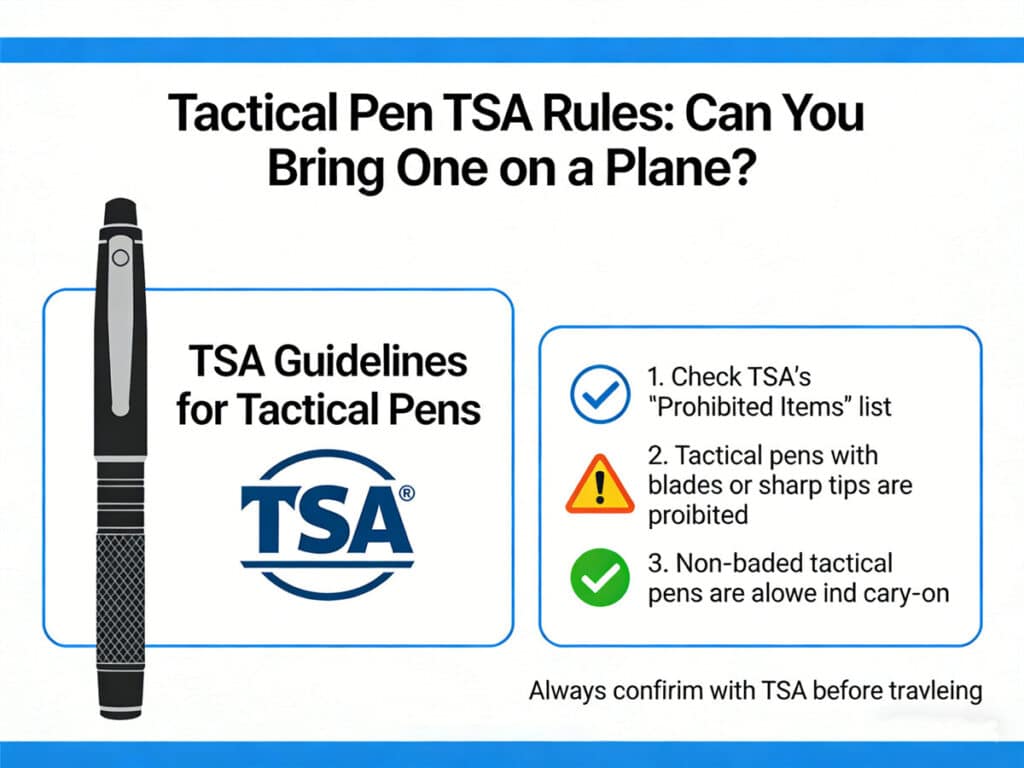
Standard pens and pencils are generally permitted in both carry-on and checked luggage. However, items designed for self-defense or constructed with reinforced striking features may fall under closer scrutiny. TSA officers have discretionary authority, meaning the final decision often depends on how the item appears during inspection.
Carry-On vs. Checked Luggage
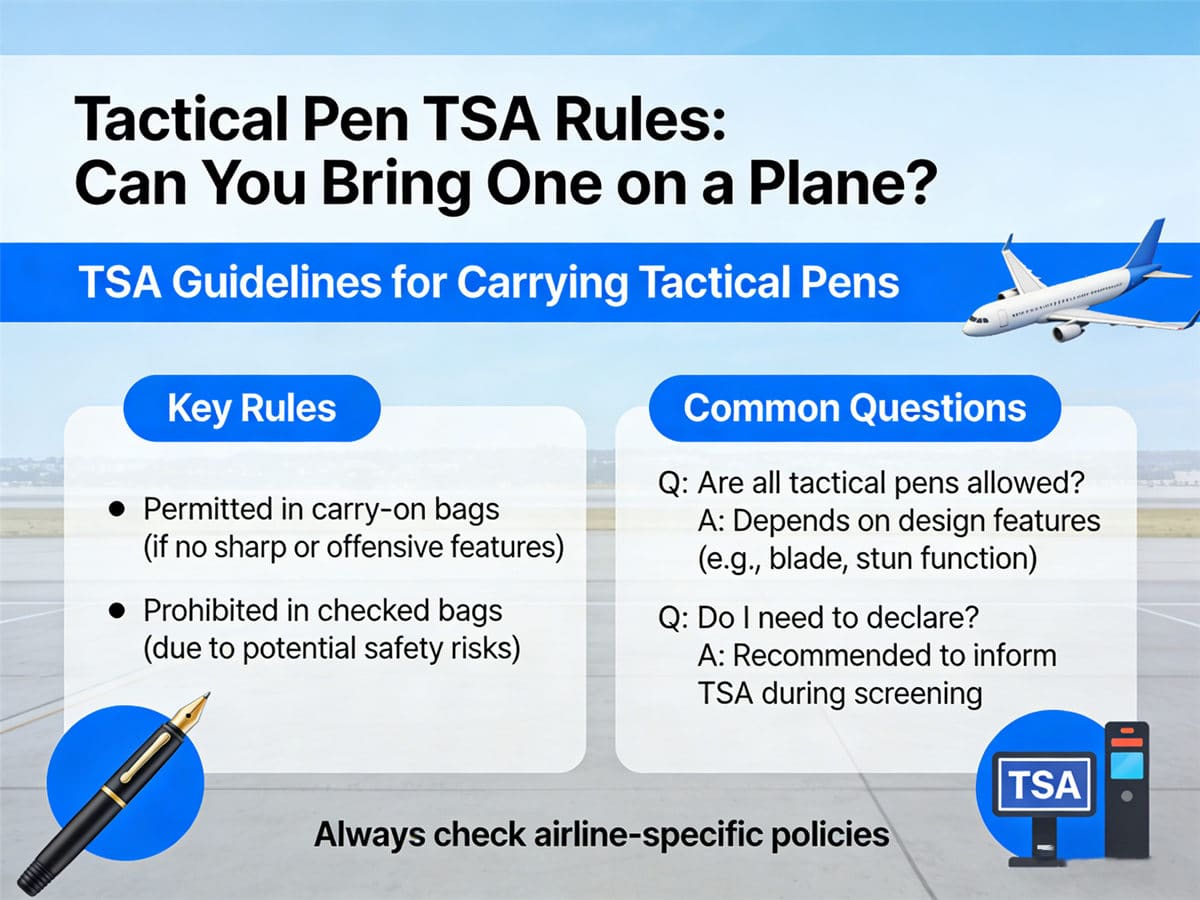
There is a significant distinction between carrying an item in hand luggage and placing it in checked baggage. Even if a tactical pen is not explicitly listed as prohibited, it may still be confiscated at the checkpoint if security personnel determine it poses a potential risk. In contrast, placing it in checked luggage typically reduces the likelihood of issues, provided the item is legal in the departure and arrival jurisdictions.
Travelers should review official TSA guidelines before flying, as regulations may change over time.
3. Why Tactical Pens Can Raise Concerns
Although many users view a tactical pen as a practical everyday tool, security personnel evaluate items based on potential misuse rather than intended use.
The reinforced tip, pointed edges, and durable metal body that make tactical pens appealing to consumers are precisely the features that may cause concern during airport screening. Security officers are trained to identify objects that could function as improvised defensive or offensive tools.
Design Variations Matter
Not all tactical pens are identical. Some models closely resemble standard writing instruments, while others clearly emphasize self-defense features. The more aggressive or weapon-like the appearance, the more likely it is to be flagged during screening. Simpler, discreet designs may attract less attention, but there is never a guarantee of approval.
4. International Travel Considerations
Travel regulations differ significantly outside the United States. Even if a tactical pen passes TSA screening in one country, it may be restricted or prohibited in another.
Some countries have strict regulations regarding self-defense tools or reinforced striking devices, and local authorities may interpret tactical pens under those categories. Travelers should research the specific laws of both departure and destination countries before packing such items.
Failure to comply with local laws can result in confiscation, fines, or legal complications. Therefore, understanding international policies is just as important as reviewing TSA guidance.
5. Practical Recommendations for Travelers
For those who rely on a tactical pen in daily life, careful planning can prevent inconvenience at the airport.
Place It in Checked Baggage
Whenever possible, placing the tactical pen in checked luggage is the safest option when flying. This minimizes direct scrutiny at security checkpoints and reduces the chance of confiscation.
Choose a Discreet Design
If traveling with a tactical pen, selecting a model that resembles a standard pen without overt defensive features may reduce attention during screening. However, discretion does not override TSA authority.
Be Prepared for Confiscation
Travelers should accept the possibility that a tactical pen may be seized. If the item has significant value, consider shipping it separately rather than risking loss at the checkpoint.
6. Legal and Safety Awareness Beyond TSA
Airport screening is only one aspect of responsible ownership. Travelers must also consider state and local laws, as regulations regarding self-defense tools vary widely.
Even if an item is permitted through airport security, carrying it in certain public spaces may still be restricted under local regulations. Responsible ownership involves understanding not only federal aviation policies but also regional legal frameworks.
When evaluating everyday carry tools, consumers should focus on practicality, legality, and appropriate use rather than novelty or perceived tactical appeal.
7. Making an Informed Decision Before You Fly
Ultimately, whether you can bring a tactical pen on a plane depends on multiple factors, including its design, the discretion of TSA officers, and the regulations of your destination country. The safest approach for air travel is to place such items in checked baggage or leave them at home altogether.
Consumers researching related personal carry equipment sometimes encounter other items such as a brass knuckle, which is far more clearly restricted in most jurisdictions and almost universally prohibited in carry-on luggage. When exploring tools or accessories from specialized retailers like brassknucklesmater.com, it is essential to verify current regulations, understand the legal landscape, and prioritize responsible use.
Air travel demands careful planning, and small oversights can lead to unnecessary complications. By reviewing guidelines in advance and making informed choices, travelers can avoid delays, protect their belongings, and move through security with confidence.