
May
Knowledge of Weapons, Weapons How
How to Choose the Right Blade Shape for Your Needs
Understanding Blade Geometry and Its Impact on Performance
The world of cutting tools presents an extraordinarily diverse landscape of blade shapes, each engineered with specific purposes in mind that have evolved over centuries of human innovation, refinement, and practical application across countless industries and disciplines. When you begin exploring the possibilities available to you, whether for everyday carry, outdoor adventures, professional use, or collecting purposes, understanding how different blade geometries influence performance characteristics becomes absolutely essential for making informed purchasing decisions that will serve you well over the long term. The shape of a blade determines everything from its cutting efficiency and piercing ability to its slicing capacity and ease of maintenance, which means that selecting the wrong configuration for your intended applications can result in frustration, reduced effectiveness, and potentially dangerous situations when tools fail to perform as expected under demanding conditions.
Many beginners make the mistake of selecting blades based primarily on aesthetic appeal or price considerations without fully appreciating how dramatically shape influences function, leading to purchases that seem attractive in marketing photographs but prove disappointing when subjected to real-world use that reveals fundamental mismatches between tool design and user requirements. By investing time in understanding the principles that govern blade geometry and how various shapes excel in different scenarios, you position yourself to make choices that align perfectly with your actual needs rather than perceived wants that may not translate into practical benefits in your specific applications and use cases. The knowledgeable team at brassknucklesmaster.com has helped countless customers navigate these decisions, and we are pleased to share that expertise with you through this comprehensive guide to selecting the ideal blade shape for your unique circumstances and requirements.
The Major Blade Shapes and Their Distinctive Characteristics
Drop Point Blades: The Versatile All-Rounder
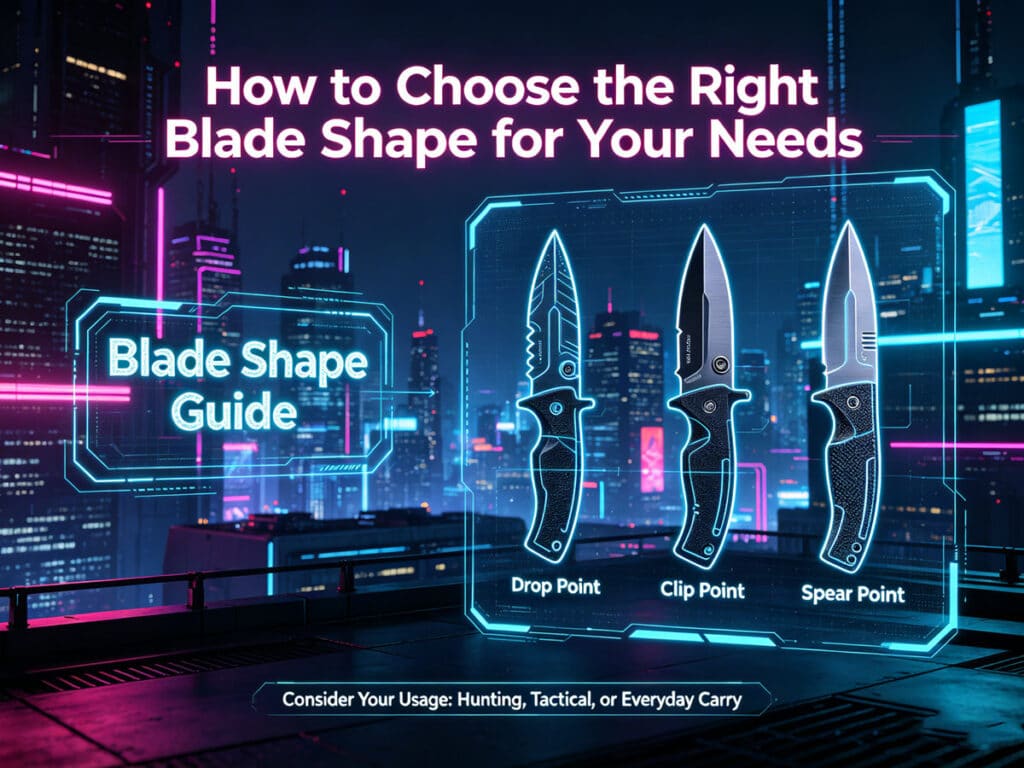
The drop point blade design represents perhaps the most universally popular configuration available today, characterized by a convex curve that slopes from the blade’s spine toward the tip in a gradual, controlled descent that creates a lowered point position relative to the spine line itself. This geometry provides exceptional control during detailed cutting tasks while maintaining robust strength in the tip area that resists breakage during demanding applications that might overwhelm more delicate configurations, making drop point blades the preferred choice for hunters, outdoor enthusiasts, and general-purpose users who need a single tool capable of handling diverse tasks without requiring multiple specialized implements. The large belly characteristic of quality drop point designs delivers excellent slicing capability that proves invaluable when processing game, preparing food, or performing any task requiring smooth, continuous cuts through soft materials that might resist less efficiently shaped alternatives.
The psychological confidence that comes from carrying a blade with a strong, reliable tip cannot be overstated, particularly for those who venture into wilderness environments where equipment failure could have serious consequences and where the ability to rely completely on your tools provides invaluable peace of mind that enhances the overall enjoyment of outdoor experiences. Drop point blades excel in survival situations precisely because their forgiving geometry accommodates the inevitable imprecision that accompanies high-stress decision-making and fine motor impairment caused by adrenaline, cold, fatigue, or injury that might cause even experienced users to make cuts they would not attempt under ideal conditions. This combination of versatility, strength, and user-forgiveness has made the drop point configuration a staple of military, law enforcement, and civilian toolkits worldwide, with countless manufacturers offering their interpretations of this proven design that continues to demonstrate its enduring value across applications and user populations.
Clip Point Blades: Style Meets Functionality
The clip point configuration presents a distinctive appearance characterized by a concave section near the blade’s tip that “clips” away part of the spine, creating a sharply defined point that drops significantly below the spine line and enables precision work that would challenge drop point designs operating under similar conditions and constraints. This lowered point position provides enhanced maneuverability in tight spaces where longer blades might prove cumbersome, while the acute angle of the clipped section creates an exceptionally sharp edge geometry that penetrates materials with minimal resistance and delivers clean, precise cuts that satisfy the requirements of professionals and enthusiasts who demand surgical accuracy from their cutting tools. The clip point design has deep historical roots, having been popularized by the iconic Bowie knife and countless traditional folding patterns that have served generations of users across diverse applications and environments that tested the limits of their capabilities.
The aesthetic appeal of clip point blades should not be underestimated, as their dramatic silhouette has captured the imagination of knife enthusiasts and collectors for centuries, with certain patterns achieving legendary status precisely because of their distinctive visual character combined with proven functional performance that has been validated through countless hours of demanding use by professionals who depend on their tools for livelihood and survival alike. However, the same concave grind that creates the clip point’s distinctive appearance also removes material from the spine area, potentially reducing strength in that region compared to straight-spined designs that maintain continuous thickness throughout their length without the dramatic geometric transitions that characterize clipped configurations. Understanding this trade-off enables intelligent selection decisions that account for the specific demands of your intended applications, ensuring that you choose clip point blades for situations where their advantages outweigh the structural considerations that might favor alternative geometries in different contexts.
Tanto Blades: Maximum Penetration Performance
The tanto blade shape originated from traditional Japanese sword designs and has been adapted for modern folding and fixed-blade applications where its distinctive geometry delivers exceptional penetration capability that outperforms virtually every other configuration when the primary objective involves piercing tough materials with minimal resistance and maximum effectiveness. Characterized by a straight-edged front section that transitions abruptly to a point formed by the intersection of the edge with the spine, tanto blades eliminate the curved belly found in most other configurations, instead featuring a flat or nearly flat edge profile that focuses all available force onto an extremely small contact area during piercing applications that demand maximum penetration depth and efficiency. This geometry proves particularly valuable in tactical and defensive applications where rapid, decisive penetration through barriers, clothing, or other obstructions can determine outcomes in life-threatening situations where seconds matter and effectiveness saves lives.
The reinforced tip area of tanto designs provides structural advantages that complement their penetration-focused geometry, as the abrupt transition from edge to spine creates a thick, robust point that resists chipping, rolling, or complete failure even when subjected to lateral stresses that might destroy more delicate configurations operating under identical conditions and abuse levels. Military and law enforcement professionals have embraced tanto blades precisely because this combination of penetration performance and tip durability addresses their unique requirements more effectively than general-purpose alternatives that must compromise between competing objectives rather than excelling at a specific primary function. However, the lack of belly in tanto designs significantly reduces their slicing efficiency, making them poor choices for applications where smooth, continuous cuts through soft materials represent the primary requirement, which means that users must honestly assess their needs before committing to tanto geometry that excels in some scenarios while proving inadequate in others that might be equally important to their particular use cases.
Matching Blade Shapes to Your Primary Applications
Everyday Carry Requirements
Selecting a blade shape for everyday carry purposes demands careful consideration of the diverse tasks you encounter regularly, as the ideal everyday carry configuration must balance cutting performance with discretion, legal compliance, and practical handling characteristics that facilitate rapid deployment when needed without creating awkwardness during routine activities that comprise the majority of your daily interactions with your tool. Drop point blades consistently emerge as the top recommendation for everyday carry precisely because their versatile geometry handles the unpredictable mix of tasks that characterize daily life without requiring you to carry multiple specialized tools, with the added benefit of typically presenting a less threatening appearance that generates less concern from observers who might feel uncomfortable around more aggressive-looking configurations that project an unnecessarily intimidating aesthetic in social situations where such impressions prove counterproductive or problematic.
The weight and size considerations that accompany everyday carry further influence optimal shape selection, as larger, heavier blades may provide superior cutting performance but become burdensome during extended carry periods or in situations requiring physical activity that would be impeded by excessive bulk and mass hanging from your belt or occupying your pocket space throughout the day. Many everyday carry enthusiasts gravitate toward compact folding knives with drop point or modified clip point blades that deliver adequate performance for common tasks while maintaining the slim profiles and light weights that make consistent carry practical and comfortable across the full range of activities that comprise their daily routines. Understanding your specific everyday carry requirements through honest self-assessment enables you to prioritize the characteristics that matter most to you personally, whether that involves maximum cutting efficiency, legal compliance in restrictive jurisdictions, social acceptability in professional environments, or simply the psychological comfort of knowing you have a capable tool readily available when unexpected needs arise.
Outdoor and Tactical Applications
Outdoor enthusiasts and tactical practitioners face demanding requirements that often justify carrying more specialized equipment optimized for specific functions rather than the general-purpose versatility that everyday carry users typically prioritize in their selection decisions and purchasing choices. Hunters benefit enormously from drop point blades with generous belly sections that facilitate the skinning, caping, and general processing tasks that consume the majority of their cutting time in the field, with the strong tip providing confidence during the occasional precision work that even routine hunting activities inevitably require at various stages of animal processing and preparation that follow successful harvests. The corrosion-resistant properties of certain blade steels become particularly important for hunting applications where exposure to moisture, blood, and biological materials creates aggressive corrosive environments that can damage inadequate finishes or coatings while leaving properly protected blades unaffected throughout extended field use.
Tactical applications introduce additional considerations regarding blade shape selection, with tanto configurations gaining significant popularity among professionals who prioritize penetration performance and tip durability above all other characteristics in their equipment choices and purchasing decisions. The integration of complementary tools such as brass knuckle designs and tactical pen configurations has created comprehensive personal defense ecosystems where multiple specialized implements work together to address diverse threat scenarios that might require different response modalities depending on specific circumstances and environmental conditions that cannot be predicted with certainty in advance. Understanding the full range of tools available and how they complement each other enables tactical practitioners to build capability sets that address their specific threat profiles more effectively than any single implement could achieve independently, which represents the fundamental principle underlying modern tactical equipment selection and deployment strategies employed by professionals worldwide.
Steel Selection and Edge Geometry Considerations
Understanding Blade Steel Properties
The material from which a blade is constructed matters tremendously for overall performance, and even the most perfectly shaped blade will disappoint if manufactured from inappropriate steel that lacks the properties necessary for your intended applications and use environments. Carbon steels offer excellent edge retention and ease of sharpening but require more attentive maintenance to prevent corrosion that can compromise both aesthetics and structural integrity if neglected over extended periods of exposure to moisture or corrosive substances that attack unprotected iron-based alloys. Stainless steels provide superior corrosion resistance that appeals to users who prioritize low-maintenance ownership experiences, though many stainless formulations sacrifice some edge retention or sharpness potential compared to carbon alternatives that require more care but deliver superior performance in specific applications where those characteristics prove decisive for success.
The heat treatment process that transforms raw steel into useful blade material dramatically influences final properties, with proper heat treatment unlocking the full potential of even modest steel compositions while inadequate processing can render premium alloys disappointing in actual use despite their theoretical capabilities on paper specifications and marketing materials. Reputable manufacturers publish detailed information about their heat treatment processes and resulting hardness ratings, enabling informed comparisons between competing products that might appear similar superficially but differ substantially in the critical details that determine real-world performance and longevity under demanding conditions that reveal weaknesses invisible during casual inspection. Understanding these technical aspects empowers you to evaluate products intelligently rather than relying solely on brand reputation or price point to guide purchasing decisions that deserve more thoughtful analysis based on verifiable specifications and demonstrated capabilities.
Edge Geometry and Sharpening Requirements
The way a blade is sharpened and the geometry of its edge significantly impact cutting performance independent of shape considerations, with thicker edges providing durability at the cost of cutting efficiency while thinner edges slice more aggressively but require more frequent maintenance to retain their optimal geometry under use. Understanding your willingness and ability to maintain your blades should influence both the edge geometry you select and the steel composition that will best match your maintenance capabilities and preferences, as premium steels that hold edges for extended periods often prove frustratingly difficult to sharpen when maintenance becomes necessary, creating a trade-off that favors different solutions for different users depending on their specific circumstances and priorities.
Factory edge quality varies dramatically between manufacturers and price points, with some budget offerings arriving with edges too thick for effective cutting while premium products arrive razor-sharp and ready for immediate use without requiring additional honing or refinement before deployment in demanding applications. Taking time to properly refine factory edges on new purchases often proves worthwhile even when initial sharpness seems adequate, as personal attention to edge geometry ensures that your blade performs optimally from the beginning rather than requiring discovery of deficiencies during critical moments when peak performance matters most and suboptimal edges might compromise outcomes in ways that could have been prevented through simple preparation steps taken in advance of actual need.
Making Your Final Selection with Confidence
The process of choosing the right blade shape ultimately comes down to honest self-assessment of your actual needs, realistic evaluation of your maintenance capabilities, and clear prioritization of the characteristics that matter most to you personally in your specific applications and use contexts. No single blade shape excels at everything, which means that even the most thoughtfully selected individual implement will represent compromises between competing objectives that cannot all be optimized simultaneously within a single design solution that must satisfy multiple requirements simultaneously. Understanding this fundamental reality enables you to approach blade selection with appropriate expectations that prevent disappointment when your chosen implement fails to perform tasks it was never designed to address effectively, rather than tasks it handles beautifully within its intended design parameters and optimal application range.
Building a collection that addresses diverse needs through multiple specialized implements often proves more satisfying than attempting to find a single blade that attempts to do everything adequately while excelling at nothing in particular, with serious enthusiasts typically accumulating various configurations over time as they discover specific requirements through experience that could not have been anticipated through theoretical analysis alone. The journey of discovering your preferences and requirements represents half the enjoyment of this hobby, with each acquisition teaching lessons that inform future purchasing decisions and gradually refine your understanding of what truly matters to you personally in the tools you choose to own and carry through daily life. Whether you are just beginning to explore the possibilities or are an experienced collector seeking to fill gaps in your existing capability set, approaching each selection decision with the thoughtful analysis outlined in this guide ensures that your purchases will serve you well for years to come.
For additional guidance on selecting the perfect blade for your needs, exploring complementary tools like quality brass knuckle designs, or discovering the full range of options available from trusted suppliers, the experts at brassknucklesmaster.com stand ready to assist you in finding solutions that match your requirements precisely while providing the exceptional customer service and product quality that distinguish truly professional suppliers from casual marketplace sellers who lack the expertise and commitment necessary to support customers through important purchasing decisions that deserve thoughtful guidance from knowledgeable professionals who understand the products they sell and the applications their customers seek to address through their acquisitions.