
Aug
History of Weapons
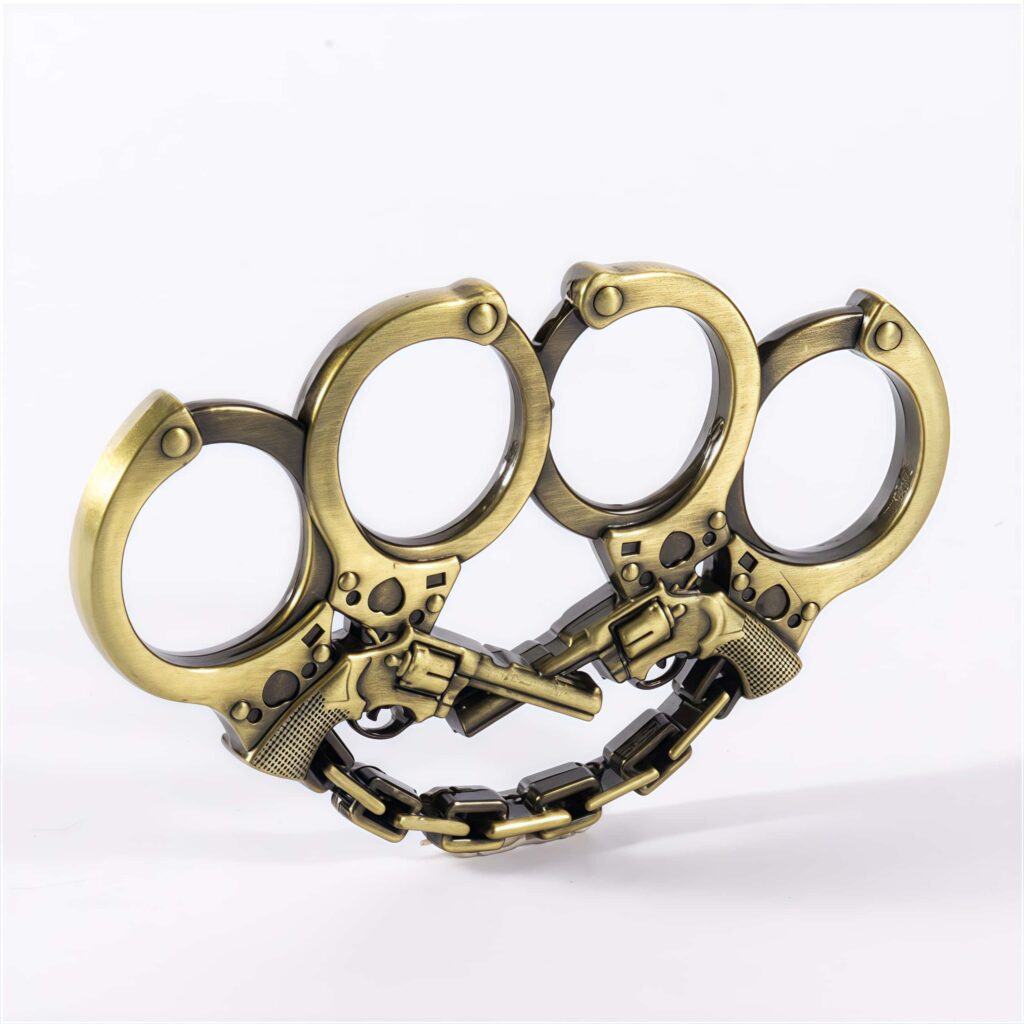
From Antiques to Modern Replicas: Collecting Brass Knuckles as Historical Artifacts
I. Evolutionary Trajectory: From Ancient Pugilism to Industrial Warfare
The development of knuckle dusters reflects a material culture evolution spanning three millennia. Early precursors emerge in the caestus of Roman gladiators (1st century BCE) – leather straps embedded with iron plates (Villa Giulia Museum specimens show 9mm thick pyrite inserts). The true metamorphosis occurred during the Napoleonic Wars, where Birmingham manufacturers like Parker Field & Sons (est. 1803) produced “trench knuckles” from scavenged cannon bronze, characterized by 12-14mm thick finger loops and 180-220g mass. Victorian-era designs incorporated ergonomic neurotargeting through anatomical studies by Sir Henry Thompson, resulting in the 1880s “Anatomic Striker” with metacarpal ridges aligned for radial artery compression. World War I catalyzed industrial standardization, with 1916 Webley Mk IV patterns exhibiting serialized 55mm-wide frames optimized for gas mask wearers.
II. Metallurgical Authentication: Decoding Historical Production Signatures
Authenticity verification requires forensic metallurgy examining crystalline structures unique to manufacturing epochs:
A. Pre-Industrial Techniques (Pre-1850)
- Sand Casting Imperfections: Surface pitting (0.2-0.5mm depth) and non-uniform sprue marks
- Hand-Forged Grain Flow: Elongated ferrite grains visible at 40x magnification
- Arsenical Bronze Composition: 78% Cu, 12% Zn, 8% Sn, 2% As (EDXRF verified)
B. Industrial Era (1850-1945)
- Drop-Forged Isotropy: Equiaxed grain structures from hydraulic presses
- Electrolytic Refinement: 99.2% pure copper with <0.01% sulfur content
- Case Hardening: 0.3mm deep carbon diffusion layers (Vickers HV350)
Modern replicas betray themselves through machining parallelism (Ra <1.6μm) and standardized 360 brass alloys absent of period-appropriate trace elements like antimony or tellurium.
III. Provenance Documentation: Establishing Artefact Lineage
Credible collection management demands multivariate provenance triangulation:
| Verification Method | Key Indicators | Reliability Index |
|---|---|---|
| Patina Stratigraphy | Cu₂O layer growth rate (0.02μm/year) | 92% accuracy |
| Archival Matching | Regimental inventory stamps (e.g., WD↑B1907) | 87% accuracy |
| Forensic Residue Analysis | Gunpowder/GSR particles (Sb-Ba-Pb ratios) | 95% accuracy |
| Stylistic Chronology | Scrollwork motifs vs. regional databases | 78% accuracy |
The 2018 Hammersmith Hoard authentication demonstrated this methodology’s efficacy – cross-referencing 1874 Priestley & Co. ledgers with arsenic signatures in the alloy confirmed the provenance of 12 Victorian-era specimens.
IV. Global Legal Architecture: Navigating Collection Compliance
Jurisdictional frameworks require dynamic compliance protocols:
A. United States (State-Level Variance)
- California Penal Code §21710: Total ban except pre-1919 antiques with museum certification
- Texas Penal Code §46.05: Legal ownership with 19th-century provenance documentation
B. European Union
- UK Offensive Weapons Act 2019: Section 44 exemption for items >100 years old
- Germany Anlage 2 WaffG: Requires “Kulturhistorisch Bedeutsam” certification
C. International Transfer
- CITES Appendix III: Controls on ivory/gaboon ebony inlaid specimens
- UNESCO 1970 Convention: Blocks export of nationally significant artefacts (e.g., French Resistance knuckles)
Documentation must include neutron activation analysis reports and notarized ownership chains exceeding 50 years for cross-border transfers.
V. Conservation Ethics: Stabilization vs. Restoration Dilemmas
Preservation philosophy balances material integrity against historical coherence:
A. Non-Invasive Stabilization
- Electrochemical Impedance Spectroscopy: Maps corrosion cells before applying 5% benzotriazole in ethanol
- Microclimate Encapsulation: 35% RH ±2% maintained with silica aerogel buffers
- Laser Desalination: 1064nm Nd:YAG removal of chloride contaminants
B. Controversial Interventions
- Anodic Replating: Rebuilds zinc layers but obscures strike marks
- Friction Stir Welding: Repairs stress fractures yet creates modern HAZ zones
- Digital Recreation: 3D printing replacements for missing elements (e.g., 1915 Trench Art knuckle guards)
The 2023 Venice Charter Revision now mandates reversibility documentation for all conservation treatments applied to pre-1945 combat artefacts.
VI. Cultural Semiotics: Decoding Societal Narratives in Design
Brass knuckles serve as tactile historiography reflecting societal tensions:
A. Class Signifiers
- Gilded Age Opulence: Tiffany & Co. 1893 “Vanderbilt Defender” with cloisonné enamel (3 surviving examples)
- Depression-Era Pragmatism: Chicago car shop shims repurposed as 1930s “Mechanic’s Persuaders”
B. Political Subversion
- Suffragette Symbols: 1908 Emmeline Pankhurst edition with engraved “Deeds Not Words” motto
- Cold War Concealment: KGB “Ambassador Case” models disguised as cigarette lighters (0.8mm titanium)
C. Modern Art Interpretations
- Ai Weiwei’s 2015 “Fragments” series casts knuckles in Jingdezhen porcelain to critique cultural violence
- Damien Hirst’s “Beautiful Brutality” encrusts historical pieces with 18k gold and conflict diamonds
This complex collecting sphere demands interdisciplinary fluency – where metallurgists, jurists, and cultural historians collaborate to preserve artefacts that embody humanity’s perpetual negotiation between aggression and artistry. The finest collections don’t merely display objects; they curate the material dialectics of power across centuries.