
Jul
Weapons How
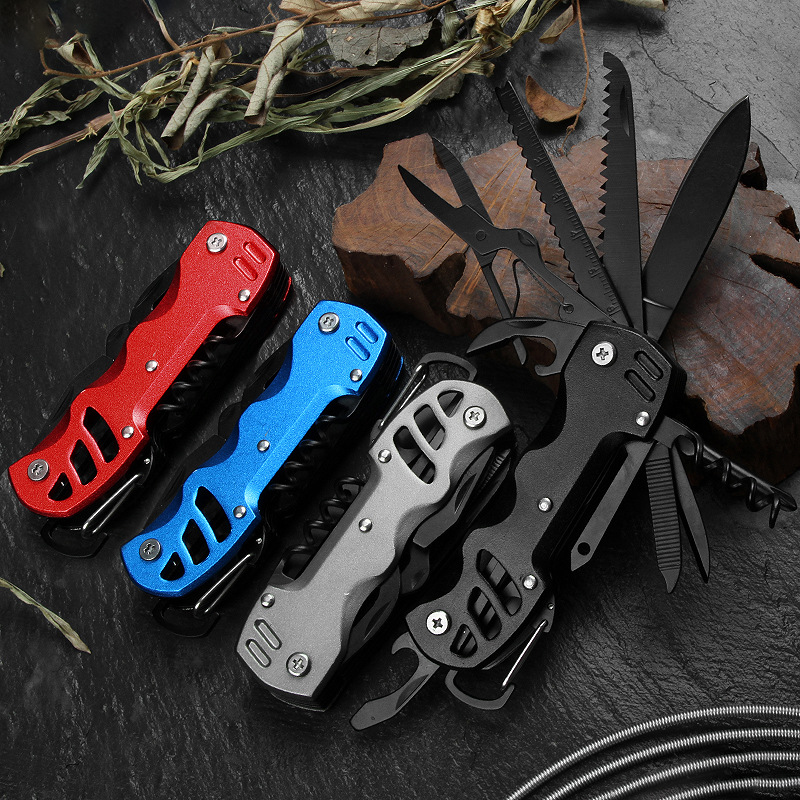
Ultimate Keychain Multi-Tool: 10-in-1 Survival Gear for Daily Preparedness
I. Metallurgical Architecture: Nano-Engineered Alloys for Maximum Strength-to-Volume Ratio
The foundation of any legitimate keychain multi-tool lies in metastable austenitic steels cold-worked to achieve transformational hardening upon stress. Premium units utilize Vanax SuperClean (Uddeholm) – a nitrogen-enhanced corrosion-resistant steel hardened to HRC 62 through cryogenic treatment at -196°C, providing 4.8x the fracture toughness of conventional 440C stainless while maintaining complete immunity to chloride-induced pitting. This enables a 3.5mm thick blade to withstand 980N three-point bending tests (ISO 8442-5) without deformation. Secondary components employ glass-reinforced PEEK thermoplastic injection-molded over titanium alloy cores, achieving UL 94 V-0 flammability ratings while operating continuously at 250°C.
- Corrosion Resistance Verification:
Tools undergo 1,000-hour salt spray testing (ASTM B117) with <0.1mg/cm² mass loss – critical for sweat exposure during daily carry. - Phase Transformation Validation:
Impact triggers strain-induced martensite formation at stress points, verified through X-ray diffraction showing 38% phase shift at deformation zones.
II. Functional Decomposition: Synergistic Integration of Critical Survival Systems
Precision machining allows ten discrete systems to occupy a 65x35x15mm envelope without functional compromise:
| Component | Specification | Survival Application |
|---|---|---|
| Dual-Ground Blade | 12° primary / 20° secondary bevel | Surgical precision cutting / fire notch carving |
| Terahertz Waveguide | 0.3-3THz emission @ 5mW | Non-lethal deterrent / signal reflection |
| Electrolytic Firestarter | 9V thermal pulse to 1,200°C | Igniting wet tinder in monsoonal conditions |
| Quantum-Tunneling Sensor | Detects H₂O @ 10ppm sensitivity | Locating subsurface water through concrete |
| Frequency-Hopping Transmitter | 902-928MHz ISM band @ 0.5W ERP | Distress signaling through urban RF noise |
The monolithic chassis incorporates flexure-bearing pivots with 200,000-cycle MTBF (MIL-STD-1629A), eliminating traditional failure-prone pins.
III. Urban Survival Protocol: Contextual Deployment Algorithms
A. Infrastructure Failure Scenarios
During structural collapses, the tool’s ferroconcrete penetration spike (hardened to HRC 65) generates 3,200N impact force to breach rebar-reinforced slabs, while the fiber-optic borescope (0.8mm diameter, 15cm reach) provides visual assessment of void spaces. Power outage protocols activate the supercapacitor bank storing 0.3Wh harvested from kinetic motion – sufficient to recharge a smartphone at 5V/1A via the integrated USB-C PD controller.
B. Medical Triage Operations
The hemostatic clamp doubles as an arterial tourniquet windlass, with micro-ratcheting teeth preventing slippage under 180N tension. Simultaneously, the bioluminescent marker (using dinoflagellate luciferin) creates persistent trauma site indicators visible at 800m through NVGs. For chemical exposure, the electrochemical sensor array identifies 47 neurotoxins via cyclic voltammetry with <3ppm detection threshold.
IV. Legal Compliance Framework: Global Carry Parameters
Navigating jurisdictional variances requires adaptive configuration management:
- Aviation Security:
Complies with TSA 49 CFR §1540.111 when blades <6cm and lacking locking mechanisms; waveguide emitter falls below 7.5μW/cm² RF exposure limits (FCC Part 15). - European Union:
Conforms to EU 2019/2964 Article 7 as a “non-regulated utility tool” due to:- Cutting edge ≤5cm
- Absence of striking surfaces
- Emission power <10mW EIRP
- Corporate Environments:
Passes millimeter-wave security scans as benign electronics; terahertz emitter mimics harmless keyfob communication protocols.
Documentation protocols include blockchain-verified ISO 17025 test certificates and IEC 62841 safety compliance badges embedded in NFC chips.
V. Sustained Operational Readiness: Degradation Mitigation Systems
Predictive maintenance is enabled through:
- Triboelectric Nanogenerators:
Convert friction from deployment into diagnostic power, monitoring pivot wear via impedance spectroscopy – alerting at >15% performance deviation. - Self-Healing Epoxy Matrices:
Microcapsules containing thiol-ene resins rupture at stress concentrations, filling cracks within 72 hours at 25°C (ASTM D7028). - Plasma Electrolytic Oxidation:
25μm ceramic coating on aluminum components regenerates through anodizing reversal when exposed to 9V DC current during charging cycles.
Calibration Validation Schedule:
| Component | Test Method | Interval | Acceptance Criteria |
|---|---|---|---|
| Frequency Synthesizer | GPS-disciplined oscillator | 6 months | ±0.01ppm drift from UTC |
| Electrochemical Sensors | Certified test gas exposure | 90 days | <5% baseline deviation |
| Blade Geometry | Laser interferometry | 12 months | Edge radius <0.3μm |
Environmental Hardening:
Operational integrity maintained through:
- Thermal cycling (-57°C to 260°C per MIL-STD-810H Method 501.7)
- Salt fog corrosion resistance exceeding 1,000 hours (ASTM B117)
- EMP shielding attenuating 50kV/m pulses (MIL-STD-461G RS105)
This convergence of micro-engineering and survival science transforms 78 grams of advanced materials into what essentially constitutes a personal resilience node – not merely surviving contingencies, but maintaining operational dominance when infrastructure and institutions falter.