
Feb
Knowledge of Weapons, Weapons What
Beginner’s Guide: What Makes a Good Rescue Knife?
In professional environments where safety, emergency response, and operational readiness are paramount, the tools selected for frontline personnel must meet standards that extend far beyond aesthetics or novelty appeal. Among these tools, the rescue knife occupies a specialized and critical role, designed not for general cutting tasks or collection display, but for urgent, high-pressure scenarios in which seconds matter and reliability can directly influence outcomes. For business owners supplying emergency equipment, fleet operators equipping service vehicles, or retailers expanding into safety-oriented product lines, understanding what truly defines a good rescue knife is essential to making responsible and commercially sound decisions.
Unlike decorative blades or historical replicas, a rescue knife is engineered for practical intervention in real-world emergencies such as vehicle extrications, maritime incidents, industrial entanglements, or disaster response scenarios. The design must prioritize accessibility, durability, and user safety under stress. This guide examines the structural features, materials, deployment mechanisms, compliance considerations, and purchasing strategies that separate a reliable rescue knife from an ordinary cutting tool.
Purpose-Driven Design: Defining the Role of a Rescue Knife
At its core, a rescue knife is built to perform specific emergency functions, most commonly cutting through seat belts, rope, webbing, or clothing in situations where trapped individuals must be freed quickly and safely. Unlike standard utility knives, rescue knives are typically optimized for one-handed deployment and controlled cutting in confined spaces.
A well-designed rescue knife often incorporates a partially serrated blade, enabling rapid slicing through fibrous materials that might resist a plain edge. The blade geometry is typically engineered to reduce accidental puncture risk, especially when cutting near a person’s body. In vehicle accident scenarios, for example, responders must be able to sever a seat belt without injuring the occupant.
For commercial operators—such as fleet managers equipping service vans, towing operators, or security teams—the rescue knife is not an optional accessory but a safety asset. Selecting a model that aligns with the intended operating environment ensures that the tool performs as expected under pressure.
Blade Configuration and Material Selection
The performance of a rescue knife depends heavily on blade construction, steel quality, and edge design. These technical elements influence cutting efficiency, corrosion resistance, maintenance requirements, and long-term durability.
Serrated vs. Straight Edge
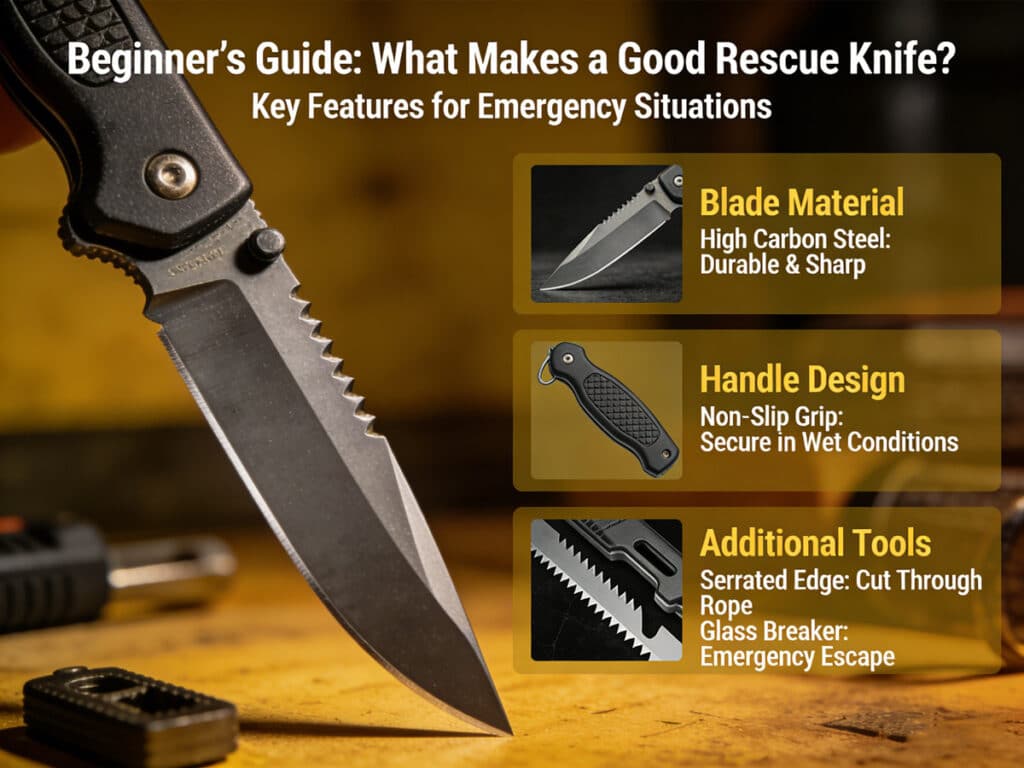
Most rescue knives incorporate a serrated section because serrations excel at gripping and slicing through tough, flexible materials. In emergency scenarios involving nylon straps or synthetic fibers, a serrated edge can dramatically reduce cutting time. Some models combine a short straight edge segment for controlled precision cuts with a serrated section for aggressive slicing.
Business owners should consider their primary customer base when selecting inventory. Emergency responders and maritime users often prefer pronounced serrations, while industrial buyers may request hybrid configurations.
Steel Quality and Corrosion Resistance
Rescue knives are frequently exposed to moisture, fluids, and outdoor conditions. High-quality stainless steel alloys offer corrosion resistance and maintain edge integrity over time. In marine environments or humid climates, corrosion resistance becomes particularly critical.
Investing in durable blade materials reduces warranty claims, enhances customer satisfaction, and strengthens brand reputation. Retailers positioning themselves as reliable equipment providers must prioritize performance specifications over purely cosmetic features.
Integrated Emergency Features
A defining characteristic of a good rescue knife is the integration of supplementary safety features that extend its functionality beyond simple cutting.
Seat Belt Cutters and Hook Blades
Many rescue knives include a dedicated seat belt cutter or hook blade integrated into the handle. This enclosed cutting channel allows users to sever straps without exposing a sharp blade, reducing the risk of accidental injury. In high-stress rescue operations, simplicity and safety are invaluable.
Glass Breakers
Another common feature is a carbide-tipped glass breaker located at the handle’s base. In vehicle extrication scenarios, responders may need to shatter tempered glass quickly. A reliable glass breaker eliminates the need for separate tools and enhances operational readiness.
For fleet managers and safety coordinators, these integrated features offer practical advantages. Equipping vehicles with multifunctional rescue knives reduces equipment redundancy while maintaining comprehensive emergency capability.
Ergonomics, Deployment, and Reliability
Emergency tools must function seamlessly under pressure, often when users are wearing gloves or operating in low-visibility conditions. Ergonomic design and dependable deployment mechanisms are therefore central to a rescue knife’s effectiveness.
One-Handed Operation
Many rescue knives utilize assisted opening mechanisms, thumb studs, or flipper tabs to enable one-handed deployment. In emergency scenarios where one hand may be stabilizing a victim or holding onto a structure, single-hand operation becomes essential.
Locking mechanisms must be robust and secure, preventing accidental closure during use. Liner locks, frame locks, or other reinforced locking systems provide the necessary stability for controlled cutting.
Handle Grip and Visibility
Textured handles made from materials such as G10, aluminum, or reinforced polymer improve grip security, particularly in wet conditions. Brightly colored handles—often in orange or high-visibility tones—make the knife easier to locate quickly inside a vehicle compartment or emergency kit.
From a procurement perspective, businesses should test sample units under realistic conditions to evaluate grip comfort and deployment smoothness. Tools that function flawlessly in controlled environments may perform differently in field conditions.
Compliance, Liability, and Responsible Retailing
Retailers and distributors operating in the rescue knife segment must remain vigilant regarding local and regional regulations governing blade length, carry permissions, and shipping restrictions. Compliance is not merely a legal obligation; it is a cornerstone of responsible business practice.
Clear product descriptions that specify blade dimensions, locking mechanisms, and intended use help reduce customer misunderstandings. Transparent communication protects both the retailer and the end user.
For online sellers expanding into related product categories—perhaps offering tactical accessories or novelty items such as brass knuckles—careful segmentation and compliance awareness become even more critical. While rescue knives are safety tools, other items may fall under stricter legal scrutiny. Responsible merchandising ensures that emergency equipment is positioned appropriately and marketed ethically.
Platforms like brassknucklemasters.com, which serve diverse customer interests, must implement clear disclaimers and compliance guidelines to maintain trust and avoid regulatory complications. Businesses that prioritize legal clarity and ethical positioning strengthen long-term viability.
Strategic Considerations for Business Owners
From an operational standpoint, stocking rescue knives should be approached with the same rigor applied to any professional-grade equipment line. Business owners must evaluate supplier reliability, material quality certifications, warranty terms, and after-sales support.
Inventory planning should account for seasonal demand variations. For example, demand may increase during winter months when road accidents rise in certain regions. Fleet operators may also conduct annual safety audits, creating predictable purchasing cycles.
Pricing strategy should balance affordability with perceived reliability. Emergency tools are not impulse purchases; buyers prioritize trustworthiness and performance. Offering mid-tier and premium options allows businesses to capture different budget segments without compromising safety standards.
In addition, cross-selling opportunities can enhance revenue while maintaining responsible positioning. For instance, pairing rescue knives with vehicle emergency kits, first-aid supplies, or safety lighting systems creates cohesive product bundles aligned with preparedness themes.
The long-term success of a rescue knife product line depends on consistent quality, transparent communication, and alignment with real-world operational needs. Business owners who treat rescue knives as critical safety instruments rather than novelty blades will build stronger customer relationships and reinforce their reputation as reliable suppliers.
A well-designed rescue knife embodies durability, accessibility, and purpose-driven engineering. For retailers and fleet managers seeking to expand their safety equipment offerings, selecting models that integrate high-performance materials, ergonomic design, and multifunctional features ensures both operational readiness and customer confidence. By focusing on practical deployment scenarios, compliance awareness, and supplier accountability, businesses can confidently incorporate rescue knives into their product portfolios while maintaining a professional and responsible market presence.