
Apr
Knowledge of Weapons
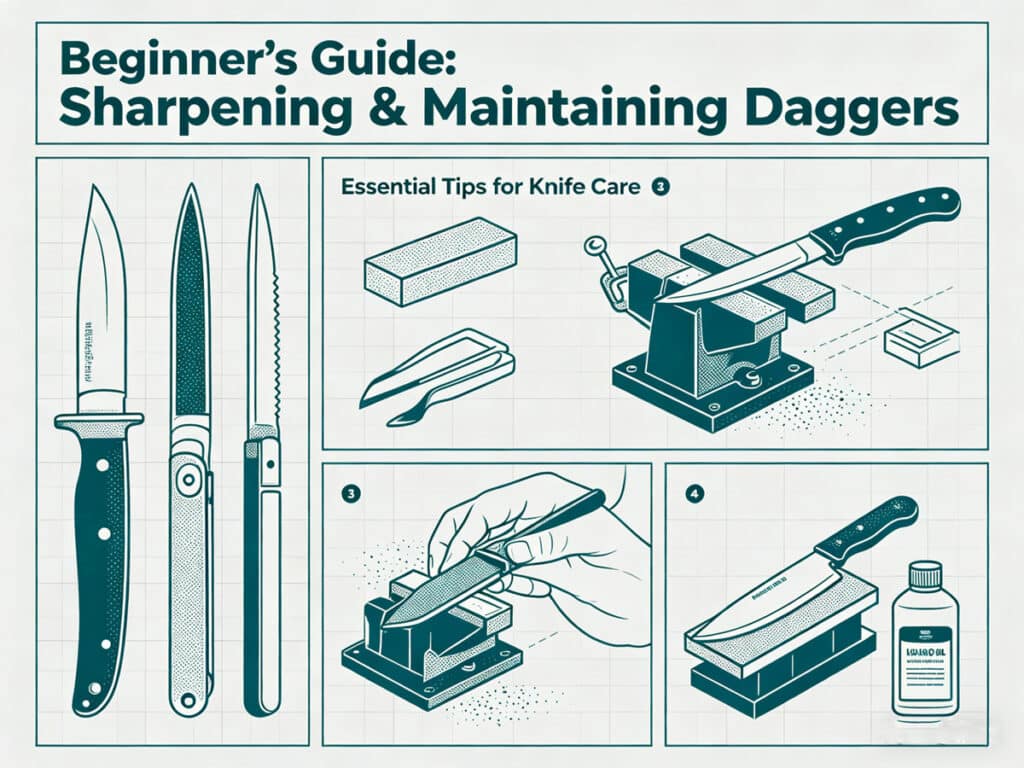
Beginner’s Guide: Sharpening & Maintaining Daggers
A dagger is more than just a blade—it’s an investment in craftsmanship, a tool of utility, and for many, a symbol of tradition and heritage that deserves proper care and attention. Whether you’ve recently acquired your first dagger or have been collecting these elegant weapons for years, understanding how to properly sharpen and maintain your blade is absolutely essential for preserving both its functionality and its aesthetic appeal. Many dagger owners make the mistake of neglecting this crucial aspect of ownership, only to discover their prized blades have become dull, corroded, or damaged beyond easy repair. The truth is that with consistent, proper maintenance, a quality dagger can last a lifetime and even be passed down through generations as a treasured family heirloom.
This comprehensive beginner’s guide will walk you through everything you need to know about keeping your dagger in optimal condition, from understanding basic blade geometry to mastering fundamental sharpening techniques that will restore and maintain your blade’s edge. We’ll cover the tools you’ll need, the techniques that work best, and the common mistakes that even experienced dagger owners sometimes make. By the end of this guide, you’ll have the knowledge and confidence to properly care for your dagger like a true enthusiast.
Understanding Your Dagger: Blade Anatomy and Steel Types
Before diving into the practical aspects of sharpening and maintenance, taking time to understand your dagger’s construction will significantly improve your ability to care for it properly. Every dagger consists of several key components—the blade itself, the edge geometry, the point, the spine, and the tang that extends into the handle—and each of these elements plays a crucial role in how the dagger performs and how it should be maintained. Familiarizing yourself with these terms and their functions will help you communicate more effectively with other enthusiasts and make better decisions when purchasing maintenance supplies or seeking professional services.
The type of steel used in your dagger’s construction has a profound impact on how it should be sharpened and maintained. High carbon steels, which include popular varieties like 1095, 1084, and O1 tool steel, are known for their excellent edge retention and ease of sharpening, but they are more susceptible to rust and corrosion if not properly cared for. Stainless steels, such as 440C, AUS-8, and VG-10, offer superior resistance to corrosion and staining, making them ideal for daggers that will be exposed to moisture or used in demanding environments, though they may require more effort to achieve a truly razor-sharp edge. Damascus steel, which is created by forge-welding multiple layers of different steels together, combines aesthetic beauty with functional properties, but requires specialized knowledge to sharpen correctly without damaging its distinctive pattern.
Blade geometry refers to the shape and angles of the blade’s cross-section, and understanding this concept is vital for effective sharpening. Daggers typically feature either a flat grind, which creates a blade with straight-edged sides tapering to a sharp edge, or a hollow grind, which features curved sides creating a distinctive concave shape. Each geometry has its own characteristics in terms of cutting performance, durability, and sharpening requirements. Knowing your dagger’s specific geometry will guide your choice of sharpening methods and help you achieve optimal results without accidentally altering the blade’s fundamental design.
Essential Tools for Dagger Maintenance and Sharpening
Equipping yourself with the right tools is the foundation of effective dagger maintenance, and fortunately, you don’t need to invest in an extensive collection of equipment to keep your blade in excellent condition. The market offers a wide range of sharpening and maintenance products at various price points, from budget-friendly options suitable for beginners to premium tools favored by professional bladesmiths and serious collectors. Understanding what each tool does and when to use it will help you build a practical toolkit that serves your specific needs without unnecessary expense.
Whetstones remain the gold standard for sharpening daggers, offering superior control and the ability to achieve exceptionally sharp edges when used correctly. These stones come in various grit levels, with lower numbers like 200 to 400 grit representing coarse stones designed for repairing damaged edges or reshaping blades, medium grits around 800 to 1000 suitable for general sharpening work, and fine grits from 2000 to 8000+ used for polishing and achieving mirror-like finishes. Many dagger owners find that a basic three-stone progression—coarse, medium, and fine—provides everything needed for routine maintenance, though additional grits can refine your results if you desire the sharpest possible edge.
Diamond plates offer another excellent option for dagger sharpening, particularly for those who prefer a more forgiving surface that won’t dish or wear unevenly over time. These plates feature tiny diamond particles bonded to a metal base, creating an extremely hard and durable sharpening surface that works effectively on virtually any steel type. They excel at quickly removing material and can be used dry or with water as a lubricant, making them convenient for field maintenance situations. However, they can be more expensive than traditional whetstones and may remove material more quickly than some users prefer.
Leather stropping paddles and bench stones serve as essential finishing tools that refine your edge after sharpening, removing any remaining burrs and aligning microscopic teeth along the blade’s edge. A properly stropped dagger can achieve shaving-sharpness that would otherwise be difficult to attain, and regular stropping between full sharpenings helps maintain your blade’s edge much longer than allowing it to deteriorate before addressing it. Quality stropping compounds, typically made from chromium oxide or diamond paste, enhance the stropping effectiveness and allow you to customize your finish based on your preferences.
Basic Maintenance Supplies Every Dagger Owner Needs
Beyond sharpening tools, several additional supplies are essential for comprehensive dagger maintenance. High-quality blade oil, such as those specifically formulated for knives or general-purpose lubricants like Tuf-Glide, protects carbon steel blades from moisture and prevents the formation of rust that can compromise both the blade’s appearance and structural integrity. Applicators like clean cotton cloths and soft-bristled brushes allow you to apply oils evenly and clean debris from hard-to-reach areas without scratching the blade’s surface.
Storage solutions deserve careful consideration as well, as improper storage can damage even well-maintained daggers over time. Blade guards and sheaths protect the edge from accidental damage and prevent scratches, while climate-controlled display cases or storage boxes shield your daggers from humidity fluctuations that can cause condensation and subsequent corrosion. For daggers with leather sheaths, leather conditioners help prevent the leather from drying out and cracking, which could eventually damage the blade or create safety hazards.
The Sharpening Process: Step-by-Step Instructions
With a solid understanding of your dagger and the right tools in hand, you’re ready to learn the actual sharpening process. While it may seem intimidating at first, sharpening a dagger is a skill that improves dramatically with practice, and even beginners can achieve satisfying results with patience and attention to technique. The key is to approach the process methodically, taking time to understand each step before moving on to the next, and accepting that your first attempts may not produce museum-quality edges but will still significantly improve your blade’s performance.
Begin by securing your dagger firmly in a stable position that allows you to maintain consistent pressure and angle throughout the sharpening stroke. A dedicated knife vise or clamp works excellently for this purpose, though improvised solutions like a wooden vice or even holding the dagger between your knees can work in a pinch for smaller blades. The critical requirement is that the blade remains absolutely stationary so you can focus entirely on controlling the sharpener rather than balancing the dagger.
Establishing the correct angle between your sharpener and the blade’s edge is perhaps the most crucial aspect of effective sharpening, and it requires careful attention to achieve consistency. Most daggers benefit from angles between 15 and 20 degrees per side, though this can vary based on the blade’s intended use and original factory specifications. Using a permanent marker to color the edge before beginning can help you see exactly where you’re removing material, as the marker will be worn away precisely where your sharpener contacts the blade. Maintain this angle consistently throughout each stroke, applying steady downward pressure while moving the sharpener away from the edge along the blade’s length.
Work through your sharpening progression systematically, beginning with your coarsest stone and progressing through finer grits as you develop the edge. Each grit level serves a specific purpose—coarse stones reshape and repair, medium stones refine and sharpen, and fine stones polish and finish. Spend appropriate time at each stage, testing your progress regularly by carefully slicing through paper or cardboard to assess how cleanly the blade cuts. Rushing through stages or skipping grits entirely often results in edges that look sharp but lack the durability and keenness of properly progressed blades.
Testing and Refining Your Edge
Once you’ve completed the basic sharpening progression, taking time to test and refine your edge ensures you’ve achieved the best possible results before considering the job complete. The paper test mentioned earlier provides a quick assessment of basic sharpness, while more demanding tests like shaving arm hair or slicing tomato skins reveal the true quality of your edge. A properly sharpened dagger should slice through paper effortlessly with clean, straight cuts and should shave hair without pulling or skipping.
Stropping represents the final refinement step that elevates a good edge to an excellent one. Running the blade along your stropping paddle with the edge trailing slightly—never pushing into the leather—removes any remaining burrs and aligns microscopic imperfections along the edge. This process requires very light pressure and multiple passes to achieve optimal results, with most daggers benefiting from 20 to 50 strokes per side on a properly prepared strop. The difference between a stropped and unstropped edge is immediately noticeable, with stropped blades demonstrating significantly superior sharpness and smoothness.
Daily and Long-Term Maintenance Practices
Sharpening addresses the immediate need for a keen edge, but ongoing maintenance prevents the deterioration that makes frequent sharpening necessary and protects your dagger from damage that might require professional repair. Establishing consistent maintenance habits takes only a few minutes but dramatically extends your dagger’s lifespan and preserves its value as both a functional tool and a collectible item. Think of maintenance as the difference between visiting a doctor when you’re sick versus following a healthy lifestyle that prevents illness in the first place.
After each use, take a moment to wipe down your dagger with a clean, dry cloth to remove moisture, oils from your skin, and any debris that might have accumulated during use. This simple habit prevents the majority of corrosion problems and keeps your blade looking its best with minimal effort. For daggers used in demanding conditions or exposed to moisture, applying a thin coat of protective oil after cleaning provides additional insurance against rust and corrosion. Remember that even stainless steels can corrode under the right conditions, so oiling should be considered a universal practice regardless of blade material.
Periodic deep cleaning removes accumulated grime and old oils that simple wiping cannot address, and it’s especially important for daggers with complex handle constructions or decorative elements that trap dirt and moisture. Disassemble your dagger if possible, cleaning each component separately with appropriate solvents and tools, then reassemble with fresh lubricant on all moving parts and pivot points. For fixed-blade daggers, pay special attention to the area where the blade meets the guard, as moisture and debris can accumulate here and cause corrosion or loosening over time.
Proper Storage and Environmental Considerations
Where and how you store your dagger significantly impacts its long-term condition, and understanding the environmental factors that affect blade health helps you make informed decisions about storage solutions. Humidity represents the primary enemy of dagger preservation, as moisture in the air promotes corrosion even on stainless steel blades and accelerates rust formation on carbon steel. Aim for storage environments with relative humidity below 50 percent, using dehumidifiers or desiccant packets in enclosed storage areas if necessary.
Display cases can showcase your daggers beautifully while providing protection from environmental hazards, but they require careful selection to ensure they’re actually beneficial rather than harmful. Quality display cases feature climate control options or at minimum provide sufficient airflow to prevent humidity buildup, while poorly designed cases can trap moisture and create ideal conditions for corrosion. Avoid displaying daggers in direct sunlight, as UV radiation can degrade handle materials, adhesives, and even blade coatings over extended periods.
Common Mistakes to Avoid in Dagger Care
Even well-intentioned dagger owners sometimes make mistakes that compromise their blade’s condition, and learning to recognize these pitfalls helps you avoid them in your own maintenance practice. Understanding why certain practices are harmful makes it easier to remember proper techniques and resist the temptation to take shortcuts that save time but damage your dagger over the long term.
Using improper sharpening angles ranks among the most common mistakes beginners make, and it can permanently alter your dagger’s geometry if practiced repeatedly. Sharpening at too steep an angle thickens the edge and reduces cutting performance, while sharpening at too shallow an angle thins the edge excessively and makes it prone to rolling or chipping. When in doubt about the correct angle for your specific dagger, start with a moderate angle around 17 to 18 degrees per side and adjust based on how the blade performs and how much material you’re removing.
Neglecting regular maintenance in favor of occasional intensive care creates a cycle of deterioration that’s difficult to break. Allowing rust to establish itself before addressing it, letting the edge become severely dull before sharpening, or storing daggers in poor conditions for extended periods all compound damage that becomes increasingly difficult to reverse. The old saying that an ounce of prevention is worth a pound of cure applies perfectly to dagger maintenance—consistent, moderate care is far more effective than sporadic intensive intervention.
Improper cleaning techniques can scratch, stain, or otherwise damage your dagger’s surface, detracting from its appearance and potentially compromising its integrity. Abrasive cleaners, steel wool, and harsh chemicals have no place in dagger maintenance, as they remove protective coatings, create microscopic scratches that promote corrosion, and can even affect the blade’s temper in extreme cases. Stick to soft cloths, mild solvents specifically designed for blade cleaning, and non-abrasive brushes for removing stubborn debris.
Building Your Maintenance Routine for Long-Term Success
Creating a sustainable maintenance routine tailored to your specific dagger and usage patterns ensures consistent care without becoming burdensome or time-consuming. The key is to match the intensity of your maintenance to how often and how intensively your dagger is used, scaling up efforts for heavily used daggers while maintaining minimal but regular attention for display pieces or occasional-use blades.
For daggers that see regular use, establishing a routine of wiping down and oiling after each use, stropping weekly or after every few uses, and performing a full sharpening every few months or whenever the edge noticeably degrades provides comprehensive care that keeps the blade performing optimally. Keep a maintenance log to track when you last performed each type of care, making it easier to maintain consistency and identify patterns in your dagger’s performance over time.
For daggers intended primarily for display or occasional use, a more relaxed maintenance schedule suffices, with inspection and oiling every few months sufficient to prevent deterioration. However, even display daggers benefit from occasional handling and inspection, as this allows you to catch any developing problems early and ensures the blade remains functional should you ever need to use it. The goal is finding a balance between adequate care and realistic expectations based on how you actually use your dagger.
For those exploring complementary self-defense tools alongside their daggers, quality equipment from trusted sources enhances your overall preparedness. A brass knuckle design or tactical pen can provide additional options for personal safety, and browsing the selection available at brassknucklesmaster.com offers access to reliable tools that complement your dagger care knowledge. Remember that proper maintenance extends to all your equipment—not just your blades—and investing time in care today ensures everything performs reliably when you need it most.