
Feb
Knowledge of Weapons, Weapons Why
Rescue Knife vs Tactical Knife: Key Differences Explained
Knives occupy a unique space in everyday carry and preparedness conversations because they can serve many roles depending on their design, intent, and context. Two categories that are often confused, especially by newer buyers, are rescue knives and tactical knives. At a glance, they may appear similar, particularly when both are marketed as durable, professional-grade tools. However, the differences between them are meaningful and directly affect legality, usability, and suitability for everyday carry.
Understanding these distinctions is not about choosing which knife is “better” in absolute terms, but about choosing the one that aligns with your actual needs, environment, and responsibilities. This breakdown explains what separates rescue knives from tactical knives, how each is designed to be used, and why those differences matter more than most people realize.
Design Purpose and Intended Use
The most important difference between a rescue knife and a tactical knife lies in why each exists in the first place. Their designs are guided by fundamentally different priorities, and those priorities influence everything from blade shape to added features.
A rescue knife is built around emergency response and life-saving situations. Its primary role is to help free someone from danger, such as cutting through a seatbelt, clothing, rope, or webbing during accidents or disasters. Every design element supports speed, safety, and control under stressful conditions.
A tactical knife, by contrast, is designed with defense, durability, and versatility in mind. While it can be used for utility tasks, its origins are rooted in military or law enforcement environments where strength, penetration, and adaptability are key considerations.
Function Dictates Form
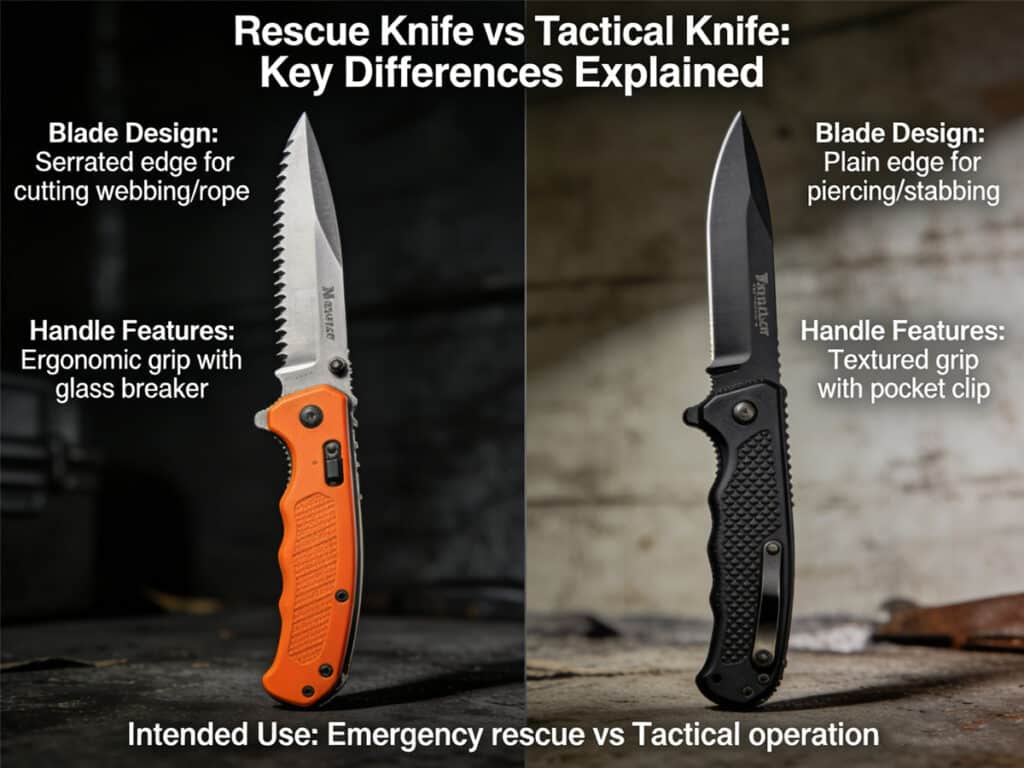
Rescue knives often feature blunt or rounded tips to reduce the risk of accidental injury during close-contact use. Tactical knives typically have pointed tips designed for piercing, which increases their effectiveness for certain tasks but also raises legal and safety considerations.
This difference alone signals how each knife is meant to interact with people and environments, and why confusing the two can lead to poor purchasing decisions.
Blade Shape, Edge Style, and Safety Features
Looking more closely at the blade itself reveals how clearly these two knife types diverge. The shape, edge, and finish are not aesthetic choices but functional ones that determine how the knife performs in real-world situations.
Rescue knives commonly use serrated or partially serrated edges because serrations cut fibrous materials quickly and with less effort. Seatbelts, thick clothing, and straps are easier to slice through with a sawing motion, especially when fine motor skills are compromised by stress.
Tactical knives often use straight or partially serrated edges optimized for controlled cutting, penetration, and edge retention. Their blades are frequently thicker and more rigid, emphasizing strength over finesse.
Safety-Oriented Design in Rescue Knives
Many rescue knives include features such as enclosed cutting hooks or shielded blades. These designs allow the user to cut near skin without exposing a sharp edge, reducing the chance of accidental harm. This is especially important in emergency scenarios where visibility is limited and emotions are high.
Tactical knives rarely include these protective features, as they prioritize accessibility and versatility over built-in safeguards.
Additional Tools and Integrated Functions
Another key difference lies in what else the knife offers beyond the blade. Rescue knives are often multi-functional tools designed to address a narrow set of emergencies efficiently, while tactical knives tend to focus on being a strong, singular tool.
Rescue knives may include glass breakers, oxygen wrench cutouts, or integrated pry points. These additions support emergency response without requiring the user to carry multiple tools. Each feature is selected to serve a clear, life-saving purpose.
Tactical knives, on the other hand, usually avoid extra components that could compromise strength or simplicity. Their value lies in reliability, balance, and the ability to perform consistently under demanding conditions.
Complexity vs Simplicity
The added functions of rescue knives make them ideal for vehicles, workplaces, or travel kits where emergencies are a realistic possibility. Tactical knives appeal to users who value a straightforward, rugged tool that can handle a wide range of cutting tasks without distraction.
Neither approach is inherently superior, but each reflects a different philosophy of preparedness.
Legal and Social Considerations
Legality is one of the most misunderstood aspects of knife ownership, and the distinction between rescue and tactical knives can be significant in this area. Laws often consider not just blade length, but also design intent and features.
Rescue knives are generally viewed more favorably under the law because their purpose is clearly non-aggressive. Their blunt tips, safety features, and emergency-focused design make them easier to justify as tools rather than weapons.
Tactical knives may face more scrutiny, especially in jurisdictions that regulate blade shape, opening mechanisms, or perceived intent. Even when legal to own, they may be restricted in certain public spaces or carry contexts.
Public Perception Matters
Beyond legality, social perception plays a role in everyday carry. A rescue knife is less likely to draw concern if noticed, particularly in professional or public settings. Tactical knives, due to their appearance and reputation, may raise questions even when carried lawfully.
For people who prioritize discretion and simplicity, this difference can influence which knife feels appropriate for daily life.
Choosing the Right Knife for Your Needs
The decision between a rescue knife and a tactical knife should be guided by honest assessment rather than trends or assumptions. Ask yourself where the knife will be kept, how often it will be used, and what situations you realistically want it to address.
If your focus is vehicle safety, emergency preparedness, or assisting others in unexpected situations, a rescue knife aligns naturally with those goals. Its design supports calm, controlled action when time and clarity are limited.
If your needs lean toward rugged utility, outdoor use, or environments where durability and adaptability matter most, a tactical knife may be more appropriate, provided it complies with local laws and fits your comfort level.
Ultimately, preparedness is not about carrying the most imposing tool, but about choosing items that fit seamlessly into your life. Some people complement their knife choice with low-profile tools like a tactical pen, while others explore options such as a brass knuckle where legally permitted. Whatever combination you choose, understanding the differences between tools ensures that your everyday carry reflects intention, responsibility, and real-world practicality rather than impulse or assumption.