
Dec
Knowledge of Weapons, Weapons How
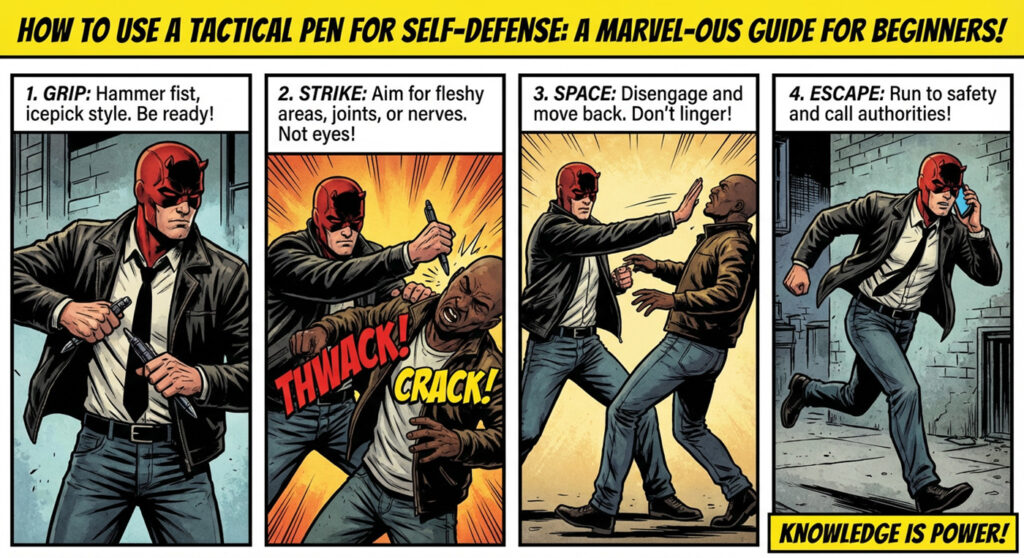
How to Use a Tactical Pen for Self-Defense: Step-by-Step Guide for Beginners
1. Understanding the Tactical Pen and Its Purpose
The modern tactical pen was originally designed as a practical tool that combines everyday writing functionality with features that make it durable enough to withstand harsh conditions, and although it can be used in self-defense environments, responsible instructors emphasize that its true value lies in the way it empowers individuals to stay aware of their surroundings, maintain confidence during unexpected encounters, and rely on a compact object that does not draw attention while still offering a sense of security in situations where escape or de-escalation becomes difficult. A tactical pen’s effectiveness has far more to do with mindset than with physical strength, because the real foundation of self-defense begins with situational awareness, calm breathing, and the ability to make clear decisions when pressures rise suddenly. In this sense, the pen is not a weapon but a reinforcement of personal boundaries, allowing a person to feel prepared without relying on tools that may escalate conflict or create unnecessary danger.
The structure of the tactical pen—usually made from reinforced aluminum or stainless steel—gives it the durability needed to manage accidental impacts or low-intensity defensive contact, yet its restrained design helps it remain appropriate for everyday carry in most public settings, provided local laws allow it. Before learning how to integrate a tactical pen into one’s self-defense plan, a beginner should recognize that the pen is merely a supplement to the more essential skills of alertness, strategic retreat, verbal boundary-setting, and the ability to manage stress under pressure.
2. Safety, Legality, and Responsible Mindset
2.1 Know the Law Before You Carry
Although tactical pens are typically considered legal in many regions due to their utilitarian design, beginners should always research local regulations, workplace policies, and travel rules, because certain features—such as glass breakers or reinforced tips—may be restricted in sensitive areas or misinterpreted by security staff. Understanding these boundaries not only prevents legal misunderstandings but also reinforces the larger principle that responsible self-defense requires awareness of environment, culture, and context, since the goal is always to reduce risk rather than create new complications.
2.2 The Importance of Proportional Response
Ethical self-defense instructors continually stress that tools like tactical pens should be viewed as last-resort options used only when a person reasonably believes they face imminent harm and cannot safely withdraw, and this mindset ensures that beginners respect the seriousness of physical confrontation, avoiding unnecessary force and focusing instead on methods that prioritize escape and personal safety. In stressful situations the mind narrows and reactions become faster, so cultivating an internal rule—only act to create an opportunity to leave—helps beginners maintain clarity even when fear rises sharply.
2.3 Building Emotional Preparedness
Because self-defense situations trigger adrenaline, shaking, and rapid breathing, beginners benefit from simple grounding practices such as slow exhalations, anchoring attention on physical stance, or repeating a mental cue like “stay aware,” as these techniques help regulate the body and support decision-making. A tactical pen becomes far more effective when paired with this sense of inner steadiness, which allows the individual to use the tool safely and with minimal risk to themselves or others.
3. Preparing to Use a Tactical Pen: Foundations Before Techniques
3.1 Grip and Handling Without Aggression
Before learning any self-defense applications, beginners should spend time simply holding the tactical pen in different ways—writing grip, thumb-supported grip, closed-fist grip—without associating these holds with force or impact, because this quiet exploration builds familiarity, reduces tension, and makes the tool feel like a natural extension of the hand rather than an object reserved for high-stress emergencies. Comfort with grip transitions helps ensure that if a person ever needs to rely on the pen under pressure, they can do so without fumbling or panic.
3.2 Stance, Balance, and Movement
A stable stance is often more important than any tool, and beginners should practice standing with feet shoulder-width apart, knees slightly bent, and weight distributed evenly, allowing quick movement in any direction without stumbling. This stance supports awareness and mobility, emphasizing that self-defense is less about force and more about balance, intention, and timing. Moving with slow, deliberate steps while holding the pen helps reinforce this principle, teaching beginners to maintain orientation even when shifting angles or avoiding obstacles.
3.3 Awareness Training
Since tactical pens are defensive aids rather than offensive devices, beginners should invest time in developing strong situational awareness—observing entrances and exits, noticing unusual behavior, and maintaining enough personal space to react calmly. This awareness prevents many conflicts from escalating and often allows individuals to avoid physical engagement entirely, which is the preferred outcome in any self-defense philosophy.
4. High-Level Self-Defense Applications for Beginners
To maintain safety and ethics, beginners should avoid imagining the tactical pen as a tool for combat and instead frame it as a device used to create a brief moment of distraction that allows them to retreat to safety, seek help, or protect vulnerable areas of the body. Self-defense instructors often teach broad, non-specific concepts that focus on minimizing harm and maximizing escape opportunities.
4.1 Creating Space
In situations where someone is grabbed or approached aggressively, the tactical pen can be used in a controlled, defensive manner to create space, not to escalate, meaning the user’s goal is to break free from an unwanted hold or prevent an aggressor from closing distance further. This might involve using the pen to apply pressure to a non-specific contact point or to interrupt the aggressor’s grip just long enough to pull back and move to safety.
4.2 Protecting Yourself During Withdrawal
If escape becomes possible, the tactical pen may help reinforce boundaries as the person retreats, serving as a psychological deterrent that signals the individual is prepared to defend themselves without resorting to reckless force. This aligns with the principle that self-defense is foremost about getting away rather than engaging.
4.3 Using the Pen Without Excessive Force
Beginners should avoid striking with full strength or taking aggressive stances, since these actions increase risk for everyone involved; instead, they should think in terms of quick, controlled actions that help interrupt the moment and give them an opportunity to flee. Responsible training always emphasizes that proportionality, restraint, and clarity of intent matter far more than power.
5. Training Approaches That Build Confidence Without Harm
5.1 Professional Instruction
While tactical pens are simple tools, responsible use benefits significantly from guidance provided by respected self-defense instructors who specialize in de-escalation, crisis management, and defensive posture rather than violent techniques. These programs typically teach conflict-avoidance strategies, verbal boundary-setting, safe movement, and stress-management skills, which collectively build confidence without encouraging risky behavior.
5.2 Practicing with Inert or Soft Tools
Beginners should consider training with soft-tipped practice pens or dummy objects, allowing them to explore movement patterns and grip transitions without the stress or risk associated with harder materials. These tools help learners stay relaxed, build coordination, and avoid forming habits that rely on excessive force.
5.3 Scenario-Based Learning
Working through controlled, realistic scenarios—such as navigating crowded spaces, responding to unexpected verbal confrontation, or identifying safe escape paths—teaches beginners to integrate their tactical pen into everyday life in a way that prioritizes awareness rather than confrontation. This style of practice strengthens confidence and helps individuals apply the principles of self-defense responsibly, making the tactical pen a natural extension of their existing safety strategies rather than a primary tool.
6. A Practical and Ethical Approach to Personal Safety
Using a tactical pen for self-defense requires far more emphasis on judgment, awareness, and restraint than on impact or technique, and beginners who adopt this mindset soon recognize that the real strength of the tool lies in its unobtrusive presence, its everyday usefulness, and its ability to remind the carrier that preparedness begins with calm observation. As people integrate the tactical pen into their safety routines, they learn to respect the boundaries of lawful self-defense, to seek de-escalation whenever possible, and to use physical measures only when absolutely necessary to protect themselves from immediate harm. This broader understanding helps individuals feel both empowered and responsible, creating a healthier and more grounded relationship with the tools they carry. And for those interested in the wider landscape of personal-safety gear—whether exploring the cultural background of items like brass knuckles in historical contexts or comparing modern security tools such as a compact baton—it is essential to approach all such objects with the same commitment to legality, ethics, and careful, informed use, ensuring that preparedness always complements safety rather than undermining it.