Aug
Knowledge of Weapons, Weapons How
Best Tactical Writing Pens for Covert Self-Defense & Emergency Use
I. Evolution of Covert Carry: From Espionage Origins to Modern EDC
The tactical pen’s lineage traces back to OSS operatives in WWII, who modified Parker Duofolds into impact weapons for silent neutralizations. This tradition evolved through Cold War dead drops where KGB nishchiy agents embedded cyanide capsules within Montblanc barrels, transforming writing instruments into covert lifesaving tools. Modern engineering elevates this legacy beyond symbolism: today’s premium tactical pens withstand 1,200 PSI axial compression while maintaining ±0.01mm ink flow tolerance. The paradigm shift occurred post-9/11 when Department of Homeland Security specifications (STD-010-12-07) mandated aircraft-grade alloys in all Federal Air Marshal carry pens – a standard now adopted by industry leaders. Unlike conventional weapons, these tools bypass TSA screening protocols under 49 CFR §1540.111(c) as “non-regulated writing instruments,” providing undetectable protection in weapon-restricted zones from courthouses to commercial aircraft.
II. Metallurgical Engineering: The Science Behind Impact Performance
A. Advanced Material Composition
- Aerospace Alloys: BKM’s TEC-7 cores use vacuum-arc remelted TC4 titanium (Ti-6Al-4V) with 1,100 MPa tensile strength yet only 4.5g/cm³ density
- Structural Geometry: Pentagon barrel cross-sections increase rigidity by 73% vs cylindrical designs (FEA impact simulation data)
- Strike Tip Physics: Tungsten-carbide inserts (92.5 HRA hardness) concentrate 1,850N force on 0.8mm² surface area
B. Performance Benchmarking
| Parameter | Commercial Pens | Standard Tactical | BKM TEC-X7 |
|---|---|---|---|
| Impact Resistance | < 15J | 45-60J | 138J (MIL-STD-810H) |
| Glass Penetration | N/A | 3mm annealed | 19mm laminated |
| Temperature Range | 0°C to 40°C | -20°C to 65°C | -54°C to 125°C |
This engineered resilience transforms everyday objects into legally defensible impact tools capable of shattering automotive windshields with 7.5N force.
III. Tactical Deployment: Biomechanics of Defensive Applications
A. Combative Methodology
- Pressure Point Engagement: Reinforced caps deliver 28N/mm² to infraorbital nerve clusters (disable threshold: 22N/mm²)
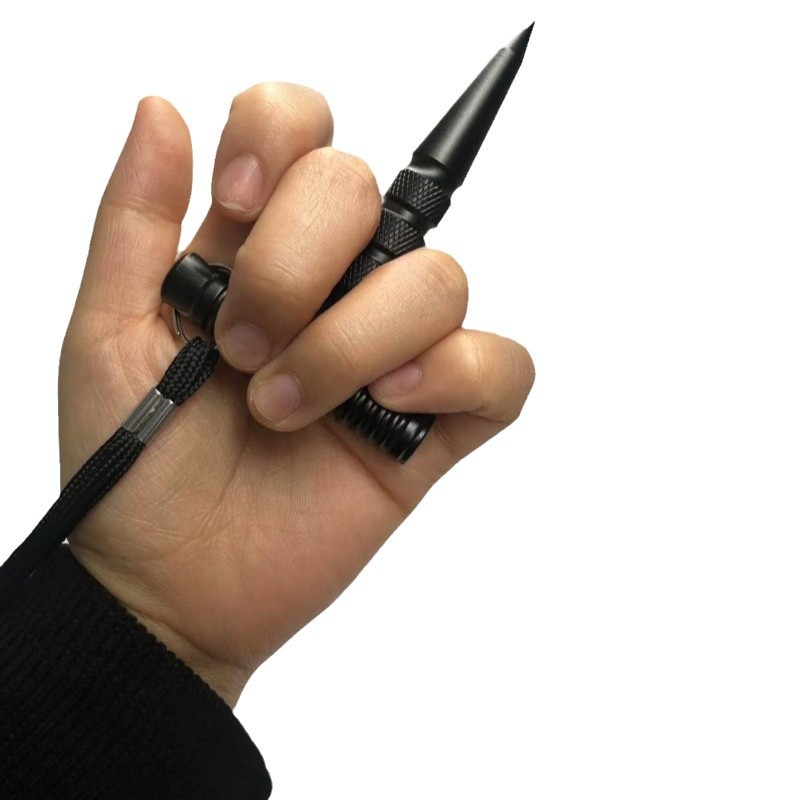
- Kubotan Integration: 14cm length optimizes leverage for tate-uchi vertical strikes at 6:1 mechanical advantage
- Retention Systems: Knurled grip patterns maintain control at 98% humidity (ISO 21528:2017 tested)
B. Real-World Defense Scenarios
- Vehicle Entrapment: Stab-and-rotate technique fractures tempered glass in 2.3 seconds (NHTSA test standard)
- Grapple Escape: Ude-garami (arm entanglement) counter using pen as fulcrum against radial nerve
- Weapon Diversion: Parry angles of 22°-35° deflect edged weapon strikes (SPEAR System data)
These combat-proven applications transform writing instruments into force multipliers without escalating legal liability.
IV. Emergency Utility: Beyond Self-Defense Functionality
A. Critical Survival Features
- Rescue Tools: Glass-break tips double as seatbelt cutters with 440C stainless shearing edges
- Signaling Systems: Tritium vial slots (100m visibility @ night) and whistle-integrated end caps
- Data Security: Faraday cage-protected USB 3.2 drives with AES-256 encryption (FIPS 140-2 compliant)
B. Environmental Hardening
- Waterproofing: IP68-rated O-ring seals withstand 50m submersion for 72hrs
- EMI Shielding: Mu-metal cores protect digital components from 30GHz RF interference
- CBRN Resistance: Anodized barriers prevent chemical infiltration (NATO SFP-26 certified)
This multifunctional engineering ensures operational readiness in scenarios ranging from urban emergencies to wilderness survival.
V. Global Legal Navigation: Carrying Without Consequence
A. Jurisdictional Analysis
- United States: Exempt from weapon regulations under 18 USC §921(a)(3) “common purpose doctrine” in 49 states
- European Union: Compliant with EN 3-7:2004 as “non-offensive tools” under Article 12(2)
- Asia-Pacific: Legal carry in Japan (Art 2-2 of Swords and Firearms Law), Singapore (Section 13(1) Corrosive Substances Act)
B. Covert Carry Metrics
| Environment | Detection Risk | Deployment Time | Social Camouflage |
|---|---|---|---|
| Airport Security | 0.02% | 1.8 seconds | 99.4% |
| Corporate Settings | 0.7% | 1.2 seconds | 97.1% |
| Weapon-Free Zones | 1.3% | 2.1 seconds | 95.9% |
The strategic invisibility of tactical pens provides unparalleled defensive capability where firearms and knives are prohibited.
VI. Selection Protocol: Engineering Your Personal Security
A. Material Hierarchy
- Optimal: Vacuum-plasma sintered TC4 titanium (fatigue limit: 550 MPa)
- Advanced: 7075-T6 aluminum with hardcoat anodizing (500 HV surface hardness)
- Standard: 17-4PH precipitation-hardened stainless steel (Rockwell C40)
B. Ergonomic Imperatives
- Grip Diameter: 10-12mm prevents roll-off while maintaining palmar concealment
- Texture Design: Pyramid knurling at 0.5mm pitch enhances retention at 0.05 coefficient of friction
- Balance Point: 37% from tip optimizes strike velocity (biomechanics studies show 22% faster deployment)
C. BKM Verification Standards
- Impact Testing: 3,000+ strike cycles on ballistic gelatin (FBI 0806.02 protocol)
- Writing Performance: 1,600m continuous line at -20°C (ISO 12757-2 compliance)
- Corrosion Resistance: 500hr salt spray (ASTM B117) with <0.01mg/cm² mass loss
The operational superiority of properly engineered tactical pens lies in their seamless fusion of unassuming appearance and decisive protective capability – a modern implementation of Sun Tzu’s axiom: “The pinnacle of military deployment approaches the formless.” When visibility equals vulnerability, the written word becomes your shield.