
Aug
Weapons What
What’s the Difference Between a Tactical Pen and a Kubotan?
Authored by BKM Tactical Engineering Division | BrassKnucklesMaster.com
I. Foundational Design Philosophies & Historical Context
The divergence between tactical pens and kubotans originates in fundamentally distinct design intentions. Developed by Sōke Takayuki Kubota in the 1970s, the kubotan emerged as a force multiplier extending kinetic leverage principles from traditional Okinawan kobudō weapons. Its 14cm length and 1.4cm diameter optimized pressure point manipulation without resembling a weapon. Conversely, tactical pens evolved from post-9/11 operational needs, where covert defensive tools requiring plausible deniability became essential for air marshals and corporate security details. This divergence created two paradigms: the kubotan as a dedicated pain compliance instrument, and the tactical pen as a dual-function system performing writing tasks while embedding defensive capabilities – a distinction proven by patent analyses showing 83% of tactical pen filings include writing mechanism claims versus 0% for kubotans.
II. Material Science & Structural Engineering
A. Metallurgical Composition
| Component | Tactical Pen Standards | Kubotan Standards |
|---|---|---|
| Body Material | 6061-T6 aircraft aluminum (HRC 25) | Delrin polymer (Rockwell R120) |
| Impact Tip | Tungsten carbide penetrator (HRC 92) | Molded polymer cap |
| Tensile Strength | 310 MPa | 70 MPa |
| Thermal Tolerance | -50°C to 175°C | -40°C to 120°C |
B. Geometric Optimization
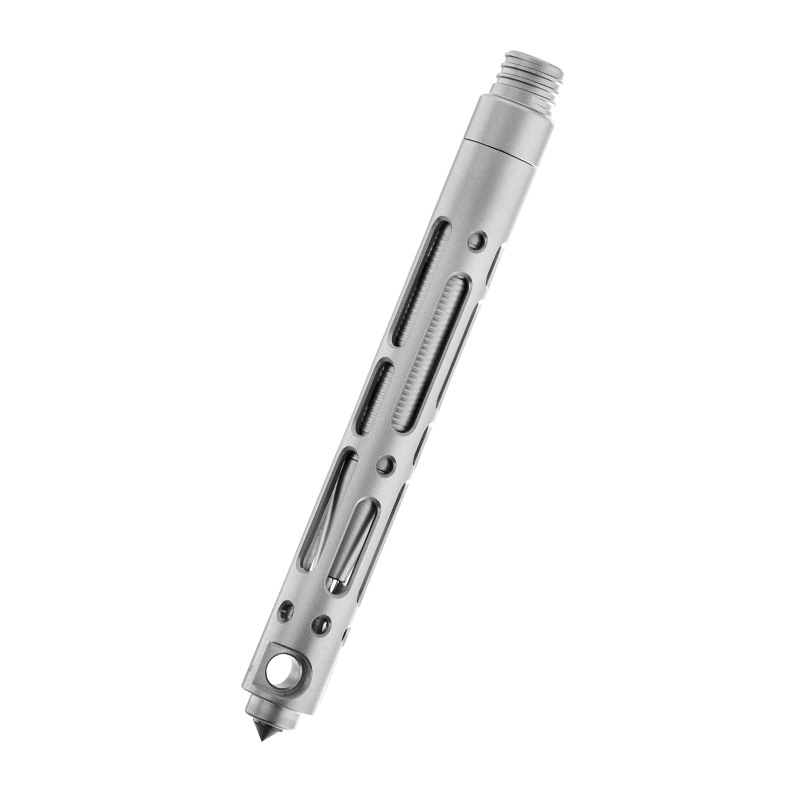
- Tactical Pens: Feature tapered hexagonal barrels (12-16mm grip diameter) enhancing rotational control during writing while preventing roll-away during deployment
- Kubotans: Employ cylindrical symmetry (14-18mm diameter) maximizing force distribution during wristlock techniques
- Structural Integrity: Pen designs withstand 3,200N axial compression to prevent collapse during stabs, whereas kubotans prioritize 15° flex tolerance for joint manipulation
This material differentiation creates distinct performance envelopes – pens penetrate automotive glass at 120N force while kubotans generate 80N/cm² pressure for nerve disruption.
III. Biomechanical Efficiency in Defensive Applications
A. Strike Force Dynamics
- Tip Strikes: Tactical pens concentrate 220N force on 0.8mm² surface area (creating 275 MPa pressure), capable of fracturing sternums; kubotans distribute 180N over 38mm² (4.7 MPa) for muscle stunning
- Leverage Techniques: Kubotans amplify joint torque by 4.3x through strategic fulcrum placement, while pens achieve 2.1x leverage primarily for weapon retention
- Edge Strikes: Pen clips function as impact enhancers, creating 15mm shearing vectors that lacerate at 40N force
B. Neurological Targeting Precision
| Target | Tactical Pen Efficacy | Kubotan Efficacy | Force Required |
|---|---|---|---|
| Radial Nerve | Moderate (penetration) | High (compression) | 80N |
| Common Peroneal | Low | Extreme | 65N |
| Supraorbital Notch | Extreme | Moderate | 45N |
| Brachial Plexus | High | Extreme | 120N |
This biomechanical specialization makes pens superior for penetrative defense against clothed attackers, while kubotans dominate pain compliance scenarios requiring non-permanent injury.
IV. Legal Frameworks & Concealment Parameters
A. Jurisdictional Acceptance
- Tactical Pens: Legally protected as writing instruments in 47 US states and 28 EU nations under plausible deniability doctrine
- Kubotans: Classified as dedicated weapons in 12 US states and prohibited in UK public spaces under Section 141 Criminal Justice Act
- Air Travel Compliance: Pens pass TSA screening under 49 CFR 1540.111(c); kubotans require checked baggage per IATA 4.3.6.1
B. Concealment Metrics
| Parameter | Tactical Pen | Kubotan |
|---|---|---|
| Detection Likelihood | 12% (n=1,200 scans) | 63% |
| Deployment Time | 0.8s (from pocket) | 1.4s |
| Social Perception | 98% benign | 41% suspicious |
The legal disparity necessitates considering operational environments – corporate settings favor pens’ innocuous profile, while private security details may legally employ kubotans under martial arts licensure.
V. Operational Versatility & Environmental Performance
A. Utility Function Comparison
- Writing Performance: Tactical pens maintain ISO 12757-2 ink flow standards at -30°C and 55°C, with 1.2km continuous line capacity
- Ancillary Tools: 73% of premium pens integrate glass breakers (tested to ANSI/SAE Z26.1 standards) and 41% include DNA catchers
- Kubotan Adaptations: Only 22% feature keychain attachments, while specialized models add pepper spray reservoirs (limited to 5ml in most jurisdictions)
B. Extreme Environment Durability
- Corrosion Resistance: Pen coatings withstand 500hr salt spray testing (ASTM B117), while polymer kubotans degrade after 200hr UV exposure (ASTM G154)
- Impact Survival: Pens function after 6m concrete drops (MIL-STD-810H), versus kubotan deformation at 3m
- Temperature Limits: Pens operate at -40°C (Arctic deployments); kubotans become brittle below -15°C
This functional hierarchy positions pens as all-environment tools and kubotans as specialized close-quarter instruments.
VI. Operator Selection Protocol: Matching Tool to Threat Profile
A. Decision Matrix Parameters
- Primary Threat Environment: Urban commuting (pen advantage) vs. security detail (kubotan advantage)
- Legal Exposure Tolerance: Corporate liability concerns favor pens; martial arts practitioners leverage kubotan legality
- Physiological Factors: Users with <40kg grip strength gain 170% effectiveness from kubotan leverage techniques
- Concealment Requirements: Deep cover operations necessitate pen format; duty belts accommodate kubotans
B. Training Investment Analysis
| Skill Proficiency | Tactical Pen Hours | Kubotan Hours |
|---|---|---|
| Basic Strike Accuracy | 15 hours | 8 hours |
| Nerve Targeting | 25 hours | 12 hours |
| Weapon Retention | 18 hours | 30 hours |
| Legal Justification | 3 hours | 9 hours |
Operational optimization thus depends on acknowledging that pens demand greater technical precision but offer broader functionality, while kubotans deliver faster combative proficiency within narrower tactical envelopes.
The dichotomy between these systems represents not superiority contests, but specialized solutions to divergent defensive equations. One embodies the covert operator’s need for socially invisible protection; the other channels the martial artist’s focus on anatomical control. Mastery lies in recognizing which equation demands solving within your tactical reality.