
Nov
Knowledge of Weapons
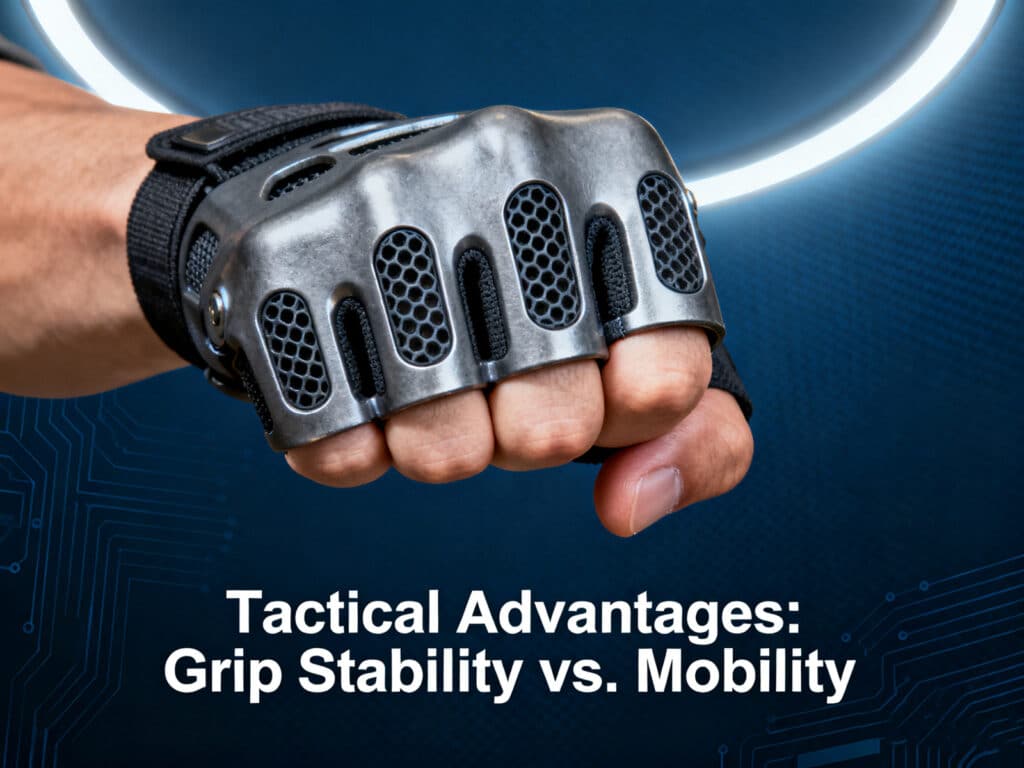
Tactical Advantages of Modern Knuckle Dusters: Grip Stability vs. Mobility
In contemporary debates about compact handheld defensive implements, knuckle dusters — sometimes called brass knuckles — occupy a paradoxical place: they are at once a piece of craft and design history, an object of controversy because of their association with violence, and an item whose modern iterations are evaluated primarily on the interplay between grip stability and mobility; this article explores that tension thoughtfully and professionally, weighing ergonomic principles, material choices, situational trade-offs, legal and ethical contexts, and safer alternatives, while avoiding operational guidance that could facilitate harm.
1. Historical context and modern reinterpretation
To begin with historical perspective: the family of fist-held striking implements has existed in various cultures for centuries, ranging from padded fighting gloves to metal rings and reinforced gauntlets, and their modern counterparts are as much products of industrial design as of martial necessity; in recent decades, however, many makers and collectors have reinterpreted the form for reasons that include craftsmanship, historical reenactment, training props, and stylistic expression, so that evaluation today often centers less on blunt force application and more on how the object performs as an interface between human hand and intended function.
A design object turned tactical question
The contemporary conversation about knuckle dusters therefore frequently reduces to a design question: how does the object optimize the connection between the user’s grip and intended output — whatever that output may be — while still allowing the hand to move fluidly, change grips, and perform other tasks; this naturally leads to a tension between grip stability — the degree to which the implement locks to the hand and becomes an extension of the skeleton — and mobility — the freedom to manipulate, reorient, or release the tool quickly when circumstances demand it.
2. Defining grip stability and mobility in practical terms
A clear conceptual definition helps frame later comparisons: grip stability refers to how securely and consistently the implement remains aligned with the hand during deliberate motion or under reactive forces, whereas mobility refers to the ease with which the hand can change position, maneuver around obstacles, or perform tasks unrelated to a single striking action; neither property is intrinsically superior — their value is context dependent — and modern designers often seek a compromise that preserves sufficient stability without rendering the hand functionally one-dimensional.
Grip stability: what practitioners value
When grip stability is emphasized, users typically appreciate a tactile certainty — a perception that the object will not shift unexpectedly, that the skeleton of the hand and arm bear load predictably, and that feedback from contact is immediate and discriminating; designers and material scientists describe this as improved input-output fidelity between intention and result, and in controlled contexts this fidelity reduces the likelihood of accidental misuse or self-inflicted strain because the forces follow anticipated anatomical lines.
Mobility: why flexibility matters
Conversely, mobility preserves the hand’s broader toolbox: the ability to open the hand, manipulate objects, transition to defensive blocks or holds, and withdraw the implement quickly; in many practical scenarios — including legal, safety, or survival contexts — the capacity to restore a neutral or non-threatening posture is as important as any transient tactical advantage, which is why mobility remains a key design consideration for responsible makers and trainers.
3. Materials and form: how choices bias the trade-off
Material selection and geometrical form are primary determinants of whether a given modern knuckle duster skews toward stability or mobility, and understanding how these variables interact offers insight without instructing on usage.
Materials and their implications
Different materials change the object’s mass distribution, surface friction, thermal feel, and maintenance profile, all of which affect both psychological and mechanical aspects of handling. Dense metals (historically brass, more recently various steel alloys) tend to increase perceived solidity and can make the implement feel like a rigid extension of the hand, reinforcing stability; lighter alloys and engineered polymers reduce inertia and allow for faster repositioning, favoring mobility while often requiring more careful gripping technique to avoid slippage in adverse conditions. Beyond density, surface texture and finish influence traction — a matte, micro-textured surface will offer more purchase than a highly polished one — which designers use to balance comfort against secure hold.
Geometry and ergonomics
Form factors — whether an implement hugs the natural curvature of the fingers, provides a broad palm shelf, or features minimal contact points — directly determine how the hand distributes force and how quickly it can adapt to new tasks. A design that maximizes contact area tends to enhance stability because it spreads loads across a larger surface and reduces localized pressure, which can be more comfortable and predictable; conversely, minimalist profiles that reduce contact and mass emphasize nimbleness and concealability, improving mobility but sacrificing some of the predictable mechanical coupling that stability offers.
4. Ergonomics, human factors, and injury mitigation
A responsible discussion cannot ignore ergonomics and the health implications of prolonged or repeated interaction with any handheld device, and these factors also shape tactical trade-offs.
Structural alignment and joint safety
An implement that aligns with the natural anatomical axes of the hand and wrist reduces shear forces that otherwise can lead to sprain or chronic strain, which is a key advantage of designs emphasizing grip stability; by maintaining neutral wrist alignment during force transmission, these designs mitigate torque and distribute stress across stronger skeletal elements. Conversely, designs that prioritize mobility sometimes require more muscular compensation to maintain alignment, potentially increasing fatigue over time if used improperly or without adequate conditioning — a reason why training props should be used under professional supervision, and why collectors should regard such items primarily as artifacts rather than functional tools.
Sensory feedback and proprioception
From a human-factors perspective, devices that provide clear tactile cues enhance proprioception — the user’s sense of limb position — which improves safety and control even in stressful situations. Stable interfaces create reliable sensory anchors, while highly mobile ones demand greater attentional resources to maintain control, a trade-off that matters most in scenarios where cognitive load is high.
5. Scenario analysis: when stability is preferable and when mobility wins
The assessment of tactical advantage ultimately depends on the situation, and a few hypothetical, non-operational scenarios illustrate how different priorities shift design preference.
Situations favoring grip stability
Stability is advantageous in contexts where controlled, repeatable force transmission is required and where the user expects to maintain a single mode of interaction for a period of time; this might include staged historical demonstrations, structural testing, or constrained training drills that emphasize alignment and load distribution, because stability reduces variability and helps preserve joint health during repetitive action.
Situations favoring mobility
Mobility is preferable when flexibility of action, rapid transitions, or multi-purpose hand use are essential, as in craftwork, rescue tasks, or contexts that require switching quickly between manipulation and release; lighter, more compact forms minimize encumbrance and allow the hand to recover its full repertoire of movements, which is why practitioners who value overall dexterity often opt for designs that emphasize mobility and concealment of mass.
6. Legal, ethical, and community considerations
No evaluation of tactical advantage is complete without acknowledging the broader legal and ethical landscape, since many jurisdictions strictly regulate the possession or carry of knuckle-type implements, and the social consequences of brandishing or using such an item can be severe.
Legal frameworks and responsibilities
Regulatory regimes vary widely: some places prohibit manufacture, sale, or possession outright; others allow ownership but restrict carry or use; still others treat them as lawful tools depending on context. Any discussion about tactical properties must therefore stress that legality is a primary constraint on what is acceptable to possess or even evaluate in practical terms, and prospective owners should consult local law and prioritize safety and compliance.
Ethical use and community norms
Beyond statutes, there are ethical and reputational considerations: objects associated with violence can carry social stigma, and responsible collectors, makers, and instructors often adopt codes of conduct that emphasize non-harm, secure storage, transparent provenance, and restricted demonstration contexts; communities devoted to historical preservation or craftmanship frequently discourage sensationalized use and instead focus on educational presentation, conservation, and contextualization.
7. Alternatives, training ethics, and design directions
Given the fraught legal and moral terrain, many practitioners and designers turn to alternatives and ethical frameworks that preserve the study of form and function without endorsing harm.
Safer training alternatives
High-density training tools engineered for safety, padded simulators, or modular forms that clearly signal non-lethality enable exploration of balance and hand mechanics while minimizing risk; these options support legitimate goals — such as conditioning, kinesthetic refinement, or historical study — while respecting legal and ethical boundaries, and they allow instructors to develop curricula that teach restraint, escalation awareness, and de-escalation skills rather than offensive application.
Design innovation and responsible craftsmanship
Contemporary designers increasingly focus on materials and geometries that highlight ergonomics and aesthetics without facilitating malicious use: hybrid pieces intended for collection, multi-purpose tools that prioritize utility (e.g., keychain tools with benign functions), and transparent educational artifacts that come with contextual documentation are all ways the craft community channels interest into constructive avenues. The most respected makers place clear disclaimers, emphasize preservation and study, and engage with regulatory and cultural stakeholders to ensure that their work contributes positively to public understanding.
Evaluating the tactical advantages of modern knuckle dusters through the lens of grip stability versus mobility reveals a multifaceted landscape where material science, ergonomic design, legal frameworks, and ethical commitments intersect; while some designs favor predictable coupling between hand and implement to reduce variance and protect joints, others prioritize freedom of movement and multi-purpose hand use, and the responsible path forward is not about glorifying potential harm but about understanding trade-offs, complying with law, prioritizing human safety, and redirecting curiosity toward education, craft, and legal alternatives that let practitioners explore form and function without compromising public welfare.