
Oct
Weapons What
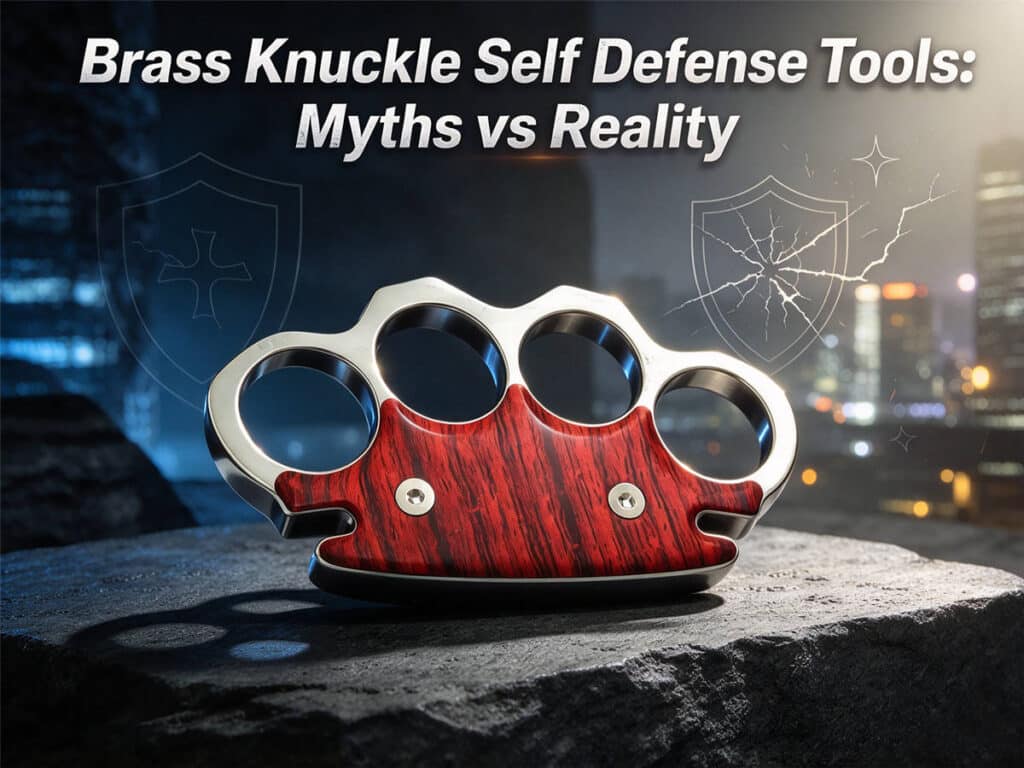
Brass Knuckle Self Defense Tools: Myths vs Reality
Brass knuckles have occupied a complicated place in popular culture for generations, appearing in movies, historical collections, tactical gear discussions, and modern EDC communities where compact personal-safety products are often marketed as practical solutions for everyday risks. Yet the image presented by entertainment and product advertising can be very different from reality, particularly when it comes to questions of legality, personal safety, effectiveness, and responsible ownership. A brass-knuckle-shaped accessory may look powerful, but appearance alone does not make an item appropriate for everyday carry, and the legal status of these products can vary dramatically depending on where a person lives. For anyone researching brass knuckle self defense tools, separating popular myths from practical facts is therefore much more useful than simply looking for the most intimidating design.
There is also an important distinction between traditional brass knuckles and modern keychain or collectible products that borrow elements of the classic knuckle-duster appearance. Some compact accessories are designed around everyday utility, while others are collectibles intended for display or historical interest. Brass Knuckles Master itself states that its products are intended as collectible artifacts for artistic display, historical study, or lawful collection rather than as weapons or self-defense tools. That distinction provides a useful foundation for understanding the subject without confusing a product’s appearance with its lawful or responsible purpose.
Myth 1: Brass Knuckles Are Automatically a Safe Self-Defense Solution
One of the biggest misconceptions surrounding brass knuckles is that carrying them automatically makes a person safer. The reality is considerably more complicated. A physical object cannot replace awareness, avoidance, communication, emergency planning, or the ability to recognize a potentially dangerous situation before it develops. In fact, introducing a weapon into a confrontation can create additional risks, including escalation, accidental injury, loss of control, or legal consequences.
Traditional brass knuckles are specifically associated with increasing the potential force of a punch, which means they are fundamentally different from ordinary emergency equipment such as a flashlight, personal alarm, or vehicle escape tool. The potential for serious injury is precisely why these objects are regulated or prohibited in many jurisdictions. Treating them as harmless accessories simply because they are compact can therefore create a dangerous misunderstanding about their actual nature.
Preparedness Is Broader Than Carrying One Object
Effective personal safety is usually based on multiple layers rather than one piece of equipment. Staying aware of surroundings, avoiding isolated or escalating situations, maintaining communication, knowing emergency contacts, and having an exit plan can all be more important than possessing a particular physical tool. A useful discussion from Brass Knuckles Master similarly emphasizes awareness, avoidance, de-escalation, and emergency preparedness as important elements of responsible safety planning.
For people interested in compact equipment, a safety keychain can be considered as part of a broader everyday-carry system, particularly when the product includes practical features such as lighting, signaling, or other emergency functions. The key point is that preparedness should not be reduced to the assumption that a weapon will solve every dangerous situation.
Myth 2: If You Can Buy It Online, It Must Be Legal to Carry
This is perhaps the most important myth to correct. Online availability does not establish legality. Products can be listed for sale while possession, transportation, importation, public carry, or concealed carry remains restricted in a particular jurisdiction. Laws can also change, and regulations may differ between countries, states, provinces, and municipalities.
The legal classification of brass knuckles can be particularly complicated because legislation may distinguish between ownership and carrying, or between ordinary possession and possession with an unlawful purpose. In some locations, brass knuckles are prohibited altogether, while other jurisdictions impose different restrictions. International travel creates another layer of complexity because an item permitted in one country may be prohibited at the destination.
Check the Law Before Making a Purchase
Responsible buyers should check the current laws that apply to their own location rather than relying on a seller’s product description or a general statement that an item is “legal.” The same caution applies to brass knuckle keychains and products that combine knuckle-style shapes with other functions, because a different appearance does not necessarily guarantee a different legal classification.
Travelers should be particularly cautious. Airports, schools, government buildings, workplaces, sporting venues, and other controlled environments can impose additional restrictions even where possession is otherwise permitted. If there is uncertainty, official government sources or qualified legal advice are more appropriate than assumptions based on online listings.
Myth 3: A More Aggressive Design Always Means Better Protection
Marketing often encourages consumers to equate larger size, heavier construction, sharper features, or a more intimidating appearance with better protection, but that is an oversimplification. A product’s visual aggressiveness does not automatically translate into practical safety, and equipment designed to cause greater physical harm can introduce greater consequences if a confrontation occurs.
For everyday preparedness, useful characteristics often include reliability, portability, accessibility, visibility, and legitimate utility. A compact flashlight can help someone identify a dark path or locate a dropped item, while a personal alarm can attract attention without requiring physical confrontation. A vehicle emergency tool can address an entirely different category of risk, such as escaping from a damaged vehicle.
This broader perspective is reflected in the growing popularity of keychain multi-tools, which combine several everyday functions in a small package. The value of such equipment comes from being useful during ordinary circumstances as well as unexpected emergencies, rather than depending exclusively on a confrontation scenario.
Myth 4: Brass Knuckles Are Just Another EDC Accessory
The popularity of EDC culture has made almost everything from compact flashlights to miniature screwdrivers and emergency tools part of everyday-carry discussions, but not every compact object should be treated as equivalent. A pocket multitool and a traditional brass knuckle may occupy a similar amount of physical space, yet their intended functions and legal implications can be completely different.
This distinction becomes particularly important when an item is marketed as a “self-defense keychain.” The phrase can encompass a wide range of products, including alarms, lights, emergency tools, decorative accessories, and objects specifically designed around a weapon-like function. Consumers should therefore examine the actual construction and intended purpose instead of assuming that all keychain products belong to the same category.
Utility Changes the EDC Equation
A product that remains useful every day can have a more practical place within an EDC system than an item carried exclusively for a hypothetical confrontation. A bottle opener, compact screwdriver, flashlight, emergency signaling device, or vehicle safety tool may be used regularly, which means the owner becomes familiar with its presence and maintenance without needing to imagine a violent scenario.
The EDC keychain essentials approach is therefore worth considering when building a compact carry system. The objective is not to fill a keyring with as many features as possible, but to choose a few reliable items that solve genuine problems without creating unnecessary weight, complexity, or legal uncertainty.
Myth 5: Brass Knuckles Make a Person Invulnerable
Movies frequently portray brass knuckles as an almost effortless way to gain control of a confrontation, but real-world situations do not follow scripted choreography. Stress can affect perception, coordination, judgment, and communication, while unpredictable environments can introduce additional hazards that no compact tool can eliminate.
More importantly, physical confrontation always carries uncertainty. Even when someone believes that they are acting defensively, the resulting situation can lead to injuries, witnesses giving conflicting accounts, property damage, or questions about whether the response was proportionate to the threat. The presence of a weapon can also change how an incident is perceived by other people and by authorities.
For these reasons, responsible safety planning should emphasize avoiding confrontation whenever possible. Creating distance, moving toward populated areas, seeking assistance, contacting emergency services, and leaving an escalating situation are generally preferable to treating a physical confrontation as the primary test of an EDC product.
Confidence Should Come From Preparation
There is a meaningful difference between confidence and overconfidence. Confidence can come from knowing your surroundings, having a charged phone, understanding local emergency procedures, carrying appropriate equipment, and having a plan for getting away from an unsafe environment. Overconfidence can come from believing that a particular object guarantees control over another person.
That distinction matters when discussing self-defense tools. The most useful piece of equipment is not necessarily the one that looks strongest; it is the one that supports sensible preparation without encouraging unnecessary confrontation or creating a false sense of security.
Myth 6: Every Brass Knuckle Product Has the Same Purpose
Another common misconception is that every product using the words “brass knuckle,” “knuckle duster,” or “knuckle keychain” is designed for exactly the same purpose. In reality, the market includes historical reproductions, decorative collectibles, novelty accessories, utility keychains, and products marketed toward personal protection, and these categories should not automatically be treated as interchangeable.
For collectors, historical accuracy, craftsmanship, materials, finishing, and display value may be more important than everyday portability. For EDC users, weight and practical functions may matter more. For someone focused on emergency preparedness, a dedicated safety device may make more sense than an object whose primary identity is connected to a weapon.
Brass Knuckles Master’s own disclaimer is especially relevant here because it explicitly describes its products as collectibles intended for artistic display, historical study, or lawful collection and states that they should not be used as weapons or self-defense tools. That means readers should distinguish between the historical or aesthetic interest surrounding these objects and the separate question of whether they are suitable or lawful personal-protection equipment.
What the Reality Means for Modern Buyers
The reality behind brass knuckle self defense tools is therefore much more nuanced than the simple image created by movies, social media, or aggressive product advertising. Traditional brass knuckles can carry substantial legal and safety concerns, and their ability to increase the potential for serious injury is precisely why responsible ownership requires careful consideration. A product that resembles brass knuckles may also fall into a different category, but buyers should never assume that appearance alone determines its legal status.
For people interested in the broader world of compact personal-safety equipment, the better approach is to build an EDC setup around realistic needs. A dependable flashlight can improve visibility, a personal alarm can attract attention, communication equipment can connect you with help, and dedicated vehicle emergency equipment can address situations that have nothing to do with interpersonal conflict. The best car safety tools are a good example of this broader philosophy, because preparedness also means being ready for mechanical and environmental emergencies rather than focusing exclusively on personal confrontation.
Ultimately, the most useful way to evaluate brass knuckles, brass knuckle keychains, self-defense keychains, EDC safety tools, personal protection accessories, and related products is to look beyond the marketing language and ask practical questions about legality, intended purpose, reliability, everyday utility, and personal responsibility. The reality is that no single object guarantees safety, while thoughtful preparation, awareness, avoidance, and lawful use of appropriate equipment can form a much stronger foundation for everyday security.