
Oct
Knowledge of Weapons, Weapons How
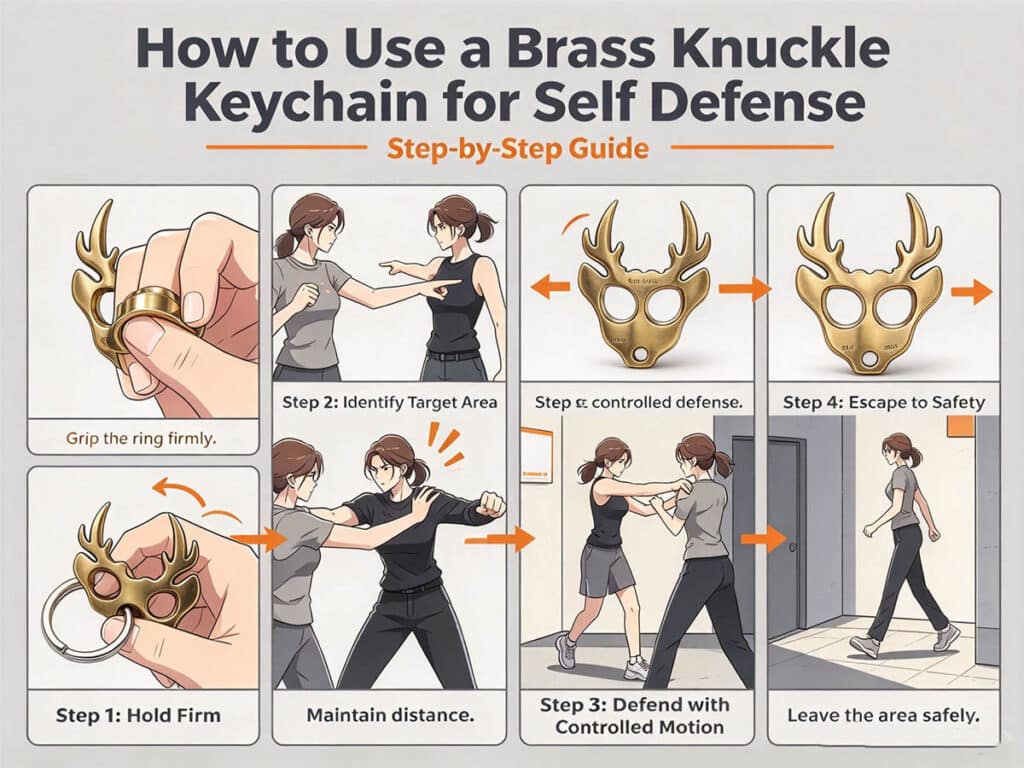
How to Use a Brass Knuckle Keychain for Self Defense (Step-by-Step)
Personal safety is something everyone should take seriously, particularly when commuting alone, walking through parking garages, traveling in unfamiliar locations, or returning home after a late shift. Although most everyday activities are uneventful, unexpected encounters can happen, and having a sensible personal safety plan can make it easier to respond calmly when something does not feel right.
This growing interest in personal preparedness has contributed to the popularity of compact everyday carry accessories, including the Brass Knuckle keychain, multifunctional keyrings, personal alarms, and other portable safety products. These accessories appeal to people who prefer keeping essential belongings close at hand without carrying a large collection of equipment.
However, it is important to understand that a brass knuckle-style keychain may legally be classified as a weapon in some locations, and using it to strike another person can cause serious injury or escalate an already dangerous confrontation. Therefore, responsible self-defense should focus primarily on awareness, prevention, creating distance, and escaping an unsafe situation rather than relying on weapon-based techniques.
In this guide, we will explain how to approach a brass knuckle-style keychain responsibly, how to build a practical personal safety routine, and what alternatives may provide more appropriate everyday protection. The following step-by-step approach emphasizes safety, lawful ownership, and avoiding unnecessary physical confrontation.
At brassknucklesmaster.com, we recognize that choosing an everyday carry accessory involves more than appearance. Understanding its intended function, construction, limitations, and legal considerations is essential before adding any product to your daily routine.
1. Understand Your Brass Knuckle Keychain Before Carrying It
The first step in responsible ownership is understanding exactly what you are carrying. Although many compact accessories are advertised as self-defense keychains or multifunctional metal tools, their appearance and construction can vary considerably.
Some products are designed primarily as decorative metal accessories, while others incorporate additional everyday utility features. A brass knuckle-inspired design may have finger openings, a reinforced metal frame, or a distinctive ring-shaped structure, making it visually different from an ordinary keyring.
Before purchasing or carrying one, take time to understand its specifications and intended purpose.
Identify the Product’s Actual Functions
Do not assume that every product advertised as a self-defense keychain offers the same capabilities. Some accessories are simple decorative items, while others may incorporate features such as bottle openers, small utility components, or emergency glass breakers.
Read the manufacturer’s description carefully and check the following details:
- Material: Determine whether the product is made from brass, stainless steel, aluminum alloy, or another material.
- Dimensions: Check its length, width, thickness, and overall weight.
- Construction: Examine the surface finish, attachment points, and general manufacturing quality.
- Additional functions: Verify which features are actually included rather than relying on promotional photographs.
- Intended use: Understand whether the accessory is decorative, designed for everyday utility, or intended for a specific emergency function.
This information helps prevent misunderstandings about what the product can and cannot do.
Understand the Legal Classification
One of the most important considerations involves local regulations. The term Brass Knuckle is associated with a specific type of weapon, and products with similar physical characteristics may be subject to restrictions even when marketed as novelty accessories or keychains.
In the United States, laws can differ significantly between states and municipalities. Restrictions may concern possession, transportation, purchase, concealed carry, or use.
Before purchasing one, consult the applicable state statutes and local regulations. If you regularly travel between states, check the rules in each destination rather than assuming that an item permitted in one jurisdiction is automatically permitted elsewhere.
Responsible ownership begins with understanding the law, not simply reading the product description.
2. Step One: Develop Situational Awareness Before an Encounter Happens
The most effective personal safety strategies often begin before a potentially dangerous encounter develops. Awareness of your surroundings helps you recognize unusual situations early, giving you more time to make decisions and move toward a safer location.
Carrying a compact accessory should never replace this basic habit. In fact, the most useful part of an everyday safety routine is often the ability to identify potential problems before they become immediate threats.
Pay Attention to Your Environment
When walking through public spaces, make a habit of observing your surroundings instead of concentrating entirely on your phone or other distractions.
For example, when leaving a shopping center at night, notice the lighting, nearby businesses, available exits, and people moving around the parking area. If an area feels isolated or uncomfortable, consider returning to a busier location.
The North Carolina Department of Public Safety recommends staying alert, trusting your instincts, and choosing well-lit, well-traveled routes when moving through public spaces.
Useful habits include:
- Keep your phone accessible without allowing it to distract you constantly.
- Avoid isolated shortcuts, particularly after dark.
- Stay near occupied businesses and other public areas.
- Notice unusual behavior without assuming that every unfamiliar person represents a threat.
- Keep your keys organized so you are not searching through a handbag when approaching your vehicle.
- Let someone you trust know your travel plans when appropriate.
These habits require little equipment and can become part of an ordinary daily routine.
Recognize Situations That Make You Uncomfortable
Personal safety is also about trusting your judgment. If someone repeatedly follows you, ignores reasonable personal boundaries, or attempts to move you toward an isolated location, take the situation seriously.
You do not need to wait until someone physically threatens you before deciding to leave.
Move toward a populated location, enter a nearby business, or contact someone you trust. If you believe you are in immediate danger, contact emergency services.
The objective is to create a safer situation before physical confrontation becomes necessary.
3. Step Two: Keep Your Personal Safety Equipment Accessible and Organized
An accessory cannot be useful if you cannot find it when you need it. This is why storage and accessibility deserve attention when building an everyday carry setup.
A keychain is naturally convenient because most people already carry keys throughout the day. However, attaching several heavy accessories to one ring can make the arrangement uncomfortable and difficult to manage.
Choose a Practical Carrying Arrangement
Consider how you normally carry your everyday belongings.
Someone who prefers a handbag may find a dedicated internal key clip convenient, while another person may prefer attaching ordinary utility accessories to a backpack or key organizer.
When arranging your equipment, consider:
- Whether the keyring is secure enough for the combined weight.
- Whether the accessory has sharp or unfinished edges.
- Whether it interferes with ordinary key use.
- Whether it can become tangled with other belongings.
- Whether the overall arrangement is comfortable for everyday carrying.
If an item is subject to legal restrictions, do not carry it in public simply because it is attached to a regular keyring.
Prioritize Nonviolent Safety Equipment
For many people, a personal safety alarm, compact flashlight, and fully charged phone provide more appropriate everyday preparedness options than a weapon-associated keychain.
A personal alarm can produce a loud sound that attracts attention, while a flashlight can help illuminate poorly lit areas, parking spaces, and building entrances.
A phone also provides access to emergency services, location-sharing features, and trusted contacts.
These items can complement one another without requiring the user to engage in physical confrontation.
4. Step Three: Create Distance and Leave an Unsafe Situation
If someone approaches you aggressively or makes you feel threatened, your first priority should be finding a safe way to disengage.
A common misunderstanding about self-defense is that successfully defending yourself means defeating an aggressor. In practical personal safety planning, the preferred outcome is usually much simpler: avoid injury, leave the dangerous location, and obtain assistance.
Use Clear Verbal Boundaries
When appropriate, communicate firmly and clearly. Short statements such as “Please stay away,” “I don’t want any trouble,” or “I need you to leave me alone” can establish a boundary without unnecessarily escalating the conversation.
You do not need to argue, explain your personal circumstances, or prove that you are not afraid.
If the other person continues behaving aggressively, prioritize moving away rather than trying to win a verbal confrontation.
Look for an Available Exit
Pay attention to nearby businesses, security desks, public areas, and other places where assistance may be available.
If someone is following you, avoid moving toward an isolated location or directly to your home. Instead, consider entering a staffed business or another populated place and contacting the police.
The Charlotte-Mecklenburg Police Department recommends moving toward crowded businesses when approached by someone in a vehicle and contacting law enforcement when suspicious activity creates a safety concern.
If a confrontation becomes violent, prioritize escaping when possible. Do not risk serious injury to protect replaceable belongings.
The key principle is that creating distance is more important than engaging in a confrontation.
5. Step Four: Understand the Role of Other EDC Tools and Safety Accessories
A brass knuckle-style keychain is only one category within the broader everyday carry market. Many people discover that a combination of ordinary utility accessories and dedicated safety equipment offers a more balanced approach to personal preparedness.
Understanding the differences between these products can help you choose items that match your daily requirements.
Keychain Multi Tool for Everyday Convenience
A keychain multi tool combines several compact utility functions into one portable accessory. Depending on the model, features may include a bottle opener, small screwdriver, LED light, or other basic household functions.
These products are particularly attractive to people who prefer minimal everyday carry equipment.
For example, a small screwdriver may help with simple adjustments, while a bottle opener can be useful during outdoor activities or social gatherings.
Some specialized designs also incorporate emergency glass breakers. However, buyers should confirm that these features are properly designed and tested for their intended purpose.
A keychain multi tool should not automatically be considered a personal protection device simply because it is made from metal or has a distinctive shape.
For additional information, read our Keychain Multi Tool Guide, which explains how to compare compact accessories according to their materials, functionality, and everyday usefulness.
Tactical Pen as a Practical Everyday Accessory
A tactical pen is another popular EDC accessory that combines a conventional writing instrument with a durable construction.
Its primary everyday function is writing, making it useful for taking notes, signing documents, and recording information while traveling or working.
Some models incorporate additional emergency features, but these should be evaluated according to their actual specifications rather than assumed from the product name.
For someone who wants to keep a practical metal accessory in a handbag, office bag, or pocket, a writing instrument can offer more regular everyday value than a specialized item that rarely gets used.
Explore our Everyday Carry Tool Guide for more information about combining compact accessories into a manageable daily setup.
6. Step Five: Prepare for Emergencies and Know When to Get Help
Personal safety planning should include what happens after an uncomfortable encounter or emergency. Even if you successfully leave a dangerous situation, you may still need assistance, medical attention, or support from people nearby.
Preparing for these possibilities makes your overall safety routine more complete.
Keep Emergency Contacts Available
Make sure your phone contains important contacts and that you know how to contact emergency services in your area.
Depending on your circumstances, consider sharing your location with a trusted family member or friend when traveling alone.
If you regularly commute late at night, establishing a simple check-in routine can provide another layer of reassurance.
Report Threats and Suspicious Incidents
If someone threatens you, follows you, or attempts to assault you, report the incident to the appropriate authorities when it is safe to do so.
Try to remember relevant details, including the location, time, clothing, vehicle information, and any other identifying characteristics that can help authorities understand what happened.
Do not put yourself at additional risk simply to collect information or record an incident.
If you have been injured, seek appropriate medical attention even when the injuries initially appear minor.
Consider Professional Self-Defense Training
A qualified self-defense instructor can help you develop practical skills involving awareness, verbal boundaries, movement, disengagement, and emergency decision-making.
Look for programs that emphasize personal safety rather than encouraging unnecessary confrontation.
Training can also help you understand how stress affects decision-making and why simple, repeatable safety habits are important.
If you choose to carry specialized personal safety equipment, learn its lawful operation through appropriate training and follow the manufacturer’s instructions.
7. How to Choose a Responsible and Practical Self-Defense Keychain
Once you understand the role of everyday accessories in personal safety, choosing the right product becomes much easier.
Rather than selecting an item solely because it has a weapon-inspired appearance, evaluate whether it meets your practical requirements and complies with the regulations where you live.
Compare Materials and Construction
The most common considerations include material quality, weight, surface finishing, and attachment strength.
Stainless steel offers good corrosion resistance, while aluminum alloy is generally lighter. Brass has a distinctive appearance, although its weight and maintenance requirements may differ from those of other metals.
Look for accurate material descriptions and clear product dimensions. Avoid relying on unsupported claims about strength or emergency performance.
Consider Whether You Actually Need a Weapon-Associated Design
A conventional key organizer, personal alarm, flashlight, or dedicated emergency tool may be a more suitable option for many users.
If your primary objective is to improve personal safety while walking, a loud alarm and a charged phone may provide practical benefits without the legal complications associated with brass knuckle-style products.
If you are considering a brass knuckle keychain, make sure you understand its legal classification before purchasing or carrying it.
Build a Balanced Everyday Carry Setup
A practical EDC arrangement could include:
| Accessory | Everyday purpose |
|---|---|
| Personal safety alarm | Attract attention when feeling threatened |
| Compact flashlight | Improve visibility in low-light environments |
| Keychain multi tool | Handle simple everyday utility tasks |
| Tactical pen | Writing and recording information |
| Mobile phone | Emergency calls and location sharing |
| First-aid kit | Basic emergency preparedness |
The best setup is not necessarily the most expensive or complicated. It is the one that fits your routine, remains comfortable to carry, and provides functions you genuinely understand.
A More Responsible Approach to Everyday Personal Safety
Learning how to approach a brass knuckle-style keychain responsibly involves much more than understanding its physical design. It requires awareness of local laws, realistic expectations about what an accessory can accomplish, and a personal safety plan that prioritizes avoiding confrontation.
The five-step approach discussed in this guide focuses on understanding the product, developing situational awareness, organizing everyday equipment, creating distance from potential threats, and preparing for emergencies.
Although the Brass Knuckle keychain remains a distinctive accessory within the EDC market, it should not be treated as a guaranteed self-defense solution or a substitute for proper training. Weapon-associated products can introduce additional risks, including serious injury, escalation, and legal consequences.
For many people, a combination of practical accessories, personal safety alarms, communication tools, and professional instruction offers a more balanced way to approach everyday preparedness.
Explore brassknucklesmaster.com to learn more about brass knuckle-inspired accessories, tactical pens, keychain multi tools, and other compact EDC products. Compare specifications carefully, check applicable regulations, and choose accessories according to their legitimate functions and your everyday needs.